Key Takeaways
- Georgia's deadline for a pedestrian injury or wrongful-death claim is two years from the date you were struck, under O.C.G.A. § 9-3-33.
- A claim blaming the City of Atlanta for signal timing or crosswalk markings requires ante litem notice within six months under O.C.G.A. § 36-33-5.
- Crossing outside a crosswalk does not end your case — O.C.G.A. § 40-6-93 requires every driver to exercise due care to avoid a pedestrian in the roadway.
- Under O.C.G.A. § 51-12-33 you recover only if you are less than 50% at fault, and your award drops by your own percentage.
- Ralph David Abernathy Boulevard carries four lanes past a transit station 0.09 miles away, with six schools inside 0.55 miles.
- I-20 ramps at the northern edge give a fleeing driver an instant exit, so hit-and-run exposure runs unusually high here.
- Your own UM/UIM coverage under O.C.G.A. § 33-7-11 often becomes the real source of recovery, even on foot.
If a driver struck you on the West End's commercial spine, a West End Ralph David Abernathy Boulevard pedestrian accident lawyer will tell you the case turns on one question: where you were standing on impact. Georgia gives you two years to sue under O.C.G.A. § 9-3-33, but the adjuster starts building a crossing-location defense within days — and if your claim touches the City of Atlanta's signals or crosswalk markings, a six-month deadline is already running.
Last reviewed: 2026-07-24
Why Pedestrians Get Hit on Ralph David Abernathy Boulevard
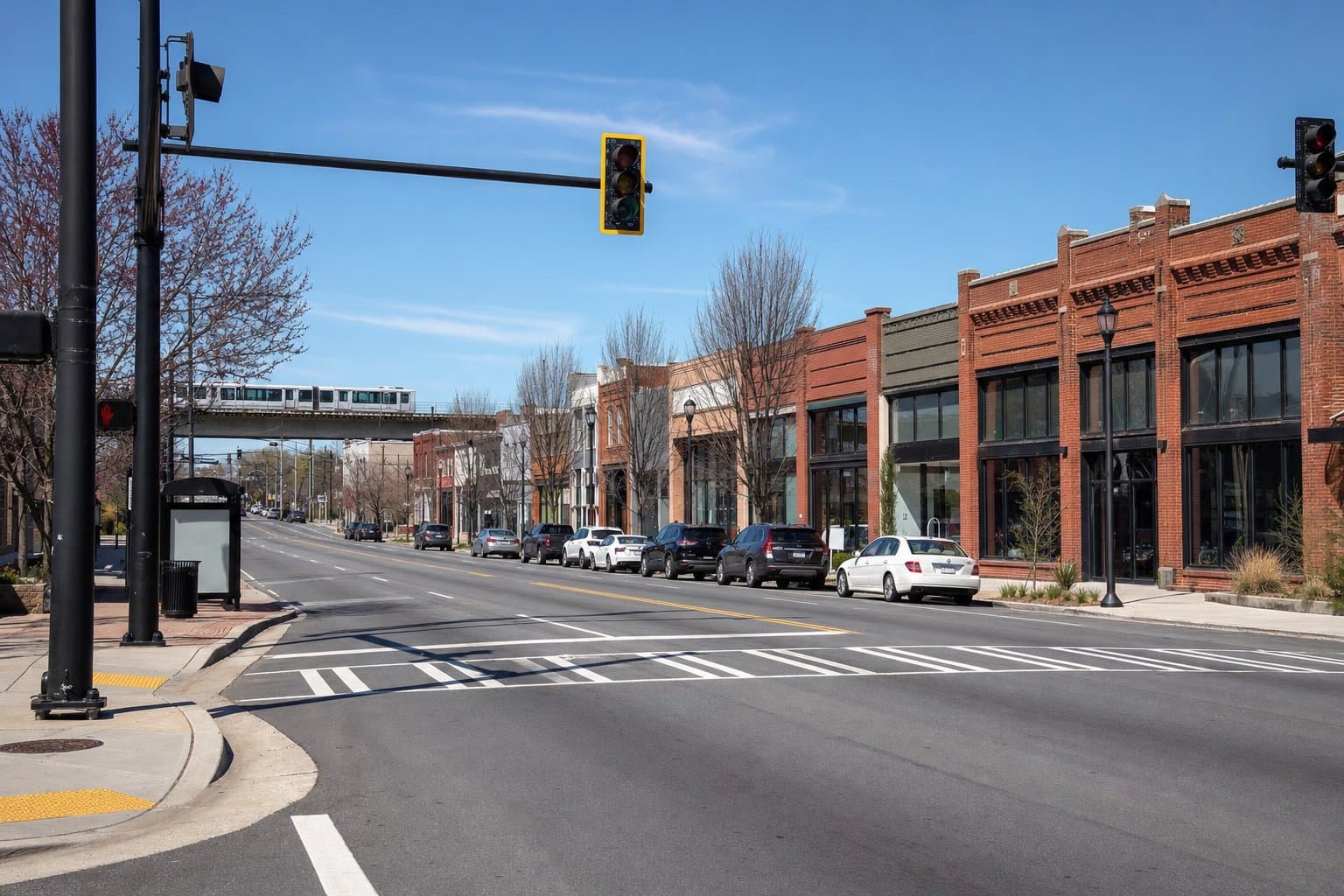
Pedestrians get hit here because the street asks people to cross four lanes in a place designed for shopping, not speed management. Storefronts sit tight to the sidewalk and cars park at the curb, so drivers ease in and out of spaces while through traffic keeps rolling. Two patterns dominate: someone stepping out from between parked vehicles into a blocked sight line, and a driver turning across a crosswalk without checking the corner.
According to NHTSA, the National Highway Traffic Safety Administration, 7,522 pedestrians were killed on U.S. roads in 2022 — the highest annual total since 1981. According to IIHS, the Insurance Institute for Highway Safety, most of those deaths occur on arterials, after dark, away from intersections. This corridor checks every box on a weeknight.
West End Station is what separates it from an ordinary arterial. Roughly 0.09 miles off the commercial district, it is a combined rail-and-bus transfer point, so riders, buses, and rideshare pickups converge in a compact footprint, and people stepping off a bus cross where they land. Six schools sit within 0.55 miles — including Lee Street School and Rusk Elementary — producing twice-daily surges that overlap the commuter peak.
The West End Streets That Generate the Most Pedestrian Claims
The worst streets are the wide ones carrying through-traffic across a walkable grid. Crossing distance predicts injury severity better than almost anything else: each added lane means one more driver whose view of you is blocked by the vehicle beside him.
| Street | Lanes | Route designation | Why pedestrians get hurt here |
|---|---|---|---|
| Ralph David Abernathy Boulevard | 4 | City arterial (retail spine) | Mid-block crossings, curbside parking, turning conflicts at signals |
| Lee Street SW | 5 | US 29 / GA 14 / GA 139 / GA 154 | Long crossing on a state route past West End Station |
| Metropolitan Parkway SW | 6 | US 19 / US 41 / GA 3 | Widest crossing here, with US-route signal spacing |
| West Whitehall Street SW | 4 | US 29 / GA 14 / GA 154 | Through-traffic feeding the I-20 ramps |
| Ralph David Abernathy Freeway (I-20) | 4 | Interstate 20, posted 60 mph | Ramps discharge highway-speed traffic onto surface streets |
Drivers coming down the I-20 ramps have not finished slowing when they reach the surface grid, and those same ramps give a driver who hits someone an immediate route out of the neighborhood — which is why hit-and-run accidents are a recurring West End fact pattern.
What Georgia Law Requires of Drivers — and of You
Georgia law puts the primary burden on the driver. O.C.G.A. § 40-6-91 requires a driver to stop and yield to a pedestrian in a marked or unmarked crosswalk at an intersection. O.C.G.A. § 40-6-241 requires due care and bars holding a wireless device. O.C.G.A. § 40-6-180 forbids driving faster than is reasonable for conditions — the posted limit is a ceiling, not a safe harbor when school lets out.
Pedestrians carry duties too. O.C.G.A. § 40-6-92 requires someone crossing outside a crosswalk to yield, and adjusters quote it as though it settles everything. It settles nothing, because O.C.G.A. § 40-6-93 sits beside it: every driver must exercise due care to avoid colliding with a pedestrian and take precaution around a child or an obviously confused person — crosswalk or not. Mark Wade, Founder and Lead Attorney at Georgia Auto Law, tells clients that the adjuster's first question on a West End pedestrian file is almost always where the person stepped off the curb, because that answer is worth more to the insurer than whether the driver was watching the road at all.
Have Questions About Your Case?
Get a free consultation with an experienced Georgia accident attorney.
The 50% Bar: How Insurers Attack a West End Crossing Case
Insurers attack these claims by pushing your share of fault toward 50%, because at 50% you recover nothing. O.C.G.A. § 51-12-33 sets Georgia's modified comparative negligence rule: you recover only if found less than 50% at fault, and any award is reduced by your percentage. On a corridor with mid-block crossings and a station pulling people across four lanes, crossing location is the entire defense playbook.
Beating it takes physical evidence gathered fast. Storefront camera footage is usually overwritten within days. Event data recorders capture pre-impact speed and braking, and point of rest, debris field, and throw distance let a reconstructionist calculate impact speed independent of the driver's account.
Severity drives what that evidence is worth. According to CDC injury researchers at the Centers for Disease Control and Prevention, pedestrians are roughly 1.5 times more likely than vehicle occupants to be killed in a crash on a per-trip basis. Head trauma is the common denominator, which is why a traumatic brain injury lawyer belongs on the file early enough to document cognitive deficits, and why fatal pedestrian accidents follow Georgia's "full value of the life" framework.
Deadlines That Expire Long Before Two Years
Two years is the outer deadline, and in West End it is often the least urgent one. O.C.G.A. § 9-3-33 gives two years for injury and wrongful death; O.C.G.A. § 9-3-32 gives four years for property damage. The clocks that kill claims here run far shorter.
If any theory blames the City of Atlanta — a dark or mistimed signal, faded crosswalk markings, a sight-line obstruction — O.C.G.A. § 36-33-5 requires written ante litem notice within six months. Miss it and that portion of the claim is gone while the two-year clock still looks wide open. Transit-property injuries carry their own six-month notice requirement and platform video that cycles off quickly; our West End Station transit injury guide and Georgia bus accident lawyer page cover both.
If the driver fled or carried nothing, your own policy becomes the case. Georgia's minimum limits under O.C.G.A. § 33-7-11 are just $25,000 per person and $50,000 per crash — nowhere near the cost of a serious pedestrian injury — and UM/UIM applies when you are struck on foot. See our Georgia uninsured motorist claims lawyer and underinsured motorist claims pages and our West End uninsured and hit-and-run guide.
Who Writes the Report and Which Fulton County Court Hears the Case
The Atlanta Police Department works crashes on West End surface streets, and the Georgia Uniform Motor Vehicle Accident Report its officers produce anchors your claim. According to GDOT, the Georgia Department of Transportation, statewide crash data has consistently shown pedestrian fatalities concentrating on urban arterials of this character. A crash on the I-20 mainline is investigated by the Georgia State Patrol instead.
Venue is Fulton County. Most pedestrian suits arising in West End are filed in the State Court of Fulton County; wrongful-death and higher-exposure claims go to the Superior Court of Fulton County. Citations against the driver are prosecuted in the Municipal Court of Atlanta, and property-damage-only disputes land in the Magistrate Court of Fulton County. A failure-to-yield conviction is real leverage in the civil case.
According to GOHS, the Governor's Office of Highway Safety, more than 1,500 people are killed on Georgia roads in a typical recent year. Fulton County juries understand what a four-lane arterial does to someone on foot.
What to Do After Being Struck Near West End Station
Get medically evaluated the same day, even if you walked away — a treatment gap is the second-favorite defense argument after crossing location. Then, in order of urgency:
- Call 911 so an APD officer generates a crash report with a case number.
- Photograph the crossing — markings or their absence, parked cars, the signal head, the vehicle's final position.
- Get names and numbers from anyone at the bus stop or storefront doorway; riders scatter within minutes.
- Note nearby cameras on storefronts, apartment entries, and transit property.
- Report it to your own insurer even though you were walking — that opens the UM/UIM file.
- Give no recorded statement to the driver's insurer.
How a West End Ralph David Abernathy Boulevard Pedestrian Accident Lawyer Builds Your Case
A West End Ralph David Abernathy Boulevard pedestrian accident lawyer locks down crossing evidence before the comparative-fault story hardens: preservation letters to every business with a camera facing the corridor, open-records requests for the APD report and signal-timing records, and a reconstructionist on the physical evidence while skid marks remain documentable. Coverage runs in parallel — the driver's policy, any employer policy, and your own UM/UIM stack — and the six-month ante litem date goes on the calendar immediately. You can decline to pursue a city claim; you cannot resurrect one.
Georgia Auto Law handles pedestrian claims across Fulton, Cobb, and DeKalb counties from our Atlanta office at 120 Ottley Dr NE. See our Georgia pedestrian accident lawyer pillar and Atlanta pedestrian accident lawyer hub, our Atlanta personal injury lawyer page for other case types, and our Cascade Avenue pedestrian crash guide for a nearby corridor.
The consultation is free and the representation is contingency-fee — no fees unless we win. Call (404) 662-4949.
Frequently Asked Questions
How long do I have to file a pedestrian accident claim in West End?
Two years from the date you were struck, under O.C.G.A. § 9-3-33; property damage runs four years under O.C.G.A. § 9-3-32. If your claim alleges anything against the City of Atlanta, ante litem notice is due within six months under O.C.G.A. § 36-33-5.
I was crossing mid-block on Ralph David Abernathy Boulevard. Do I still have a case?
Usually yes. O.C.G.A. § 40-6-92 requires a pedestrian crossing outside a crosswalk to yield, which shifts some fault to you. But O.C.G.A. § 40-6-93 imposes an independent duty on the driver, and O.C.G.A. § 51-12-33 bars you only at 50% or more. The fight is over the percentage.
The driver who hit me drove off toward I-20. What now?
Report it to APD and your own insurer within days. Fleeing violates O.C.G.A. § 40-6-270. When the driver is never identified, your uninsured motorist coverage under O.C.G.A. § 33-7-11 becomes the source of recovery, subject to its own prompt-reporting conditions.
Does my own car insurance cover me if I was walking?
Usually yes. UM and UIM coverage under O.C.G.A. § 33-7-11 follows the insured person, not just the insured vehicle — and Georgia's $25,000 per-person minimum is exhausted quickly by a serious injury.
Which court will hear my West End pedestrian case?
The State Court of Fulton County handles most pedestrian suits arising in West End; wrongful-death and higher-exposure claims go to the Superior Court of Fulton County. Traffic citations run separately through the Municipal Court of Atlanta.
What if I was hurt on transit property rather than in the street?
That becomes a claim against a transit authority, with a six-month written-notice requirement instead of the two-year deadline, and platform video overwritten absent an immediate preservation demand.
Talk to a West End Pedestrian Accident Lawyer
If a driver hit you on Ralph David Abernathy Boulevard or anywhere around West End Station, the evidence that decides your case is on a short clock. Call Georgia Auto Law at (404) 662-4949 for a free consultation — contingency fee, no fees unless we win.