Key Takeaways
- Georgia's statute of limitations for pedestrian injury and wrongful-death claims is two years from the date of the crash under O.C.G.A. § 9-3-33.
- Georgia applies modified comparative negligence under O.C.G.A. § 51-12-33 — recovery is reduced by your share of fault and barred entirely at 50% or more.
- Cascade Avenue crashes are worked by Atlanta Police Department Zone 4 and litigated in the State Court of Fulton County or the Superior Court of Fulton County.
- School-zone crashes near Connally Elementary trigger enhanced speed enforcement under O.C.G.A. § 40-6-188 and § 40-14-8, which makes a citation against the driver admissible in the civil case.
- According to NHTSA, 7,522 pedestrians were killed on U.S. roads in 2022, the highest annual toll since 1981 — most on arterial roads, at night, outside intersections.
- Hit-and-run drivers on Cascade typically flee west toward Lee Street SW or south to the Langhorn Street ramp onto I-20, which makes uninsured-motorist coverage on your own auto policy the most reliable recovery path.
- If your claim names the City of Atlanta for a signal or roadway-design defect, written ante litem notice is due within six months under O.C.G.A. § 36-33-5.
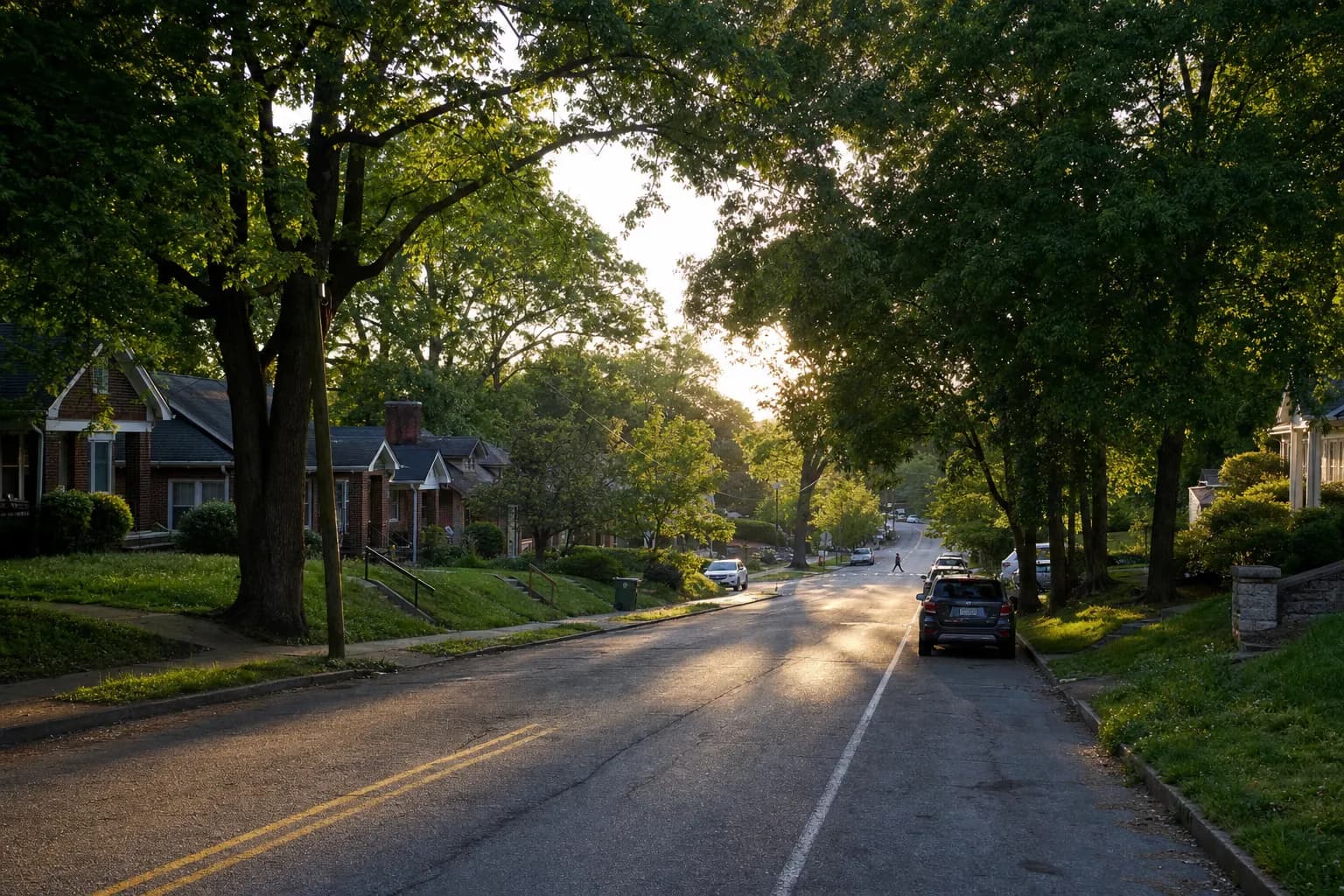
This guide covers pedestrian crashes on the Cascade Avenue Southwest corridor in SW Atlanta — specifically the stretch between John A. White Park and Connally Elementary School in ZIP 30310 (Westview, Cascade Heights, Adair Park, Mozley Park, and Oakland City). If you were hit while walking or riding here, Georgia's two-year statute of limitations and 50% comparative-negligence bar control your case, the City of Atlanta's Zone 4 police district wrote your crash report, and your claim will be litigated in Fulton County.
Why Cascade Avenue Produces So Many Pedestrian Crashes
Cascade Avenue Southwest and Cascade Road were not built as the commuter route they have become. The corridor is a two-lane secondary road through historic SW Atlanta — narrow lanes, no center median on most blocks, on-street parking, and unsignalized crossings between RDA Boulevard and West Park Lane. Drivers heading downtown or onto I-20 at the Langhorn Street exit treat the straightaways between signals as a place to make up time, which is where pedestrians get hit.
Land use along this stretch is dense with foot traffic. Connally Elementary sits about 0.21 miles from the cluster center and generates two daily pedestrian surges at arrival (~7:15-7:45 a.m.) and dismissal (~2:15-2:45 p.m.). John A. White Park — at roughly 60 acres the largest neighborhood park in SW Atlanta, with a public golf course, ballfields, and a recreation center — sits about half a mile south and funnels pedestrians and cyclists across Cascade and Lawton Street. The BeltLine Westside Trail crosses neighborhood streets just east of the cluster, spilling cyclists onto Cascade itself. MARTA Route 51 runs along Cascade Road on a daytime frequency that overlaps school dismissal. ZIP 30310 also has lower car ownership and higher transit reliance than the metro average, so a larger share of crash victims here are pedestrians, cyclists, and transit riders — which is why this corridor needs an Atlanta pedestrian accident lawyer who knows the route.
According to the Governors Highway Safety Association, the majority of U.S. pedestrian fatalities now occur on arterial roads, at night, and away from intersections — exactly the conditions Cascade produces between signals. According to the CDC, people walking are roughly 1.5 times more likely than vehicle occupants to be killed in a crash on a per-trip basis. Georgia Department of Transportation crash data has historically shown pedestrian fatalities concentrated on urban arterials of exactly this character.
Mark Wade, Georgia Auto Law's lead attorney, has handled pedestrian cases on this corridor and notes that the design failures shape every defense. Adjusters argue the pedestrian was "in the roadway" as if that fact settles liability — but the real questions are whether a safe alternative existed at that block face, what the driver's actual speed was between signals, and whether the on-street parking hid the pedestrian until impact. Photographs of the block, sight-line measurements, and the timing of the nearest signal are usually worth more than any verbal statement.
School-Zone, Unsignalized-Crossing, and Hit-and-Run Claims Compared
The legal path on Cascade Avenue differs depending on whether you were struck inside the Connally Elementary school zone, at an unsignalized mid-block crossing, or by a driver who fled.
| Factor | School-Zone (Connally Elementary) | Unsignalized Mid-Block Crossing | Hit-and-Run / Uninsured |
|---|---|---|---|
| Statute of limitations | 2 years (O.C.G.A. § 9-3-33) | 2 years (O.C.G.A. § 9-3-33) | 2 years; UM policy terms also apply |
| Governing rules | O.C.G.A. §§ 40-6-91, 40-6-188, 40-14-8 | O.C.G.A. §§ 40-6-92, 40-6-93 | O.C.G.A. §§ 40-6-270, 33-7-11 |
| Comparative-fault exposure | Low — speed limit and crosswalk duty favor pedestrian | High — mid-block crossing argued as partial fault | Low if lawfully positioned; turns on insurance |
| Primary insurance source | At-fault driver's auto liability | At-fault driver's auto liability | Your own UM/UIM coverage |
| Key evidence | School-zone signage, beacon timing, dashcam, citation | Sidewalk gaps, parked-car sight lines, signal timing | 911 timestamp, Ring/Nest footage, debris, plate fragments |
| Court of filing | State or Superior Court of Fulton County | State or Superior Court of Fulton County | State or Superior Court of Fulton County |
| Police agency | APD Zone 4 | APD Zone 4 | APD Zone 4 |
The school-zone column is the strongest fact pattern a Cascade Avenue pedestrian can have. Under O.C.G.A. § 40-6-188, drivers must obey reduced speed limits in posted school zones during the hours children are present, and O.C.G.A. § 40-14-8 allows school-zone speed enforcement that elevates points on a driver's record. A school-zone speeding citation is admissible in the civil claim and pushes adjusters toward early settlement.
The unsignalized-crossing column is the hardest. Defense lawyers cite O.C.G.A. § 40-6-92 — pedestrians crossing outside a marked crosswalk must yield to vehicles — and argue contributory fault. The counter is in the design facts: where sidewalks end, where parked cars block the driver's view, and whether the driver violated O.C.G.A. § 40-6-93's duty of due care toward any pedestrian on the roadway.
The hit-and-run column almost always points back to your own uninsured motorist coverage under O.C.G.A. § 33-7-11. A serious Atlanta car accident attorney inventories every UM policy in the injured person's household — not only the policy tied to a car in the driveway — because Georgia UM is available to pedestrians and resident relatives.
How Comparative Negligence Plays Out on Cascade
Under O.C.G.A. § 51-12-33, Georgia is a modified comparative negligence state with a 50% bar. If a jury finds you 30% at fault, damages drop by 30%. At 50% or more, you take nothing. That is why adjusters defending Cascade crashes push two arguments: that the pedestrian crossed outside a crosswalk in violation of O.C.G.A. § 40-6-92, or that the cyclist failed to ride as far right as practicable under O.C.G.A. § 40-6-294.
Both arguments have answers, and both decay quickly. Whether a marked crosswalk existed, whether the sidewalk gap forced the pedestrian into the road, whether the driver was over the posted residential limit under O.C.G.A. § 40-6-181 — these are documented with photographs, sight-line measurements, signal-timing records, and video from doorbell cameras or rec-center surveillance at John A. White Park. Mark Wade routinely sends an investigator within 48 hours, because once the road gets repaved or restriped, the evidence that controls comparative fault is gone. The difference between a 10% fault finding and a 40% finding is usually that early documentation.
Have Questions About Your Case?
Get a free consultation with an experienced Georgia accident attorney.
Fulton County, APD Zone 4, and the Right Court
All of Cascade Avenue between John A. White Park and Connally Elementary sits inside the City of Atlanta and Fulton County. There is no city-line or county-line wrinkle here — every crash on this corridor is investigated by Atlanta Police Department Zone 4, which covers SW Atlanta including West End, Westview, Adair Park, Oakland City, and Cascade Heights. Traffic citations are heard in the City of Atlanta Municipal Court. Civil personal injury claims are filed in the State Court of Fulton County for most cases or the Superior Court of Fulton County for larger or equity claims.
The clean jurisdictional picture matters in two ways. You do not have the cross-county confusion that complicates cases on the Atlanta/Brookhaven or Atlanta/East Point edges. And if your case alleges a roadway-design or signal-maintenance defect against the City of Atlanta, you must serve written ante litem notice on the city within six months under O.C.G.A. § 36-33-5 — miss that and the city defense is gone, even if the two-year SOL is still open. If a Georgia DOT-maintained state route is involved, a separate twelve-month notice under O.C.G.A. § 50-21-26 controls. If a MARTA bus was involved — Route 51 runs Cascade Road — MARTA's own notice rules apply.
The corridor is bordered to the east by West End, and the cluster sits inside the broader Atlanta metro market.
What to Do at the Scene
If you have just been hit on Cascade Avenue:
- Call 911 immediately, even if you think you can walk away. Concussion and internal bleeding often present hours later, and the dispatch timestamp anchors your medical record.
- Tell the responding officer where you were struck so APD Zone 4 writes the report at the correct address. Get the case number before you leave.
- Photograph the sidewalk on both sides of the road for 100 feet in each direction. The sidewalk-gap and parked-car sight-line photos are the case.
- If you were near Connally Elementary, note whether the school-zone beacon was flashing — that controls whether O.C.G.A. § 40-6-188 applied.
- Collect witness contact info, including drivers stopped behind the at-fault vehicle.
- If the driver fled, canvass nearby homes for Ring and Nest footage. Most doorbell systems overwrite within 7 to 14 days.
- Do not give a recorded statement to the at-fault driver's insurer before talking to a lawyer.
- Seek medical treatment the same day and follow up. Treatment gaps are the second-favorite defense argument after comparative fault.
Some Cascade collisions are catastrophic, producing fatal pedestrian crashes. Georgia wrongful-death claims carry the same two-year deadline under O.C.G.A. § 9-3-33.
Cyclists Off the BeltLine and Hit-and-Run Drivers
The BeltLine Westside Trail crosses Lena Street and Westview Drive just east of this cluster, and cyclists routinely exit the protected trail and ride a block or two on Cascade. Under O.C.G.A. § 40-6-294, a cyclist may ride in the travel lane when the lane is too narrow to safely share — which is the case on most of Cascade's residential blocks. Adjusters do not concede that point. According to the Insurance Institute for Highway Safety, the majority of cyclist fatalities occur on major roads, outside intersections, with low-light conditions overrepresented — facts that fit Cascade exactly. An experienced Atlanta bicycle accident lawyer works the lane-position question hard before comparative-fault arguments harden.
ZIP 30310 has historically run above the city-wide average for hit-and-run rates. Drivers who strike a pedestrian here often flee west toward Lee Street SW or south to the Langhorn Street ramp onto I-20. O.C.G.A. § 40-6-270 makes leaving the scene a serious crime, but prosecution does not pay medical bills. The civil path for hit-and-run accidents almost always runs through UM coverage under O.C.G.A. § 33-7-11, on your own policy and on resident-relative policies. Georgia does not require PIP, so before a case resolves, medical bills are usually covered through health insurance (which will assert a subrogation lien), any med-pay on your own auto policy, and in some cases letters of protection from treating providers. A good Atlanta personal injury attorney coordinates those sources so you are not chased by collections while the claim is pending.
Last reviewed: May 21, 2026
Frequently Asked Questions
How long do I have to file a pedestrian injury claim after a Cascade Avenue crash?
Two years from the date of the crash under O.C.G.A. § 9-3-33 for both personal injury and wrongful death. If your claim names the City of Atlanta as a defendant for a roadway-design or signal-maintenance defect, written ante litem notice is due within six months under O.C.G.A. § 36-33-5. Missing the six-month notice destroys the city claim even though the underlying two-year SOL is still open.
I crossed Cascade Avenue mid-block and got hit. Can I still recover?
Usually yes — but expect the adjuster to argue partial fault under O.C.G.A. § 40-6-92, which requires pedestrians crossing outside a marked crosswalk to yield to vehicles. Georgia's 50% comparative-fault bar under O.C.G.A. § 51-12-33 means recovery survives as long as your share of fault stays below 50%. Photographs of sidewalk gaps, parked-car sight lines, and the driver's speed are what move that number down.
The driver hit me on Cascade and drove off. What now?
Call 911 immediately to anchor the timestamp, get the APD Zone 4 case number, and canvass for Ring or Nest footage on Cascade and the streets toward Lee Street SW or the Langhorn Street I-20 ramp — those are the typical escape routes. Then file a UM claim under O.C.G.A. § 33-7-11 against your own auto policy and any resident-relative policies. UM coverage is available to pedestrians in Georgia, not only to people inside a car.
Who pays my hospital bills while my pedestrian case is pending?
Bills are usually covered through your health insurance (which will assert a subrogation lien against any settlement), any med-pay coverage on your own auto policy, and in some cases letters of protection from treating providers that defer payment until the case resolves. Georgia does not require PIP, so there is no automatic auto-policy med-pay benefit unless you bought it.
The driver who hit my child near Connally Elementary was speeding in the school zone. Does that help our case?
Yes. School-zone speed limits are enforced under O.C.G.A. § 40-6-188 and § 40-14-8, and a citation issued to the driver is admissible evidence of negligence. Combined with the heightened duty of care under O.C.G.A. § 40-6-93, a documented school-zone speeding ticket usually pushes comparative-fault exposure to the floor and accelerates settlement.
Should I talk to the at-fault driver's insurance adjuster?
Not until you have spoken with a lawyer. Recorded statements taken in the first days after a crash are used to lock you into facts before you know the full extent of your injuries, and adjusters routinely ask leading questions about crosswalk use and lane position designed to create comparative-fault exposure under O.C.G.A. §§ 40-6-92 and 40-6-294. You are not required to give one to recover.
Talk to a Georgia Auto Law Pedestrian-Injury Attorney
If you or a family member was struck on Cascade Avenue, Cascade Road, or anywhere along the SW Atlanta corridor between John A. White Park and Connally Elementary, talk to a Georgia Auto Law attorney before you talk to any insurance adjuster. Mark Wade and our team have handled pedestrian, bicycle, and hit-and-run cases on this exact stretch — we know the APD Zone 4 reporting practices, the Fulton County filing rules, and the design facts that move comparative-fault numbers down. Our office is at 120 Ottley Dr NE, Atlanta. Consultations are free and we work on a contingency fee, meaning no fee unless we recover for you.