Key Takeaways
- When the at-fault driver has no insurance, not enough insurance, or flees, your own UM/UIM coverage under O.C.G.A. § 33-7-11 steps in — and your own insurer effectively becomes the opposing party.
- Georgia requires UM coverage to be offered with every auto policy, but a driver can reject or reduce it in writing. Many West End drivers do not realize what they actually carry until a crash forces the question.
- A hit-and-run is a crime under O.C.G.A. § 40-6-270 (duty to stop and provide information) and § 40-6-271 (duty after striking an unattended vehicle). Reporting it promptly — ideally within 24 hours — is critical to preserving the UM claim.
- Georgia's personal-injury statute of limitations is two years under O.C.G.A. § 9-3-33. UM claims also carry contractual notice and cooperation requirements that can bite much sooner.
- Under Georgia's modified comparative negligence rule (O.C.G.A. § 51-12-33), you recover only if you are less than 50% at fault.
- West End injury claims are filed in Fulton County — the State Court of Fulton County and Fulton County Superior Court; traffic charges against a located hit-and-run driver run through the City of Atlanta Municipal Court.
A West End uninsured-motorist or hit-and-run accident claim is a Georgia personal injury case in which the at-fault driver carries no insurance, carries too little insurance, or flees the scene — leaving your own uninsured/underinsured motorist (UM/UIM) coverage under O.C.G.A. § 33-7-11 as the primary or only source of recovery. These claims arise on West End streets like Ralph David Abernathy Boulevard and Lee Street SW, are filed in Fulton County, and follow a procedural path that is very different from a routine two-insured-driver crash.
The West End Setting: Why These Crashes Happen Here
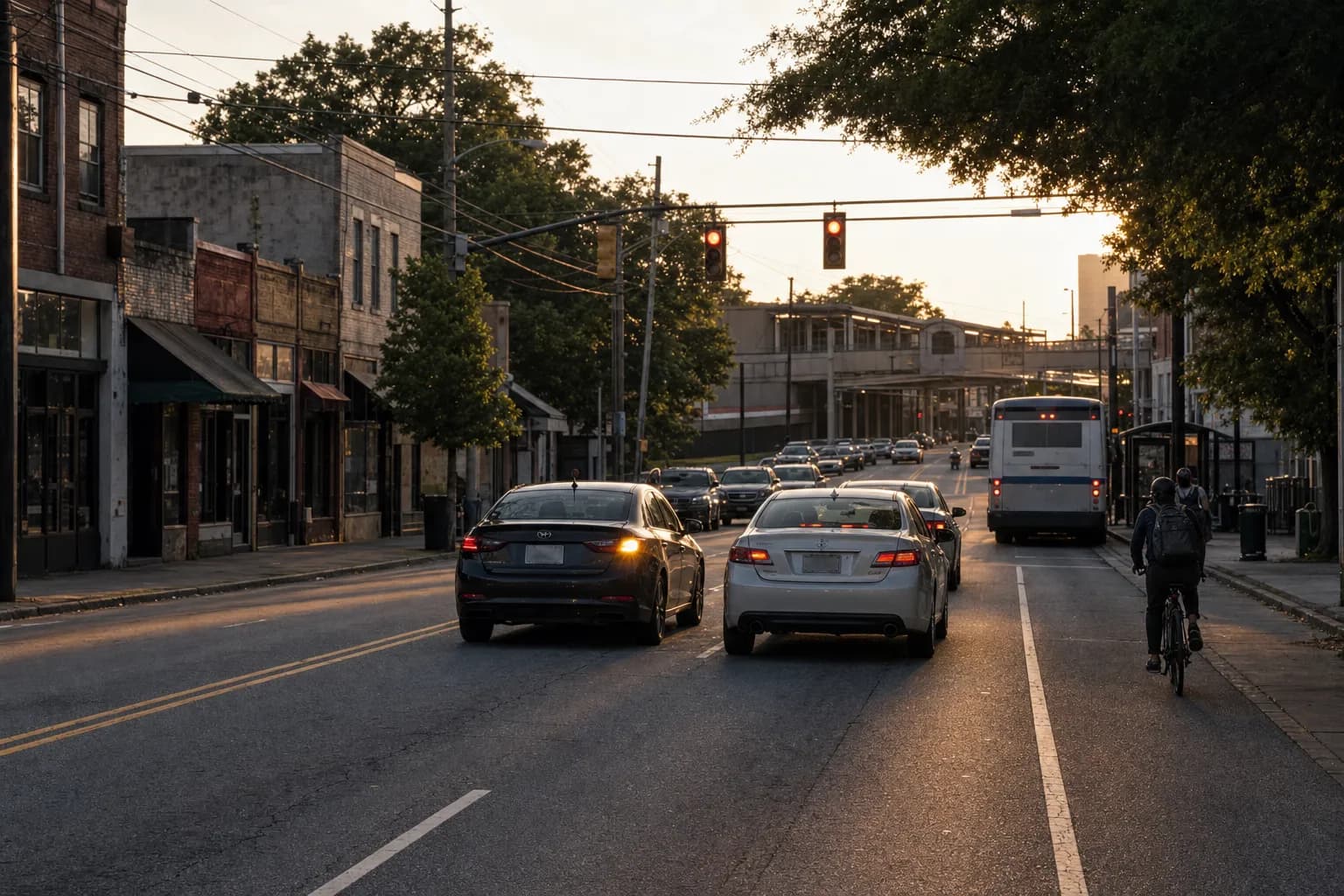
West End is one of Atlanta's oldest neighborhoods, built around the West End MARTA station and the commercial spine of Ralph David Abernathy Boulevard. It funnels heavy traffic through a compact grid: Lee Street SW (carrying US 29 / GA 14) and West Whitehall Street SW feed the station area, and I-20 — the Ralph David Abernathy Freeway — runs along the northern edge with ramps dumping fast-moving traffic onto surface streets.
That combination — a transit hub, a dense residential core, and interstate ramps feeding four- and five-lane arterials — produces exactly the conditions where uninsured and hit-and-run crashes concentrate: heavy volume, frequent lane changes, and drivers who have a quick exit onto the freeway or into the neighborhood's side streets.
The Numbers: How Common Are Uninsured and Hit-and-Run Crashes?
Georgia has one of the higher uninsured-driver rates in the country. According to the Insurance Research Council's most recent uninsured-motorist study, roughly one in eight U.S. drivers is uninsured, and Georgia consistently ranks above the national average — meaning a meaningful share of the drivers on Ralph David Abernathy Boulevard at any given moment cannot personally cover the harm they cause.
Hit-and-run crashes have been rising and are disproportionately deadly. According to the AAA Foundation for Traffic Safety's analysis of National Highway Traffic Safety Administration (NHTSA) data, hit-and-run crashes kill more than 2,000 people in the United States in a typical recent year, with a long-term upward trend. The Governor's Office of Highway Safety (GOHS) has repeatedly flagged hit-and-run and unlicensed-driver behavior as a persistent contributor to Georgia's traffic-death toll.
Pedestrians and cyclists bear an outsized share of hit-and-run harm. According to NHTSA, pedestrian fatalities reached 7,522 in 2022 — the highest figure recorded since 1981 — and a substantial portion of fatal hit-and-run crashes involve a pedestrian or cyclist struck and left in the road. In a walkable, transit-oriented neighborhood like West End, that risk concentrates near the MARTA station, the Abernathy Boulevard storefronts, and the crosswalks around Adair Park II and Rose Circle Park.
Three Scenarios, Three Different Claims
"Uninsured motorist" is a catch-all that covers three distinct situations, and the claim path differs for each one.
The at-fault driver has no insurance at all
The other driver caused the crash on Lee Street SW — and then hands over a lapsed policy, or none at all. There is no liability insurer to pay your medical bills, lost wages, or pain and suffering, so your uninsured motorist coverage under O.C.G.A. § 33-7-11 becomes the primary source of recovery and you pursue the claim against your own insurer. This is the core scenario covered on our uninsured motorist accident case-type page.
The at-fault driver has insurance — but not enough
Georgia's minimum liability limit is $25,000 per person. A serious orthopedic injury, a back surgery, or a traumatic brain injury can blow past that figure before you are discharged from the emergency department at Grady Memorial Hospital or Hughes Spalding Hospital. When the at-fault driver's policy is exhausted and real damages remain, your underinsured motorist (UIM) coverage sits behind their policy to make up the difference. See our underinsured motorist claims page for how that coverage is structured.
The at-fault driver flees the scene
A hit-and-run on Ralph David Abernathy Boulevard or near the I-20 ramps leaves you with no plate, no name, and no insurer to bill. Leaving the scene is a crime under O.C.G.A. § 40-6-270, which requires a driver involved in a crash to stop, provide identifying and insurance information, and render reasonable aid; O.C.G.A. § 40-6-271 governs the separate duty owed after striking an unattended vehicle. For the injured person, the civil remedy is the same UM coverage under O.C.G.A. § 33-7-11 — the "phantom" or unknown driver is treated, for claim purposes, as an uninsured driver. Our hit-and-run accident case-type page and our Atlanta hit-and-run lawyer page walk through the investigation steps that matter most.
Have Questions About Your Case?
Get a free consultation with an experienced Georgia accident attorney.
Insured vs. Uninsured vs. Hit-and-Run: How the Claim Changes
The three situations look similar from the curb but diverge sharply once the claim begins.
| Factor | At-fault driver insured | At-fault driver uninsured / underinsured | Hit-and-run (driver flees) |
|---|---|---|---|
| Who pays | The at-fault driver's liability insurer | Your own UM insurer (UM); at-fault insurer + your UIM insurer (UIM) | Your own UM insurer |
| Which coverage applies | At-fault liability policy | Your UM/UIM coverage under O.C.G.A. § 33-7-11 | Your UM coverage under O.C.G.A. § 33-7-11 |
| Who you negotiate against | A third-party insurer | Your own insurer — now functionally the adversary | Your own insurer — now functionally the adversary |
| What you must prove | The other driver's fault and your damages | Fault, your damages, and that the driver was uninsured/underinsured | Fault, your damages, and that a real unidentified vehicle caused the crash |
| Key deadlines | 2-year SOL (O.C.G.A. § 9-3-33) | 2-year SOL + your policy's notice/cooperation terms | Prompt police report (ideally within 24 hours) + 2-year SOL + policy terms |
| Common insurer tactics | Disputing fault, minimizing injuries | Disputing UM applicability, undervaluing the claim, delay | Arguing "no physical contact," disputing the phantom vehicle, claiming late notice |
The single most important line in that table is the third one. In a UM or hit-and-run claim, the company you have paid premiums to for years is the company writing the check — and it negotiates accordingly.
When Your Own Insurer Becomes the Adversary
"The trap in a UM or hit-and-run case is that people expect their own insurance company to be on their side, because that is who they have been paying. It is not how it works. The moment your claim is against your UM coverage, that adjuster's job is to pay you as little as possible — same as any other insurer. In a hit-and-run, they will look hard for a reason to say there was no real second vehicle, or that you reported it too late. That is why the first 24 hours matter so much: call the police from the scene on Abernathy Boulevard, get an official report with a case number, and get checked at Grady or Hughes Spalding. A documented, promptly reported claim is very hard for your own carrier to wave away. A claim you sat on for two weeks is not."
— Mark Wade, Founder and Lead Attorney, Georgia Auto Law
The Hit-and-Run Reporting Window: Why 24 Hours Matters
Georgia does not impose a rigid statutory "report within X hours or lose your UM claim" rule, but every auto policy contains notice and cooperation conditions, and insurers enforce them. In practice, a hit-and-run UM claim is far stronger when the injured person:
- Calls 911 from the scene so the Atlanta Police Department generates a crash report with a case number that same day.
- Reports the crash to their own insurer promptly — within 24 hours is the safe target — to satisfy the policy's notice condition.
- Documents the phantom vehicle with whatever exists: paint transfer, debris, partial plate, direction of travel onto I-20 or into the neighborhood.
- Identifies witnesses — near the West End MARTA station, the Abernathy storefronts, or the Lee Street corridor there are often pedestrians who saw the vehicle.
This window is decisive because a UM insurer's most common defense in a hit-and-run case is that there was no real unidentified vehicle — that the loss was single-vehicle or staged. A same-day police report and prompt notice cut that defense off. A claim first reported days later, with no case number, hands the insurer the argument.
Statutes That Govern a West End UM/Hit-and-Run Claim
- O.C.G.A. § 33-7-11 — the central statute: it requires UM coverage to be offered with every Georgia auto policy, defines who counts as an uninsured or underinsured motorist (including unknown hit-and-run drivers), and governs how the coverage is triggered.
- O.C.G.A. § 40-6-270 — duty of a driver involved in a crash to stop, provide identifying and insurance information, and render reasonable aid; leaving the scene is the criminal offense commonly called hit-and-run.
- O.C.G.A. § 40-6-271 — the separate duty owed when a driver strikes an unattended vehicle.
- O.C.G.A. § 9-3-33 — Georgia's two-year statute of limitations for personal-injury claims.
- O.C.G.A. § 51-12-33 — Georgia's modified comparative negligence rule, with the 50% bar: a plaintiff 50% or more at fault recovers nothing, and damages are reduced by the plaintiff's share below that.
Fault and Forum: Comparative Negligence and Fulton County Courts
Georgia is a modified comparative negligence state under O.C.G.A. § 51-12-33. A West End driver found 0%–49% at fault still recovers, with damages reduced by their share; at 50% or more, recovery is barred. In a UM or hit-and-run case, the comparative-fault fight has a twist — because there is often no other driver present to dispute the account, your own insurer may step into that role and argue you contributed to the crash.
A West End injury claim is filed in Fulton County. Most personal-injury cases — including UM and UIM claims against an insurer — proceed in the State Court of Fulton County, which handles civil cases without a monetary cap. Fulton County Superior Court hears claims combining personal injury with equitable relief or real-property issues. If a fleeing driver is later identified and charged, the traffic prosecution typically runs through the City of Atlanta Municipal Court. A Georgia car accident lawyer handling a West End case should know how each of those forums runs its calendar.
What to Do After an Uninsured or Hit-and-Run Crash in West End
- Call 911 immediately. Atlanta Police Department or Georgia State Patrol will respond and generate the crash report. For a hit-and-run, that report and its case number are the spine of your UM claim.
- Get medical attention. Grady Memorial Hospital and Hughes Spalding Hospital are the closest emergency departments. Soft-tissue and traumatic-brain symptoms can surface hours or days later.
- Document the scene. Photograph your vehicle, any paint transfer or debris from the other vehicle, the roadway, signage, and landmarks fixing the location.
- Capture the fleeing vehicle's details. Even a partial plate, color, make, or direction of travel toward I-20 helps investigators and helps defeat a "no phantom vehicle" defense.
- Identify witnesses. West End's foot traffic near the MARTA station and the historic district means there are often people who saw the other vehicle. Get names and numbers.
- Notify your own insurer promptly — within 24 hours is the safe target — but do not give a recorded statement before talking to a lawyer.
- Preserve nearby video. Storefront and MARTA-area cameras frequently overwrite footage within 14–30 days; a preservation letter in the first week can be decisive.
- Talk to an Atlanta car accident lawyer before negotiating with any adjuster — including your own.
Why Local Knowledge Matters Here
A UM or hit-and-run claim is won on documentation and on knowing how to handle an insurer that is on the other side of the table. A Georgia personal injury lawyer handling a West End case should understand how the Abernathy Boulevard and Lee Street corridors funnel traffic, how the I-20 ramps shape fleeing-driver behavior, and how Fulton County courts handle UM litigation against insurers. Georgia Auto Law represents injured people throughout the neighborhood — see our West End Atlanta personal injury page for our local coverage.
Frequently Asked Questions
What is uninsured motorist coverage in Georgia?
Uninsured motorist (UM) coverage is part of your own auto policy that pays for your injuries and losses when the at-fault driver has no insurance, does not have enough insurance, or cannot be identified after a hit-and-run. It is governed by O.C.G.A. § 33-7-11, which requires Georgia insurers to offer UM coverage with every auto policy — though a driver can reject or reduce it in writing. When UM coverage applies, you pursue the claim against your own insurance company.
What should I do if a hit-and-run driver hit me in West End?
Call 911 immediately so the Atlanta Police Department creates a crash report with a case number, get medical attention at Grady Memorial Hospital or Hughes Spalding Hospital, and document everything you can about the fleeing vehicle — partial plate, color, make, direction of travel. Then report the crash to your own insurer promptly, ideally within 24 hours, but do not give a recorded statement before speaking with a lawyer. A prompt police report is the strongest protection for your uninsured motorist claim.
Does my own insurance pay if the other driver has no insurance?
Yes, if you carry uninsured motorist coverage. Under O.C.G.A. § 33-7-11, your UM coverage becomes the primary source of recovery when the at-fault driver is uninsured, and your underinsured motorist coverage makes up the difference when their policy is too small to cover your damages. You file the claim against your own insurer — which is why these cases are negotiated very differently from a standard two-insured-driver crash.
How long do I have to file an uninsured motorist or hit-and-run claim in Georgia?
Georgia's personal-injury statute of limitations is two years from the date of the crash under O.C.G.A. § 9-3-33. Your own policy also contains notice and cooperation conditions requiring you to report the crash promptly — often well before the two-year mark. Because UM and hit-and-run claims depend heavily on early documentation, waiting is almost always costly even when the deadline has not yet run.
Is a hit-and-run a crime in Georgia?
Yes. Under O.C.G.A. § 40-6-270, a driver involved in a crash must stop, provide identifying and insurance information, and render reasonable aid; leaving the scene is the criminal offense commonly called hit-and-run. O.C.G.A. § 40-6-271 covers the separate duty owed after striking an unattended vehicle. If the fleeing driver is later identified, the traffic charges typically proceed through the City of Atlanta Municipal Court, while your injury claim proceeds separately as a civil matter.
What if I was partly at fault for the crash?
Georgia follows modified comparative negligence under O.C.G.A. § 51-12-33. You can still recover as long as you are found less than 50% at fault, with damages reduced by your percentage of fault. At 50% or more, you recover nothing. In a UM or hit-and-run claim, your own insurer may be the party arguing you share fault — one more reason to have detailed scene documentation and, ideally, legal representation.
Where will my West End accident case be filed?
In Fulton County. Most personal-injury cases — including UM and UIM claims against an insurer — are filed in the State Court of Fulton County, which hears civil cases without a monetary cap. Fulton County Superior Court handles cases combining personal injury with equitable relief or real-property issues. If a fleeing hit-and-run driver is identified and charged, the traffic prosecution generally runs through the City of Atlanta Municipal Court.
Talk to a West End Uninsured Motorist and Hit-and-Run Lawyer
If you or a family member was injured by an uninsured driver, an underinsured driver, or a hit-and-run driver anywhere in West End — on Ralph David Abernathy Boulevard, Lee Street SW, near the West End MARTA station, or on the I-20 ramps — Georgia Auto Law can help. We handle UM/UIM claims against insurers, hit-and-run investigations, and Fulton County litigation. Consultations are free and you pay nothing unless we recover for you.
Last reviewed: May 14, 2026
Disclaimer: This article is for general informational purposes only and is not legal advice. Reading it does not create an attorney-client relationship. Statutory deadlines — including the two-year personal injury statute of limitations and your own policy's notice requirements — are time-sensitive; consult a qualified Georgia personal injury attorney about your particular situation as soon as possible.