
Key Takeaways
- Two-year deadline. Georgia gives crash victims two years from the date of injury to file suit under O.C.G.A. § 9-3-33. Property-damage-only claims get a separate four-year window under O.C.G.A. § 9-3-32.
- Evidence has a six-month shelf life. Hours-of-service logs and ELD data — the records that prove driver fatigue — can be lawfully discarded after six months under 49 CFR 395.8(k)(1), which is why a preservation letter must go out within days.
- You can pursue the company, not just the driver. Under respondeat superior the carrier is liable for its driver's on-duty negligence, and it can also be sued directly for negligent hiring, training, supervision, and maintenance.
- Trucking insurance is far higher than auto. Interstate freight carriers must carry at least $750,000 in liability coverage under 49 CFR 387.9, versus Georgia's $25,000 personal-auto minimum under O.C.G.A. § 33-7-11.
- Partial fault is not a bar — until 50%. Under O.C.G.A. § 51-12-33, you recover nothing only if you are 50% or more at fault; below that, your award is reduced by your share.
- Most truck crashes must be reported. A wreck with injury, death, or apparent property damage of $500 or more triggers mandatory reporting under O.C.G.A. § 40-6-273.
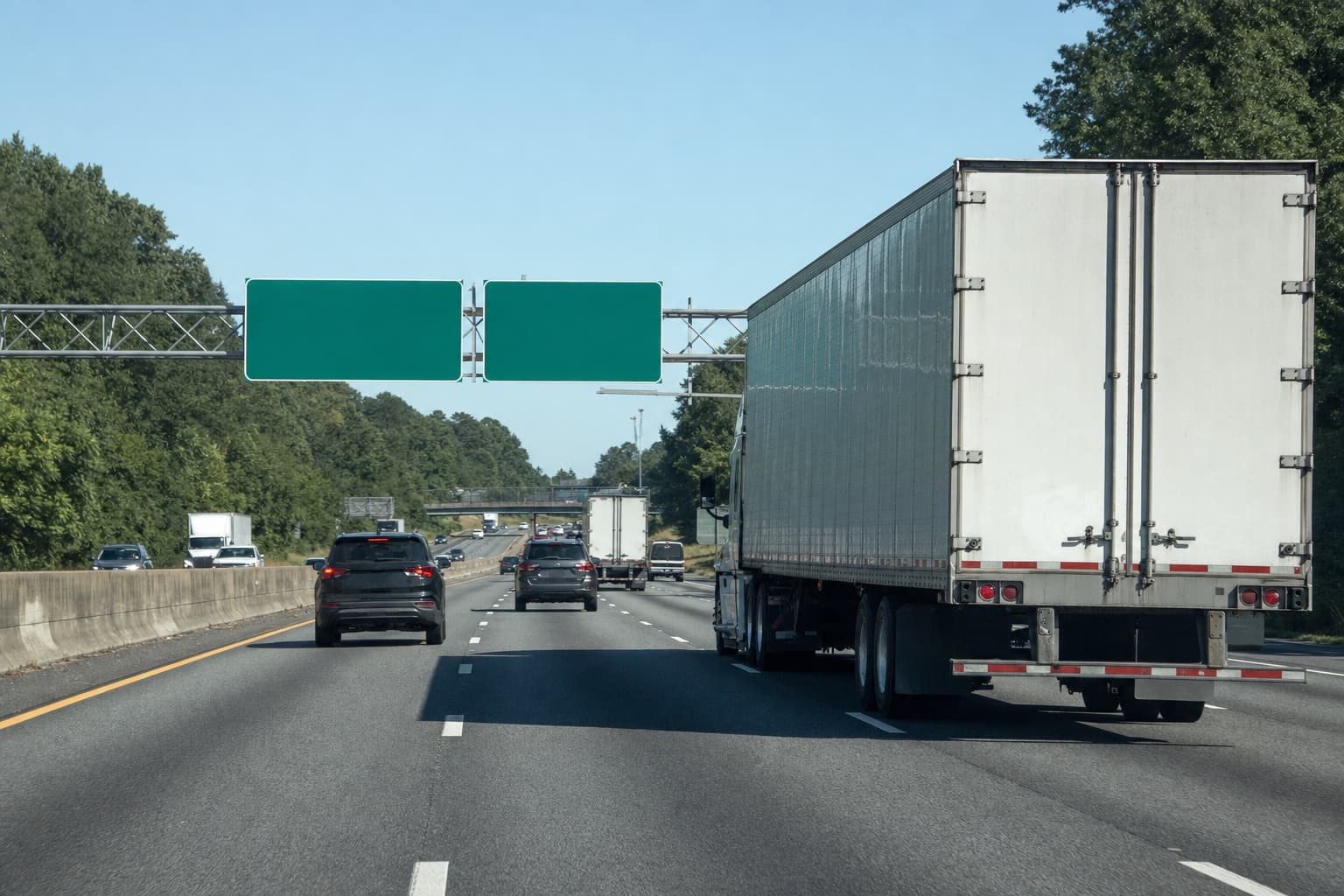
If you were hit by a commercial truck in Georgia, the steps that protect your claim are the same statewide: call 911 and get medical care, document the scene and the truck's USDOT number, decline any recorded statement to the trucking company's insurer, and call a Georgia truck accident lawyer within days — not weeks. Your injury claim runs on Georgia's two-year deadline under O.C.G.A. § 9-3-33, but the evidence that proves the crash — the driver's logbook and electronic logging device data — can be lawfully overwritten in as little as six months under federal rules. That is why moving fast matters. To reach one of our truck accident lawyers right now, call (404) 662-4949 or fill out our consultation form.
Last reviewed: June 2026
How Common — and How Severe — Are Truck Crashes?
Large-truck crashes are both common and disproportionately deadly because of the weight gap between a loaded tractor-trailer and a passenger car. According to the Federal Motor Carrier Safety Administration, 5,837 large trucks were involved in fatal crashes in 2022. According to updated National Highway Traffic Safety Administration data, 5,472 people were killed in large-truck crashes in 2023 — down about 8% from 2022, but still roughly 40% higher than a decade earlier.
Georgia sits at the center of that risk. The state is a national logistics hub, and I-75, I-85, I-20, I-16, and the I-285 perimeter carry some of the heaviest freight volumes in the country. High truck volume mixed with dense metro-Atlanta congestion and long rural two-lane stretches is exactly the combination that turns a moment of driver fatigue or a deferred brake repair into a catastrophic collision. The size disparity is the core problem: an 18-wheeler can weigh up to 80,000 pounds — about 20 times a typical car — so the occupants of the smaller vehicle absorb almost all of the force.
The Time-Sensitive Steps To Take After a Truck Accident in Georgia
The right sequence in the first hours and days does more to protect a truck-crash claim than anything else. Take these steps in order, and lean on a friend or family member for any you cannot physically manage because of your injuries.
Call 911 and Get Medical Attention
Your first move is to call 911 and accept medical evaluation, even if you feel "okay." Adrenaline and shock routinely mask serious injuries at the scene. A traumatic brain injury, neck and whiplash injury, or back and spinal injury can take hours or days to surface. If the injury is not documented near the time of the crash, the trucking company's insurer will argue it came from something else. Reporting is also a legal duty: under O.C.G.A. § 40-6-273, a crash with injury, death, or apparent property damage of $500 or more must be reported — a threshold almost any truck crash clears.
Document the Scene and the Truck
Capture as much as you can before vehicles are moved and witnesses leave. Photograph the damage to every vehicle, the truck's company markings, and — critically — the USDOT number painted on the cab, which identifies the motor carrier you may need to pursue. Collect the names and contact information of the truck driver, any passengers, and independent witnesses, because truck drivers sometimes revise their account after the fact, and a neutral witness can lock in what actually happened. If your injuries prevent this, ask the investigating officer to gather detailed witness statements, and be vocal at the scene about getting every name recorded in the report.
Retain a Truck Accident Lawyer Within Days
Hire a lawyer immediately, because the most valuable evidence is on a clock that the trucking company controls. Carriers are required to keep logs of driver hours and vehicle inspections, but only for short federal retention periods — after which those records can lawfully be destroyed. A truck accident lawyer's first job is to send an evidence-preservation letter that freezes those records before they vanish. Because Georgia Auto Law handles only car and truck accident cases, we have systems built to fire that demand off the moment we are retained, so a strong case is not quietly compromised by the carrier's routine document purge.
Notify Your Own Insurer — and Read the Fine Print
Tell your own auto insurer about the crash promptly, because Georgia policies impose their own notice deadlines separate from the law. Many policies require notice within a set window, and uninsured/underinsured motorist provisions under O.C.G.A. § 33-7-11 often carry even stricter notice terms. Miss a policy deadline and you can forfeit coverage you paid for — coverage that matters if the truck driver's insurance falls short of your damages. Review the full policy with a lawyer who knows Georgia auto-insurance law before you rely on it.
Never Give a Statement or Sign a Release
Decline any recorded statement and sign nothing until your lawyer has reviewed it. A trucking company's adjuster will often call within days, sound sympathetic, and ask you to "just confirm what happened" — then mine that recording for an offhand line to minimize your injuries later. Even a narrow property-damage release can contain language that also waives your bodily-injury claim. When an adjuster asks for a statement, a signature, or access to inspect your vehicle, the answer is to talk to your truck accident lawyer first.
Common Truck Crash Types in Georgia
The way a truck crash happens shapes who is liable and what evidence wins the case. These are the patterns we see most across Georgia's freight corridors.
| Crash type | What happens | Typical liability question |
|---|---|---|
| Jackknife | The trailer swings out at an angle to the cab after a brake lockup or skid | Improper braking, worn brakes, deferred maintenance |
| Tractor-trailer / underride | A car is forced beneath the trailer in a high-energy impact | Speed, following distance, missing guards |
| Wide right turn | The truck swings left to turn right and traps a vehicle in the squeeze zone | Mirror checks, driver training, route planning |
| Overloaded / shifting cargo | Improperly secured or overweight freight shifts, causing rollover or debris | Loading company, shipper weight, load securement |
| Delivery-truck / no-zone | A collision in the truck's blind spot or during a delivery maneuver | Blind-spot awareness, signaling, training |
When hazardous cargo is involved, a hazmat spill adds an entirely separate regulatory layer and a higher insurance floor. And because the mechanics of a truck case differ so sharply from a passenger-car wreck, it helps to understand how a truck accident is different than a car accident before you talk to anyone's insurer.
Have Questions About Your Case?
Get a free consultation with an experienced Georgia accident attorney.
The Evidence a Truck Accident Lawyer Preserves First
Truck cases are won on records the carrier is allowed to destroy, so preserving them comes before everything else. A truck accident lawyer's opening move is a spoliation letter demanding the carrier hold the electronic and paper trail: the ELD or "black box" event-data-recorder download showing speed and braking, the driver's logs, post-crash drug and alcohol test results, the truck's USDOT registration, the cargo weight and bill of lading, maintenance and inspection files, and any post-crash DOT inspection report.
The reason for the rush is concrete. Federal rules set short minimum retention periods, and once they lapse, the records can lawfully disappear:
| Record | Minimum retention | Federal rule |
|---|---|---|
| Records of Duty Status (logbooks) + ELD hours-of-service data | 6 months | 49 CFR 395.8(k)(1) |
| Driver Vehicle Inspection Reports (DVIRs) | 3 months | 49 CFR 396.11(c) |
| Inspection, repair, and maintenance records | While in control + 6 months | 49 CFR 396.3(c) |
| Driver Qualification file | Employment + 3 years | 49 CFR 391.51(d) |
The logbook and ELD data — the evidence that proves driver fatigue and hours-of-service violations — can be overwritten in as little as six months. That is long before Georgia's two-year filing deadline, which is exactly why the preservation letter cannot wait. When you come in, our truck accident document checklist helps you bring what you already have so we can move on the rest immediately.
What Mark Wade Tells Truck-Crash Clients
The two mistakes that sink the most truck cases are giving a recorded statement and waiting too long to lock down evidence. Mark Wade, Founder and Lead Attorney at Georgia Auto Law, puts it plainly: "In every truck accident case, our first priority is preserving the electronic evidence. ELD data, black box recordings, and driver logs can be overwritten or destroyed within weeks." The adjuster's early call is not courtesy — it is strategy, aimed at getting a quote the company can use to discount the claim while the clock runs down on the very records that would prove the driver was fatigued or the brakes were neglected. The right response is to decline the recorded statement, write down the adjuster's name and claim number, and call a lawyer the same day so a preservation demand goes out before the carrier's routine document purge ever reaches it.
Can You Sue Both the Driver and the Trucking Company?
Yes — Georgia law lets you pursue the truck driver and the motor carrier as separate defendants, and that often doubles the path to full recovery. There are two distinct theories. First, under respondeat superior, the carrier is vicariously liable for negligence its driver commits while on duty — speeding, fatigue, a missed signal. Second, the company can be sued directly for its own conduct: negligent hiring, training, supervision, and retention, plus negligent maintenance and negligent entrustment when it put an unfit driver or unsafe truck on the road.
Both theories matter because of how Georgia apportions fault. Under O.C.G.A. § 51-12-33, a jury can assign a percentage of fault to each at-fault party, so building a direct case against the company — not just the driver — can expand the total recovery and reach the carrier's larger insurance policy. Sorting out whether the driver or the employer is liable is one of the first things a truck accident lawyer investigates, and in a fatal crash it is central to a Georgia wrongful death claim.
Trucking Insurance: $750,000 vs. $25,000
Commercial trucks carry far more insurance than passenger cars, which is one reason truck-crash recoveries can be substantially larger. According to the Federal Motor Carrier Safety Administration, interstate for-hire carriers hauling non-hazardous freight must maintain at least $750,000 in liability coverage under 49 CFR 387.9, and carriers hauling hazardous materials must carry more. Compare that to Georgia's personal-auto minimum of just $25,000 in bodily-injury coverage per person — the same figure that sets the floor for uninsured-motorist coverage under O.C.G.A. § 33-7-11. Many carriers exceed the federal floor with $1 million or more in coverage — but accessing it requires identifying the right policies and the right defendants early, which is part of why the evidence race and the two-defendant analysis matter so much. The same care that goes into valuing a personal injury claim applies here; if you want a rough starting point, our car accident settlement calculator explains how the pieces fit together.
Frequently Asked Questions
How long do I have to file a Georgia truck-accident claim?
Two years from the date of the crash under O.C.G.A. § 9-3-33 for personal injury, and four years for property or cargo damage under O.C.G.A. § 9-3-32. The filing deadline is not the urgent one, though — an evidence-preservation letter should reach the carrier within days, long before logbook and ELD data can be overwritten.
How fast can the trucking company destroy evidence?
Faster than most people expect. Records of Duty Status (logbooks) and ELD hours-of-service data only have to be kept for six months under 49 CFR 395.8(k)(1). Driver Vehicle Inspection Reports must be kept just three months under 49 CFR 396.11(c). Once those minimums pass, the carrier can lawfully discard the records, which is why a spoliation letter cannot wait for the two-year filing deadline.
Can I sue both the truck driver and the trucking company?
Yes. Under respondeat superior, the carrier is generally liable for its driver's on-duty negligence. The company also has independent duties to hire, train, supervise, maintain, and route safely — and breaching those duties creates direct claims against the carrier beyond the driver's own conduct, both of which can be apportioned fault under O.C.G.A. § 51-12-33.
What evidence is unique to truck-accident cases?
Federal rules require carriers to keep records that do not exist in an ordinary car crash: ELD hours-of-service data, paper or electronic driver logs, post-crash drug and alcohol test results, driver qualification files, maintenance and inspection records, and post-crash DOT inspection reports. The seven most common causes behind truck accidents in Georgia almost always leave a trail in one of these records.
How much insurance do trucking companies carry in Georgia?
Interstate carriers hauling non-hazardous freight must maintain at least $750,000 in liability coverage under 49 CFR 387.9 — far above Georgia's $25,000 auto minimum under O.C.G.A. § 33-7-11. Hazmat carriers and many large fleets carry $1 million or more, which is part of why truck-crash recoveries can exceed passenger-vehicle cases.
Do I still have a case if I was partly at fault?
Often yes. Georgia follows modified comparative negligence under O.C.G.A. § 51-12-33: you can still recover as long as you are less than 50% at fault, with your award reduced by your share. You are barred only when you are found 50% or more responsible, which is exactly why insurers push to assign you blame early.
Should I hire a truck accident lawyer instead of a general car accident lawyer?
For a serious truck crash, yes. Truck cases turn on federal motor-carrier regulations, short evidence-retention windows, and multiple potential defendants — none of which a standard Georgia car accident matter usually involves. In metro Atlanta, an Atlanta truck accident lawyer who handles these cases knows to send the preservation letter and identify every liable party before the trail goes cold.
Talk to a Georgia Truck Accident Lawyer Today
If you or a loved one was hurt by a commercial truck anywhere in Georgia, the two-year clock under O.C.G.A. § 9-3-33 is already running — and the logbook and ELD data that prove your case may be overwritten within months. Georgia Auto Law handles car and truck accident cases exclusively, and we move fast to preserve the evidence that wins them. With our No Fee Pledge™, you pay nothing up front and owe no fee unless we recover for you, and the consultation is always free. Call (404) 662-4949 or complete our consultation form, and one of our truck accident lawyers will reach out to you within minutes.