Key Takeaways
- Georgia gives you two years to sue (O.C.G.A. § 9-3-33) — but the truck's data can lawfully be gone in six months.
- Carriers keep duty logs and back-up ELD records only 6 months (49 C.F.R. §§ 395.8(k)(1), 395.22(i)(1)).
- Delk Road (GA 280) runs five lanes at 45 mph into I-75's six lanes at 65 mph — a 20 mph step.
- 5,340 people died in large-truck crashes in 2024; 62% were in passenger vehicles, not the truck.
- Interstate for-hire freight carriers must carry at least $750,000 in liability coverage (49 C.F.R. § 387.9).
- Marietta Police work the surface corridor; Georgia State Patrol works the I-75 mainline.
- Cobb suits are filed in the State Court of Cobb County; out-of-state carriers often remove to federal court.
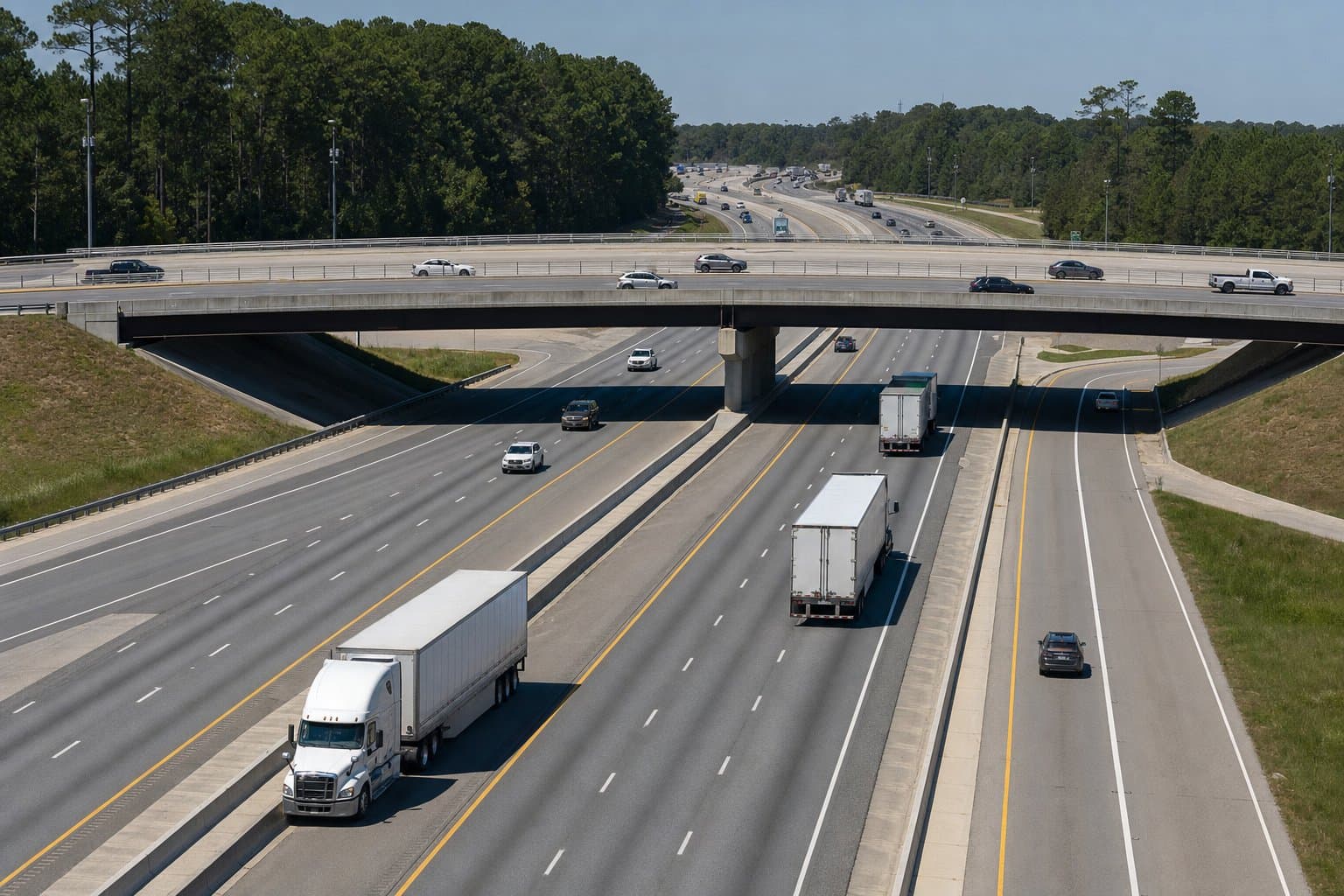
If a tractor-trailer hit you where Delk Road Southeast meets I-75 in Marietta, the proof of what happened is already on a deletion clock. An I-75 Delk Road Marietta truck accident lawyer moves first on the truck's electronic logs, its engine control module download, and the carrier's driver file — records federal law requires the company to keep for as little as six months (49 C.F.R. § 395.8(k)(1)), plus video it need not keep at all. Georgia gives you two years to sue under O.C.G.A. § 9-3-33. The evidence does not wait that long.
Last reviewed: 2026-08-12
Why the Delk Road Interchange Is So Hard on Heavy Trucks
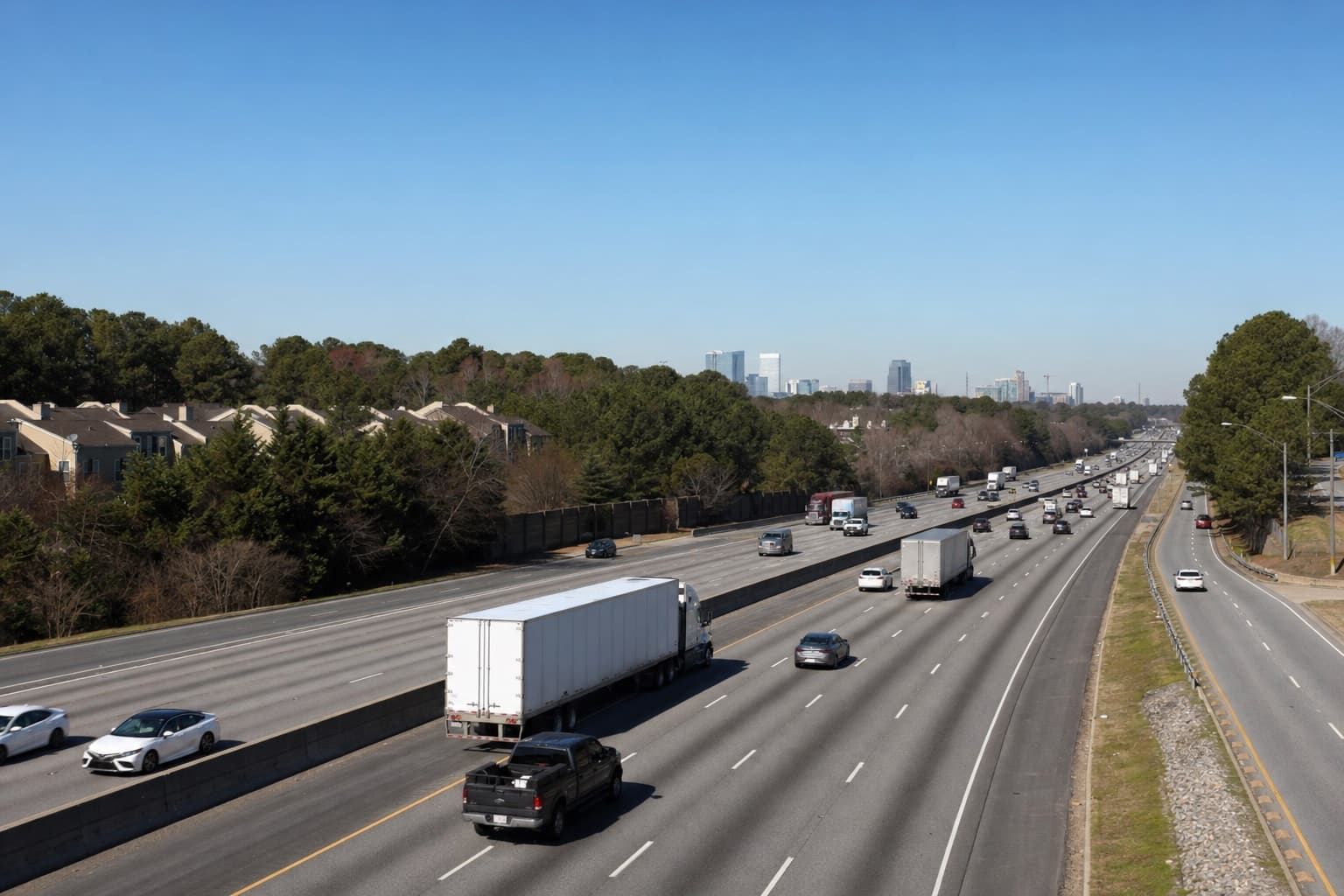
This interchange is dangerous because it asks an 80,000-pound vehicle to change speed regimes twice within a few hundred feet. Delk Road Southeast carries GA 280 across five lanes posted at 45 mph, narrows to three lanes, and terminates at Larry McDonald Memorial Highway (I-75) — a six-lane motorway posted at 65 mph. A truck entering must build 20 mph in a short ramp while highway traffic closes on it; a truck exiting carries that momentum onto a commercial strip of curb cuts and left turns.
According to IIHS, the Insurance Institute for Highway Safety, 5,340 people died in large-truck crashes in 2024, and 62% were in passenger vehicles versus 17% in the truck. Where a car and a large truck collide, 96% of those killed are in the car. Loaded tractor-trailers also need 20% to 40% more distance to stop — the whole story of a queue stacking up behind the Delk Road ramps at 5:30 p.m.
The corridor conditions that decide these cases
IIHS data puts 51% of large-truck crash deaths on major roads other than interstates, against 30% on interstates and freeways — which is why the arterial approach here, not just the mainline, produces serious tractor-trailer crash claims. Local conditions sharpen it: the Northwest Corridor Express Lanes, roughly 30 miles of two reversible toll lanes at 55 mph that flip direction between peaks and degrade driver expectancy; Franklin Gateway Sports Complex 0.5 miles out and Cobb Horizon High School 0.96 miles out, adding evening and dismissal traffic; and WellStar Windy Hill Hospital 1.69 miles away. Queueing on GA 280 is where chain-reaction pileup claims form under O.C.G.A. § 40-6-49, Georgia's following-distance rule.
The Evidence That Disappears Before You Call a Lawyer
The most valuable evidence lives on the carrier's servers and inside the truck, and most of it has a short, lawful expiration date. A car crash is rebuilt from photographs and a police report; a commercial case is rebuilt from data — and the party holding that data is the party you are about to sue. That is why an I-75 Delk Road Marietta truck accident lawyer works the retention calendar first.
| Evidence | Who holds it | How long it survives | What it proves |
|---|---|---|---|
| ELD data and records of duty status | Motor carrier | 6-month federal minimum (49 C.F.R. §§ 395.8(k)(1), 395.22(i)(1)) | Hours driven, missed breaks, fatigue |
| ECM "black box" download | Truck owner or repair shop | Until the truck is repaired or the module is overwritten | Speed, throttle, braking before impact |
| Dashcam and telematics video | Carrier or its telematics vendor | No federal minimum — a rolling cycle set by the company | The seconds before the collision |
| Driver qualification and training file | Motor carrier | During employment, then per company schedule | Negligent hiring, training, supervision |
| The tractor and trailer | Carrier or its insurer | Until repaired, sold, or returned to service | Brakes, tire failure, cargo securement |
| Gouges, skid marks, debris | Nobody | Cleared within hours on an interstate ramp | Impact geometry and pre-impact braking |
Mark Wade, Georgia Auto Law's Founder and Lead Attorney, puts the priority bluntly: in every truck case the first job is locking down the electronic evidence, because ELD data, black-box recordings, and driver logs can be overwritten within weeks — and once they are gone, no amount of later lawyering brings them back. The carrier's rapid-response team is often at the scene the same day.
The preservation letter is the first real move
A spoliation letter stops the clock: a formal written demand served on the carrier and its insurer requiring it to preserve the ELD records, ECM download, dashcam and telematics video, driver qualification file, dispatch records, maintenance history, and the vehicle itself. Georgia courts can sanction a party that destroys evidence after notice, and a jury can be told to infer the lost proof would have hurt that party. That leverage exists only if the letter went out first — the reason to call a truck accident lawyer serving Marietta in days.
What Part 395 requires of the driver
Federal hours-of-service rules cap how long a commercial driver can be behind the wheel, and the logs are where violations surface. According to FMCSA, the Federal Motor Carrier Safety Administration, a property-carrying driver may drive at most 11 hours after 10 consecutive hours off duty, may not drive past the 14th consecutive hour on duty, must take a 30-minute break after 8 cumulative driving hours, and is capped at 60 hours in 7 days or 70 hours in 8 days. A driver who blew past those limits before rear-ending the Delk Road queue has handed you a documented violation — if the logs survive.
Two Agencies, One Interchange: Getting the Right Crash Report
Which agency holds your report depends on exactly where the impact occurred. Marietta Police work the Delk Road Southeast surface corridor inside city limits, Cobb County Police handle adjacent unincorporated segments, and the Georgia State Patrol typically works the I-75 mainline and its ramps. One interchange, three possible custodians — and injured people routinely request the wrong one, then assume no report exists.
Georgia requires notice of a reportable crash under O.C.G.A. § 40-6-273, and the resulting Georgia Uniform Motor Vehicle Accident Report fixes the officer's initial narrative. According to GDOT, the Georgia Department of Transportation, statewide crash records flow through its crash data and reporting system. Get it early: the first diagram and any citation — following too closely, or reckless driving under O.C.G.A. § 40-6-390 — shape how the adjuster values the file.
Have Questions About Your Case?
Get a free consultation with an experienced Georgia accident attorney.
Who Actually Pays After a Delk Road Truck Crash
The motor carrier usually pays, not just the driver. Under respondeat superior an employer answers for an employee's negligence within the scope of employment, and a carrier can also be sued directly for negligent hiring, training, supervision, or maintenance. That distinction is worth real money: according to FMCSA regulation, an interstate for-hire carrier hauling general freight in a vehicle rated 10,001 pounds or more must carry at least $750,000 in public liability coverage, rising to $5,000,000 for certain bulk hazardous cargo. Georgia defines commercial motor vehicles at O.C.G.A. § 40-1-1.
Catastrophic injuries can still outrun those limits. A mainline impact can produce traumatic brain injury claims in Georgia whose lifetime care costs dwarf any policy, and the worst outcomes become a matter for a Marietta wrongful death lawyer. When coverage falls short, your own underinsured motorist claims under Georgia law may fill the gap: UM/UIM under O.C.G.A. § 33-7-11 must be offered at limits equal to your liability coverage unless you rejected it in writing.
Fault still gets fought over. Georgia applies modified comparative negligence under O.C.G.A. § 51-12-33: recovery drops by your percentage of fault and disappears entirely at 50%. Defense counsel will argue you merged late into a blind spot on the ramp — and the ECM download is often what refutes it.
Where a Cobb County Case Gets Filed
Most Cobb injury suits are filed in the State Court of Cobb County, the practical benchmark for case value and timeline here. The Superior Court of Cobb County takes wrongful death and higher-exposure actions, the Magistrate Court of Cobb County takes small claims and property-damage disputes, and Marietta Municipal Court handles citations issued inside city limits, including the Delk Road Southeast corridor. Georgia venue rules generally follow the defendant's county of residence (O.C.G.A. § 9-10-31 covers joint tortfeasors in different counties), so a Cobb crash does not automatically mean a Cobb lawsuit — and an out-of-state carrier will often remove to the U.S. District Court for the Northern District of Georgia, Atlanta Division.
Deadlines against a government entity are far shorter and notice-driven: six months to the City of Marietta under O.C.G.A. § 36-33-5, twelve months to Cobb County under O.C.G.A. § 36-11-1.
What to Do in the First 10 Days
- Get evaluated immediately, then keep every follow-up. Treatment gaps are the first thing an adjuster discounts.
- Identify the investigating agency — Marietta Police, Cobb County Police, or Georgia State Patrol — and request the report.
- Photograph the tractor, trailer, and lane markings if you can do it safely, before the truck is repaired.
- Write down the carrier's name and USDOT number, which decide whose insurance and safety record are in play.
- Decline a recorded statement to the carrier's insurer until you have talked to a lawyer.
- Get a preservation letter served before the ELD and video retention cycles run out.
Georgia Auto Law handles these cases across our Marietta service area and all of Cobb County — freight collisions at the interchange, the surface-street wrecks a car accident lawyer in Marietta sees daily, and the crossings handled by a pedestrian accident lawyer in Marietta. If a commercial vehicle hurt you here, an I-75 Delk Road Marietta truck accident lawyer can send the preservation demand today. Consultations are free and we work on contingency — no fees unless we win. Call (404) 662-4949.
Frequently Asked Questions
How long do I have to file an I-75 Delk Road Marietta truck accident claim?
Generally two years from the crash date under O.C.G.A. § 9-3-33. Waiting is still costly: duty logs and ELD back-ups can be lawfully destroyed at six months, and video often disappears sooner.
How fast can the truck's electronic evidence really disappear?
Faster than most people expect. Federal rules require only six-month retention of duty logs and back-up ELD data, and set no minimum for dashcam video, telematics, or an ECM download — a repair or rolling overwrite can erase it within weeks.
Who has the crash report if I was hit on the I-75 ramp at Delk Road?
Usually the Georgia State Patrol, which works the mainline and its ramps. Impacts on the Delk Road Southeast surface corridor inside city limits go to Marietta Police; unincorporated segments fall to Cobb County Police.
Can I hold the trucking company responsible, not just the driver?
Yes. Under respondeat superior the carrier answers for its driver, and it can be sued directly for negligent hiring, training, supervision, or maintenance. Commercial policies also start at a $750,000 federal minimum for interstate general freight.
What happens if my bills exceed the truck's insurance coverage?
Your own uninsured/underinsured motorist coverage can fill the gap under O.C.G.A. § 33-7-11. The add-on versus reduced-by election controls whether those limits stack on top of the at-fault coverage or only fill to it.
Which court will hear my Cobb County truck case?
Most auto and truck injury suits go to the State Court of Cobb County, with higher-exposure and wrongful death actions in Superior Court. Out-of-state carriers frequently remove cases to the U.S. District Court for the Northern District of Georgia, Atlanta Division.
What does an I-75 Delk Road Marietta truck accident lawyer cost?
Nothing upfront. Georgia Auto Law works these cases on contingency — the consultation is free and there is no fee unless we recover for you. A Georgia truck accident lawyer also fronts the reconstruction and data-download costs.