Key Takeaways
- Georgia gives you two years from the crash date to file a motorcycle injury lawsuit under O.C.G.A. § 9-3-33 — do not let the deadline lapse while you negotiate.
- Under Georgia's modified comparative negligence rule (O.C.G.A. § 51-12-33), you recover only if you are less than 50% at fault, and insurers routinely try to push blame onto riders.
- Georgia law entitles a motorcyclist to full use of a lane (O.C.G.A. § 40-6-312) — critical on a squeezed two-lane road where drivers try to share the lane.
- Georgia requires a DOT-compliant helmet for every rider (O.C.G.A. § 40-6-315); defense insurers raise helmet use to chip away at damages.
- The corridor straddles the county line: a crash worked by Atlanta Police Zone 2 (Fulton) versus Brookhaven Police (DeKalb) changes which report you request and which court has venue.
- If a driver flees or has no coverage, uninsured motorist coverage (O.C.G.A. § 33-7-11) is often the practical recovery path.
- Preserve scene evidence early — signal data and business camera footage cycle out within weeks.
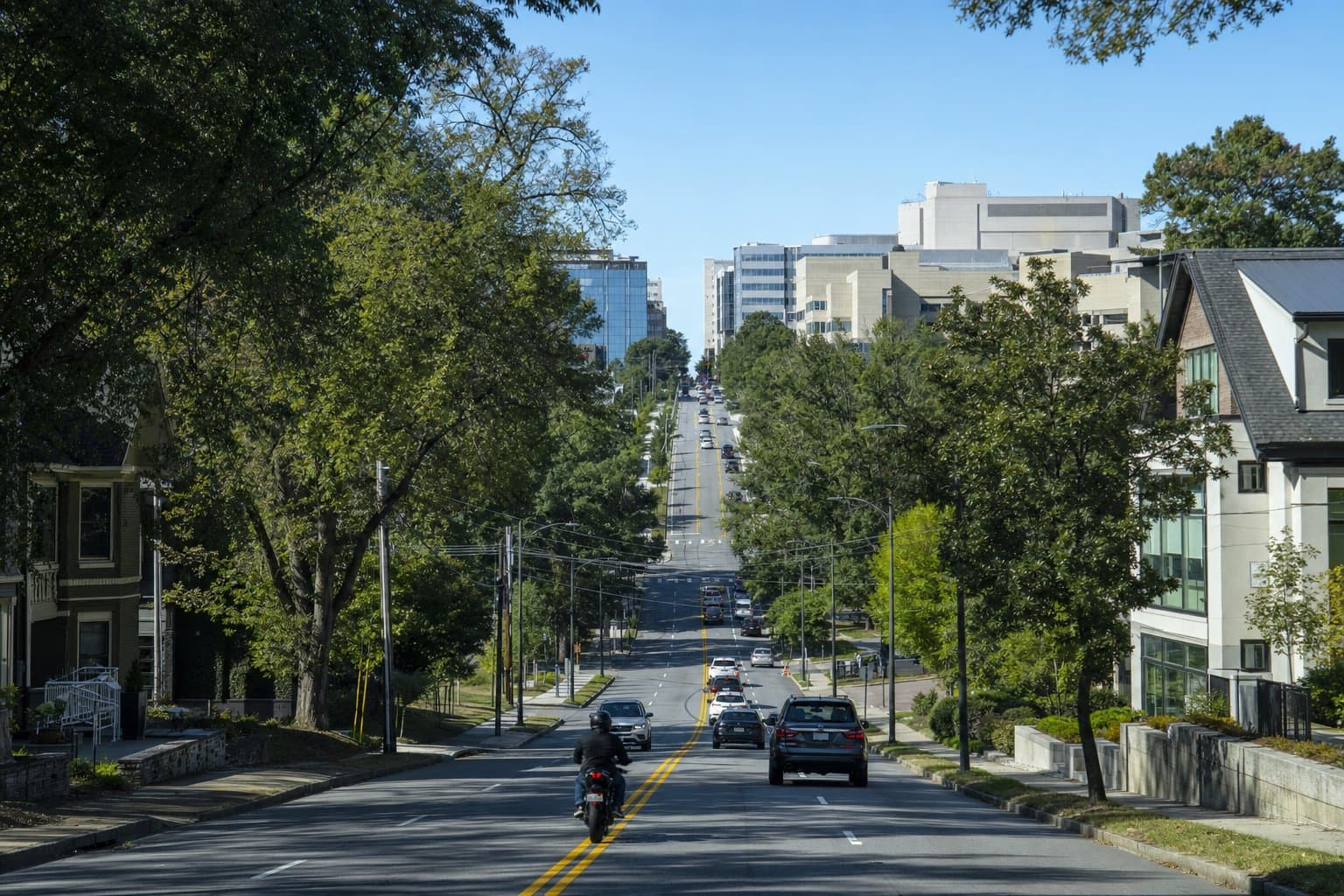
If you were hurt riding the Peachtree Dunwoody Road corridor between Buckhead and the Pill Hill hospital cluster, a Peachtree Dunwoody motorcycle accident lawyer Brookhaven riders rely on can help you untangle fault, deadlines, and the insurance tactics that single out motorcyclists. This stretch is a two-lane, 35 mph secondary road that funnels hospital shift-change traffic past Northside Hospital, Emory Saint Joseph's Hospital, and Children's Healthcare of Atlanta at Scottish Rite — and it sits right on the Fulton–DeKalb county line near Lynwood Park and Club Circle NE. That combination of tight lanes, heavy commuter volume, and a two-county policing seam is exactly where riders get hit. Here is a plain-English breakdown of how Georgia law treats these crashes and what to do next.
Last reviewed: 2026-07-08
Why Peachtree Dunwoody Road Is So Dangerous for Riders
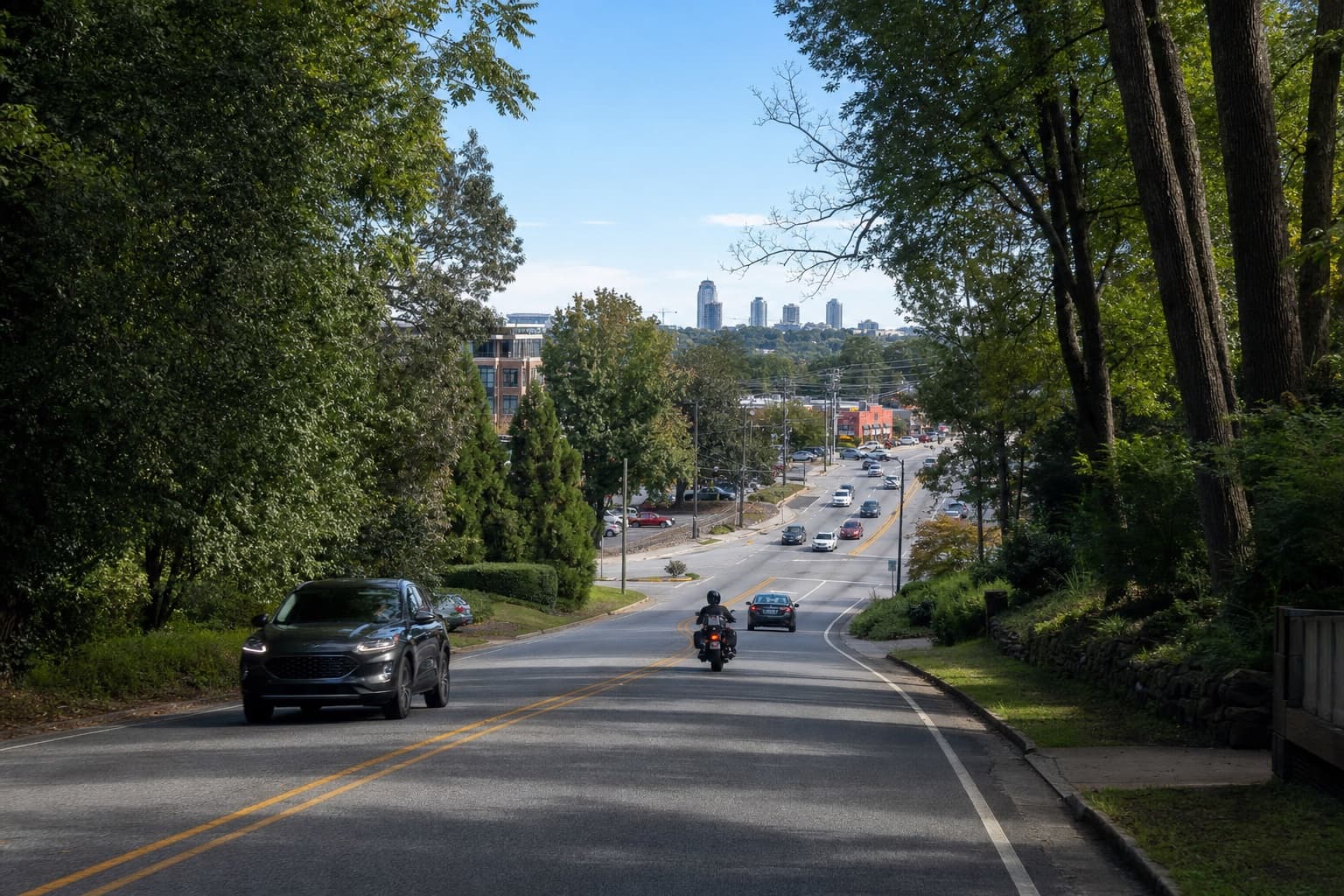
The core hazard is a mismatch: a narrow, tree-lined two-lane road carrying the traffic volume of a much bigger arterial. Peachtree Dunwoody Road is a secondary road posted at 35 mph with one lane in each direction, yet it serves as a primary connector between Buckhead and the Pill Hill medical cluster roughly two miles north. When Northside Hospital, Emory Saint Joseph's Hospital, and Scottish Rite change shifts around 7 a.m. and 7 p.m., that volume compresses onto a road with no room to spare. A motorcyclist has nowhere to go when a driver drifts, brakes late, or turns across the lane.
According to NHTSA, motorcyclists are about 22 times more likely to die in a crash per mile traveled than people in passenger vehicles, and riders made up roughly 14% of all U.S. traffic deaths despite being about 3% of registered vehicles. That risk concentrates wherever a driver has to judge an oncoming or adjacent bike's speed and gets it wrong — and a squeezed two-lane corridor forces that judgment call constantly.
Two local factors make it worse. First, GA-400 runs roughly half a mile west, and when the highway backs up, cut-through drivers spill onto the residential grid around Club Circle NE and Lynwood Park, adding impatient, distracted traffic to streets that were never built for it. Second, sidewalk gaps around Lynwood Park and Mayson Park push walkers and runners toward the travel lanes, so riders are threading between cars, pedestrians, and drivers whose attention is split. As a Brookhaven motorcycle accident lawyer team, we see the same conflict points repeat along this corridor.
Left-Turn Collisions: The Deadliest Conflict on the Corridor
The most catastrophic crash on this road is the left-turn collision — a driver turning left across the path of a rider going straight. On a two-lane road with driveways, the hospital feeders, and residential cross streets, oncoming drivers are constantly turning across the single travel lane, and they misjudge how fast a motorcycle is closing.
According to NHTSA crash data, in two-vehicle fatal motorcycle crashes involving a turn, about 42% involve the other vehicle turning left while the motorcycle goes straight. The driver almost always says the same thing: "I never saw the motorcycle." Georgia law puts the duty to yield on the turning driver, but proving it still takes corridor evidence — the rider's lane position, the driver's sightlines, and the physical marks left on the pavement.
If a turning driver hit you, our page on left-turn motorcycle accidents walks through how fault is established, and for crashes at the signalized cross streets feeding the corridor, see our overview of intersection motorcycle accidents.
Lane-Squeeze and Lane-Change Crashes on a Two-Lane Road
On a road this narrow, the second major hazard is a driver treating one lane like two. Georgia law is clear that a motorcyclist is entitled to the full use of a lane under O.C.G.A. § 40-6-312 (<a href="https://law.justia.com/codes/georgia/title-40/chapter-6/article-13/part-2/section-40-6-312/" rel="noopener noreferrer">read the statute</a>), and no driver may operate a vehicle so as to deprive a rider of that lane. Yet on Peachtree Dunwoody Road, drivers routinely crowd a rider toward the shoulder to squeeze past, drift over the center line around parked delivery vehicles, or change position without checking a blind spot.
These are classic blind-spot and lane-position cases, and they often turn on inches. A driver who checks a mirror but not a blind spot can move directly into a rider who is legally and visibly in the lane. Our page on lane-change collisions explains how these cases are reconstructed. The corridor's uneven pavement, utility patches, and debris kicked in from the GA-400 spillover also create genuine road-hazard crashes, where a defect — not the rider — put the bike down.
Common Conflict Points on Peachtree Dunwoody Road
| Location / movement | Typical cause | Usually at fault |
|---|---|---|
| Driver turning left into a hospital feeder or driveway | Misjudges oncoming rider's speed | Turning driver |
| Two-lane squeeze around parked or stopped vehicles | Driver crowds rider or crosses center line | Passing/crossing driver |
| Club Circle NE cut-through when GA-400 backs up | Distracted, impatient shortcut driver | Cut-through driver |
| Residential cross-street pull-out | Driver fails to yield from a stop | Entering driver |
| Shift-change congestion near Pill Hill | Rear-end in stop-and-go traffic | Following driver |
Have Questions About Your Case?
Get a free consultation with an experienced Georgia accident attorney.
How Georgia Law Decides Fault After a Corridor Crash
Georgia uses modified comparative negligence under O.C.G.A. § 51-12-33 (<a href="https://law.justia.com/codes/georgia/title-51/chapter-12/article-2/section-51-12-33/" rel="noopener noreferrer">read the statute</a>). A rider can recover damages only if found less than 50% at fault, and any award is reduced by the rider's percentage of blame. If you are assigned 20% of the fault on a $100,000 case, you collect $80,000 — and if an insurer can push you to 50% or more, you collect nothing.
That math is exactly why insurers work so hard to pin fault on riders, leaning on tired stereotypes about speed and "lane splitting" even when the physical evidence tells a different story. Mark Wade, Founder and Lead Attorney at Georgia Auto Law, points out that insurance companies apply a well-documented bias against motorcycle riders, and the firm counters that bias with hard evidence — accident reconstruction, biomechanical analysis, and a careful read of the scene rather than the adjuster's assumptions. That evidence-first approach is what a Peachtree Dunwoody motorcycle accident lawyer Brookhaven clients hire should bring to every case.
Because the corridor is dense with hospital, business, and traffic-signal cameras, the proof you need often exists — for a while. Signal timing data, private surveillance footage, and skid or gouge marks on the pavement can confirm who had the right of way, but much of it is overwritten or paved over within weeks. Getting a Georgia motorcycle accident lawyer involved early can be the difference between a documented case and one driver's word against another's.
The County Line: Why the Same Crash Can Follow Two Different Paths
The location of your crash — sometimes a single block — decides which agency worked it and where your case is filed. This cluster sits directly on the Fulton–DeKalb line. A crash on the Atlanta side is typically worked by Atlanta Police Department Zone 2, and personal-injury suits are filed in the State Court of Fulton County. A crash on the Brookhaven side is worked by the Brookhaven Police Department in DeKalb County, with suits filed in the State Court of DeKalb County and traffic citations handled in the Municipal Court of Brookhaven.
That seam matters in practice. The two departments store reports differently and follow different records-request procedures, so knowing which agency responded tells you where the crash report lives and which court has venue. Riders coming from the DeKalb side can read more about our Brookhaven service area, and those on the Fulton side can see our Buckhead service area. Getting this right early avoids weeks of chasing a report from the wrong department.
The Helmet Law and How Insurers Use It Against You
Georgia is a universal-helmet state, and wearing one both keeps you legal and protects your claim. O.C.G.A. § 40-6-315 (<a href="https://law.justia.com/codes/georgia/title-40/chapter-6/article-13/part-2/section-40-6-315/" rel="noopener noreferrer">see the statute</a>) requires every motorcyclist and passenger to wear a DOT-compliant helmet. Defense insurers still raise helmet use to argue your injuries should have been less severe, so the safety data cuts in your favor.
According to NHTSA, helmets are about 37% effective at preventing rider fatalities and roughly 67% effective at preventing brain injuries. The Insurance Institute for Highway Safety similarly reports that motorcyclists are far more likely to be killed in a crash than passenger-vehicle occupants, which is why conspicuity and lane position matter so much on a tight corridor. The Georgia Governor's Office of Highway Safety runs rider-visibility safety programming built around the same reality: drivers routinely fail to see motorcycles. Even with a helmet, head trauma is common in these crashes, and when a corridor collision turns fatal, our work on fatal motorcycle accidents explains how Georgia's wrongful-death claims work for surviving families.
What to Do After a Crash on Peachtree Dunwoody Road
The first hours matter most. After a crash on the corridor:
- Get medical care. Northside Hospital and Emory Saint Joseph's Hospital sit about two miles north, and Scottish Rite handles pediatric trauma nearby. A medical record made the same day links your injuries to the crash.
- Call law enforcement and confirm a report is created. On the county line, note whether Atlanta PD or Brookhaven PD responds, because that determines where the report lives.
- Document the scene — photos of your lane position, the turn or driveway involved, vehicle damage, and any nearby businesses or hospital facilities whose cameras may have caught it.
- Do not give a recorded statement to the other driver's insurer before you talk to a lawyer.
- Preserve evidence early, before signal data and store footage cycle out.
If the driver who hit you fled — a real risk on the low-witness residential cut-throughs off the corridor — or carried no insurance, your own policy may be the answer. Georgia drivers can pursue uninsured motorist claims in Georgia under O.C.G.A. § 33-7-11 (<a href="https://law.justia.com/codes/georgia/title-33/chapter-7/section-33-7-11/" rel="noopener noreferrer">read the statute</a>) when the at-fault driver is unidentified or uninsured. The broader damages a rider can pursue — medical bills, lost income, future care, and pain and suffering — are the subject of our Georgia personal injury lawyer practice.
Neighbors on this corridor also deal with pedestrian and bicycle risk at the Mayson Park and Lynwood Park sidewalk gaps, and the broader Pill Hill hospital-corridor crash picture puts the motorcycle risk in context. Georgia Auto Law works on a contingency fee: the consultation is free, and there is no fee unless we win.
Frequently Asked Questions
How long do I have to file a motorcycle accident claim after a Peachtree Dunwoody Road crash?
Georgia's personal-injury statute of limitations is two years from the date of the crash under O.C.G.A. § 9-3-33 (<a href="https://law.justia.com/codes/georgia/title-9/chapter-3/article-2/section-9-3-33/" rel="noopener noreferrer">read it here</a>). A wrongful-death claim from a fatal crash generally runs two years as well. If a government vehicle is involved, a shorter ante litem notice deadline can apply, so do not wait to get advice.
A driver turned left in front of me near the hospital corridor — who is at fault?
Georgia law puts the duty to yield on the driver turning left across oncoming traffic, so the turning driver is usually at fault. According to NHTSA data, left-turning vehicles account for about 42% of fatal two-vehicle motorcycle crashes involving a turn. You still have to prove it with scene evidence, because the driver will often claim they never saw you.
The car tried to share my lane — was that legal?
No. O.C.G.A. § 40-6-312 entitles a motorcyclist to the full use of a lane, and no driver may operate a vehicle so as to deprive a rider of that lane. On a two-lane road like Peachtree Dunwoody, a driver who crowds you toward the shoulder to squeeze past is violating that right, which supports your claim if a crash results.
Does it matter whether Atlanta police or Brookhaven police worked my crash?
Yes. The corridor sits on the Fulton–DeKalb county line. A crash on the Atlanta side is generally worked by Atlanta Police Zone 2 with suits filed in the State Court of Fulton County, while a Brookhaven-side crash is worked by Brookhaven Police with suits in the State Court of DeKalb County. Knowing which agency responded tells you where to request your report and which court has venue.
Can I still recover if the insurer says I was partly to blame?
Yes, as long as you are found less than 50% at fault under O.C.G.A. § 51-12-33. Your award is reduced by your share of fault, so a 20% finding cuts a recovery by 20%. Because insurers push hard to inflate a rider's percentage, evidence and reconstruction matter enormously.
What if the driver who hit me fled or had no insurance?
You may still recover through your own uninsured/underinsured motorist coverage under O.C.G.A. § 33-7-11. On the low-witness residential cut-throughs off the corridor, hit-and-run is a real risk, and a UM claim against your own policy is often the practical path to compensation when the at-fault driver is unidentified or uninsured.
How much does it cost to hire a Peachtree Dunwoody motorcycle accident lawyer Brookhaven riders trust?
Georgia Auto Law handles motorcycle cases on a contingency fee. The initial consultation is free, and you pay no attorney fee unless we recover money for you. You can reach the firm any time at (404) 662-4949.