Key Takeaways
- The Pill Hill medical corridor runs along Peachtree Dunwoody Road inside ZIP 30342, with Northside Hospital, Scottish Rite, and Emory Saint Joseph's clustered within roughly two miles north. All civil suits arising from these crashes are filed in Fulton County.
- Georgia's personal-injury statute of limitations is two years under O.C.G.A. § 9-3-33. Property-damage claims have a separate four-year window under O.C.G.A. § 9-3-32.
- Most motor-vehicle injury suits in the corridor are filed in the State Court of Fulton County; higher-value or equity claims go to the Superior Court of Fulton County. The three municipal courts (Atlanta, Sandy Springs, Brookhaven) handle only the traffic-citation side of the case.
- ZIP 30342 spans three police departments — APD Zone 2, Sandy Springs PD, and Brookhaven PD — and which one writes the crash report controls how quickly the report can be obtained.
- Georgia is a modified-comparative-fault state under O.C.G.A. § 51-12-33: an injured driver who is 50% or more at fault recovers nothing.
- Driver duties commonly invoked at Pill Hill: O.C.G.A. § 40-6-180/181 (basic speed rule and prima-facie limits) and O.C.G.A. § 40-6-71 (duty of a left-turning driver to yield).
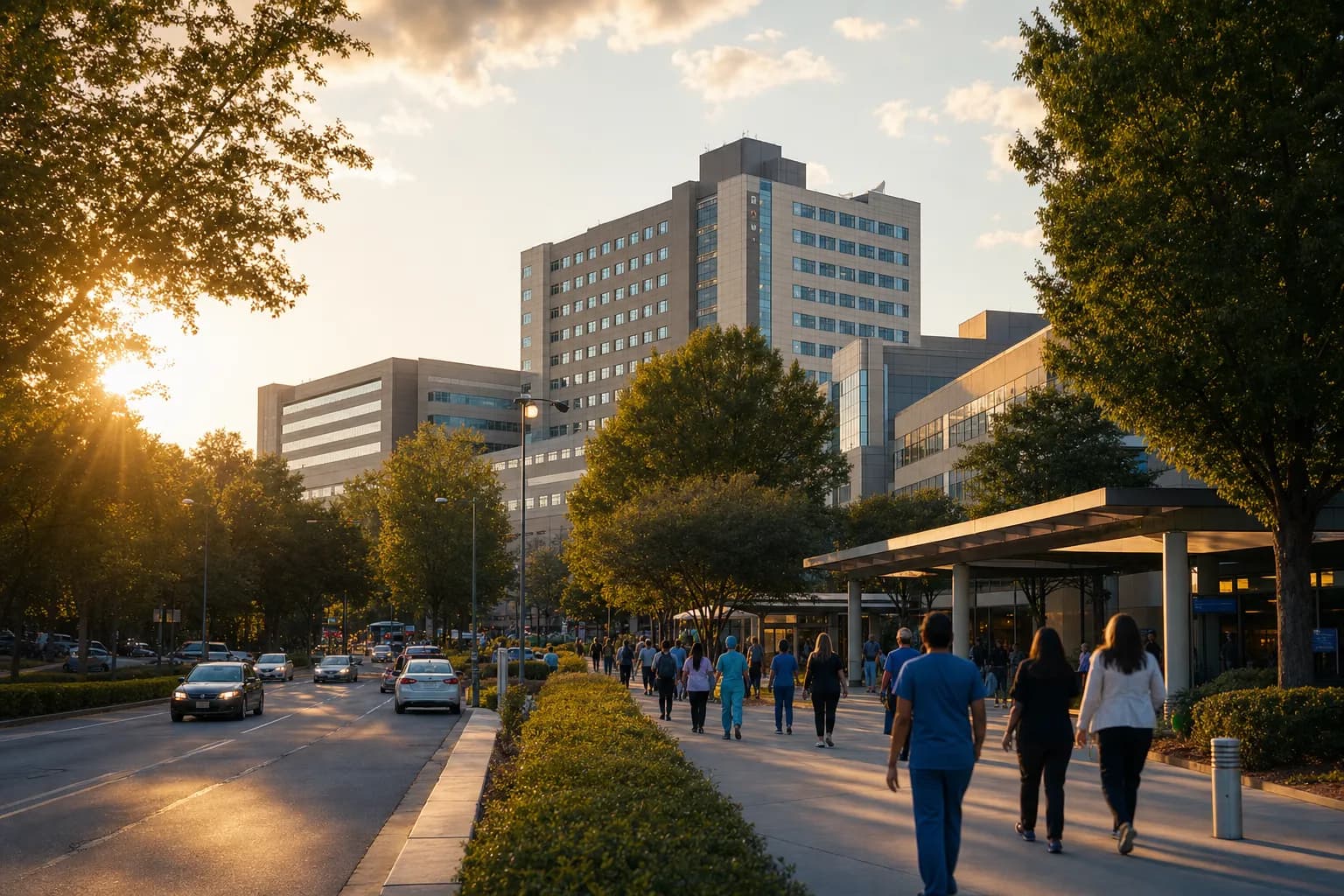
A Pill Hill Peachtree Dunwoody car accident lawyer handles driver-vs-driver crashes on the two-lane medical-corridor stretch of Peachtree Dunwoody Road that connects Northside Hospital Atlanta, Children's Healthcare of Atlanta at Scottish Rite, and Emory Saint Joseph's Hospital. The work is Fulton County civil litigation under Georgia's two-year personal-injury statute, complicated by a single ZIP code — 30342 — that splits across three police departments: Atlanta PD Zone 2, Sandy Springs PD, and Brookhaven PD.
What Pill Hill Actually Is — And Why Driver-vs-Driver Crashes Happen Here
Pill Hill is the local name for the cluster of three large hospitals north of Buckhead: Northside Hospital Atlanta (on-site Level III trauma), Children's Healthcare of Atlanta at Scottish Rite (pediatric Level I trauma), and Emory Saint Joseph's Hospital. They sit within roughly two miles of each other along the I-285 / Johnson Ferry / Peachtree Dunwoody axis. Peachtree Dunwoody Road is the spine that strings them together — at this latitude it is a two-lane secondary arterial with a posted 35 mph limit, narrow lanes, no usable shoulder, and a continuous string of unsignalized commercial and hospital driveways.
The traffic problem is structural, not behavioral. Each campus runs three nursing and clinical shift changes per day — roughly 7 a.m., 3 p.m., and 11 p.m. — and each shift change pushes a surge of arriving and departing employees through the same two travel lanes that families, outpatients, ambulances, and visiting clinicians are already using. Outpatient surgery and oncology infusion appointments concentrate visitor traffic between 7 a.m. and 11 a.m., layering a slower-moving wave of unfamiliar drivers on top of the employee turnover. When I-285 backs up at the Glenridge Connector and Roswell Road exits, GPS-following commuters divert onto Peachtree Dunwoody Road as a parallel route, pushing through-traffic volume well past what the corridor was designed for.
Those four flows — staff turnover, outpatient surgery, ambulance priority, and I-285 cut-through — explain why this hyperlocal stretch generates a disproportionate share of driver-vs-driver crashes for the broader 30342 ZIP. The classic Pill Hill collision is not a speeding crash. It is a low-speed, high-energy rear-end at a hospital driveway, or a left-turn collision where a driver tried to cross oncoming Peachtree Dunwoody traffic to reach a hospital entry without a protected signal.
The Numbers Behind the Corridor
According to the National Highway Traffic Safety Administration's 2023 Overview of Motor Vehicle Crashes report, rear-end collisions account for roughly 28% of all reported U.S. crashes — the single most common crash type, and the most common Pill Hill crash type by far. According to the Insurance Institute for Highway Safety, left-turn crashes at intersections without protected left-turn signals are responsible for roughly 22% of urban intersection fatalities, with the at-fault driver almost always being the one turning across oncoming traffic. According to the Georgia Governor's Office of Highway Safety 2023 Strategic Highway Safety Plan, Fulton County is one of Georgia's three highest-crash counties for non-interstate arterial collisions, with hospital and commercial-driveway-dense corridors flagged as elevated-risk segments.
The Northside Hospital Atlanta campus alone reports roughly 22,000 employees and 250,000 patient encounters per year across its medical-center hub, and Children's Healthcare of Atlanta at Scottish Rite reports more than 600,000 annual patient visits system-wide — much of it routed through the Johnson Ferry / Peachtree Dunwoody approaches. Independently of the official statistics, those volumes are the operative reason a Pill Hill Peachtree Dunwoody car accident lawyer often sees multiple crashes per week clustered at the same handful of unsignalized driveways.
Lead attorney Mark Wade of Georgia Auto Law has handled driver-vs-driver Pill Hill claims for years, and his consistent observation is that the first thirty days control the case. Security-camera footage from hospital valet kiosks, ER drives, and adjacent retail typically auto-overwrites in fourteen to thirty days; ambulance dispatch logs and the responding department's CAD records require formal records requests that take a week or more to return; and the at-fault driver's vehicle telematics — the EDR or "black box" — can be unrecoverable once the car is totaled and sent to salvage. A victim who calls a lawyer on day 31 has often lost the most objective record of what happened at the driveway.
Four Driver-vs-Driver Crash Patterns on Peachtree Dunwoody
Rear-end shift-change collisions at hospital driveway entries. The defining Pill Hill crash. A hospital employee or visitor brakes hard to turn into a campus entry at 6:55 a.m. or 2:55 p.m. The driver behind them — also trying to make the same shift — is closing at 30 to 35 mph and does not brake in time. Liability anchors in O.C.G.A. § 40-6-49 (following too closely) and the basic-speed rule under O.C.G.A. § 40-6-180. These cases turn on the EDR speed-at-impact data and any available retail or hospital camera footage.
Left-turn crashes at unsignalized Peachtree Dunwoody driveways. The other dominant pattern. A southbound driver attempts to cross northbound Peachtree Dunwoody traffic to reach a hospital entry, an outpatient clinic, or one of the I-285 frontage-road approaches without a protected left-turn arrow. They misjudge the gap and are T-boned by the oncoming driver. Liability anchors squarely in O.C.G.A. § 40-6-71, which imposes a clear duty on the left-turning driver to yield. The defense argument is almost always speed by the oncoming car (an attempt to push the fault percentage above the 50% bar under O.C.G.A. § 51-12-33), which is why early EDR preservation matters.
Stacking rear-end crashes in I-285 diversion traffic. When I-285 backs up at Glenridge Connector or Roswell Road, commuters cut through Peachtree Dunwoody at a velocity profile the corridor cannot absorb. A single braking event at a driveway can produce a three- or four-car chain. Apportionment of fault between every driver in the chain becomes the entire case, and an experienced Atlanta car accident lawyer approaches these the way a multi-vehicle deposition would be staged — every driver's EDR, every dash-cam file, every cell-phone activity timeline.
Parking-lot and entry-lane collisions inside hospital campuses. Hospital-entry confusion is its own crash category. Unfamiliar visitors turn into valet lanes, the wrong garage, and one-way service drives — producing low-speed but high-frequency contact in and around campus driveways. These crashes are still Fulton County civil claims, but liability turns on hospital signage, lane geometry, and (in some campuses) private-roadway rules rather than the Uniform Rules of the Road.
Have Questions About Your Case?
Get a free consultation with an experienced Georgia accident attorney.
What to Do for Each Pill Hill Driver-vs-Driver Crash Type
| Driver-vs-driver crash type | Primary legal anchor | Key evidence to preserve | Typical coverage path |
|---|---|---|---|
| Rear-end at hospital driveway | O.C.G.A. § 40-6-49 (following too closely); § 40-6-180 (basic speed) | Hospital/retail security video; rear EDR; CAD log; ambulance dispatch | At-fault driver's BI policy; UM if limits exhausted |
| Left-turn across Peachtree Dunwoody | O.C.G.A. § 40-6-71 (left-turn duty to yield) | Both vehicles' EDR; intersection cameras; phone activity timeline | Left-turning driver's BI policy; UM gap coverage |
| I-285 diversion chain-reaction | O.C.G.A. § 40-6-49; § 51-12-33 (apportionment) | Every driver's EDR; dash-cam files; GDOT 511 traffic-state logs | Apportioned across each at-fault BI policy |
| Hospital-campus entry / parking lot | O.C.G.A. § 40-6-181 (prima-facie speed); private-road duties | Hospital security/valet video; incident report from facility security | At-fault driver's BI policy; possible premises claim |
Three Police Departments, One ZIP Code
ZIP 30342 sits at the seam of three municipalities, and a Pill Hill driver who calls 911 from a hospital driveway does not get to choose who answers.
- APD Zone 2 covers the Buckhead / Atlanta-side corner of 30342 — generally south of the city line, including parts of the Peachtree Dunwoody corridor closest to Buckhead.
- Sandy Springs PD covers the central Pill Hill hospital campuses themselves and most of the Peachtree Dunwoody mileage between the campuses and I-285.
- Brookhaven PD covers the Lynwood Park residential streets east of Peachtree Dunwoody and parts of the corridor's eastern frontage.
Which department writes the report controls (a) which records portal the crash report comes from, (b) how long it takes to obtain — Atlanta and Sandy Springs each run on their own retention windows for body-cam and in-car video, with Brookhaven's window typically shorter than either — and (c) whether the report is filed under the correct address at all. Misfiled reports — a Sandy Springs crash logged as APD, or vice versa — are common, and they delay the investigation by weeks while a victim's PIP-equivalent benefits and UM-notice deadlines keep ticking.
| Responding department | Typical Pill Hill coverage area | Crash-report portal turnaround | Practical issue |
|---|---|---|---|
| APD Zone 2 | South 30342, Buckhead-adjacent | ~7-14 days via OpenRecords | Reports occasionally cross-filed to wrong zone |
| Sandy Springs PD | Hospital campuses, central Peachtree Dunwoody | ~5-10 days via city portal | Body-cam retention window can elapse before request lands |
| Brookhaven PD | Lynwood Park streets, east of Peachtree Dunwoody | ~5-10 days via city portal | Shorter video retention than APD; requires immediate written request |
This is why identifying the correct responding department within 24 hours is not paperwork — it is evidence preservation. A Sandy Springs car accident lawyer, a Brookhaven personal injury attorney, or a Buckhead Atlanta auto accident lawyer handling a Pill Hill case should be opening the records request the same day, in writing, to the correct department.
Injuries and Forum
Because Pill Hill crashes happen at the front door of three trauma-capable hospitals, the medical record is unusually complete. Northside operates an on-site Level III trauma program; Scottish Rite is the pediatric Level I trauma center for North Atlanta. For catastrophic polytrauma — multi-system injuries, severe TBI, unstable spine — patients are transferred south to Grady Memorial Hospital, Atlanta's Level I adult trauma center, roughly eleven miles down the interstate. Recurring injury types we see on Peachtree Dunwoody driver-vs-driver claims are closed head injury and concussion injuries after a crash, cervical and lumbar soft-tissue injury, and broken bones and orthopedic injuries from a vehicle crash — sternal, clavicle, and distal-radius fractures from rear-end belt loading, tibial plateau and pelvic fractures from left-turn T-bones.
Civil suits arising from these crashes are filed in Fulton County. The State Court of Fulton County handles the bulk of motor-vehicle injury cases — there is no monetary cap, and the court has its own dedicated civil division. The Superior Court of Fulton County takes higher-value, complex, or equitable claims, including wrongful-death actions. Traffic citations against a charged driver — failure-to-yield, following-too-closely, basic-speed violations — route separately through the municipal court of whichever city responded (Atlanta, Sandy Springs, or Brookhaven), but those municipal proceedings handle the citation only and do not adjudicate civil damages.
Georgia's minimum auto-liability limits — 25/50/25 — routinely fail to cover a trauma admit at any of the three Pill Hill hospitals, which is why uninsured motorist coverage in Georgia frequently determines actual recovery. Where the at-fault driver is fully covered, the case proceeds on their bodily-injury policy. Where the at-fault driver is unidentified or underinsured — far more common in the I-285 diversion subset — the victim's own UM coverage becomes the operative policy.
Two passing notes for completeness, because they are the other dominant crash categories on this same corridor but each has its own dedicated post: rear-end and lane-change crashes at hospital entries also produce a meaningful subset of Uber and Lyft accident claims in Atlanta when an actively transporting rideshare driver is one of the involved vehicles, and the same corridor produces hospital-corridor Atlanta hit-and-run accident claims when an at-fault driver flees onto the adjacent I-285 ramps. Each of those scenarios is covered in its own sibling post; the present article is the driver-vs-driver-car case.
The case is, at its core, an Atlanta personal injury law firm case: Fulton County jurisdiction, three-municipality coordination on the report, three-hospital medical records, and a two-year clock running from the date of the crash under O.C.G.A. § 9-3-33.
Last reviewed: May 26, 2026
Frequently Asked Questions
How long do I have to file a car accident claim after a crash on Peachtree Dunwoody Road at Pill Hill?
Two years from the date of the crash, under O.C.G.A. § 9-3-33. That is Georgia's personal-injury statute of limitations, and it applies to any car crash on Peachtree Dunwoody Road regardless of which of the three police departments responded. Property-damage claims arising from the same crash get a longer four-year window under O.C.G.A. § 9-3-32, but the bodily-injury clock is the one that controls. Your own auto-insurance policy also contains separate notice and cooperation deadlines that can run far shorter — sometimes 30 days — so a Pill Hill Peachtree Dunwoody car accident lawyer typically opens both the civil-statute calendar and the carrier-notice calendar in the first 48 hours.
Which police department writes the crash report for a Pill Hill car accident?
It depends on which side of which city line the crash landed on. ZIP 30342 is split across three municipalities — Atlanta, Sandy Springs, and Brookhaven — and each has its own police department. APD Zone 2 covers the Buckhead-adjacent southern end. Sandy Springs PD covers the central hospital campuses and most of the corridor between the campuses and I-285. Brookhaven PD covers the Lynwood Park streets and eastern frontage. The responding department controls which records portal the report comes from, how long it takes to obtain, and what the body-cam and in-car-video retention windows look like. Misfiled reports — for example, a Sandy Springs crash logged as APD — are common and delay investigation by weeks.
Where will my Pill Hill car accident lawsuit be filed?
In Fulton County. Most driver-vs-driver auto-injury suits arising from Peachtree Dunwoody crashes are filed in the State Court of Fulton County, which has no monetary cap and a dedicated civil division. Higher-value cases, wrongful-death claims, and any case joined with equitable relief go to the Superior Court of Fulton County. The three municipal courts — Atlanta, Sandy Springs, and Brookhaven — only adjudicate the traffic citation against the at-fault driver. They do not handle civil damages. There is no separate Pill Hill court or 30342 court.
What if the other driver was turning into a hospital and I was going straight on Peachtree Dunwoody?
The left-turning driver almost always carries the fault. O.C.G.A. § 40-6-71 imposes a clear duty on a driver turning left to yield to oncoming traffic until the turn can be completed safely. The defense will argue you were speeding (to push your share of fault above the 50% bar under O.C.G.A. § 51-12-33's modified-comparative-negligence rule and zero out your recovery). The right answer is to preserve both vehicles' EDR data, any intersection or hospital camera footage, and both drivers' phone activity timelines as soon as possible. A Pill Hill Peachtree Dunwoody car accident lawyer typically opens those preservation letters in the first week.
What evidence disappears fastest after a Pill Hill car accident?
Three categories of evidence have the shortest shelf life. Security-camera footage from hospital valet kiosks, ER drive entries, and adjacent retail buildings typically auto-overwrites in 14-30 days. Police body-cam and in-car video from the responding department has fixed retention windows that vary by department — Brookhaven's is typically the shortest. Vehicle EDR data can be unrecoverable once the car is totaled and released to salvage, which often happens within 30-45 days of the crash. Skid marks, paint transfer, and debris fields wash out with the first heavy Atlanta rain. The thirty-day window matters more on Peachtree Dunwoody than on most Atlanta corridors because the volume of available video evidence is high — but only briefly.
Can I still recover if the insurance company says I share some of the fault?
Yes, as long as your share is less than 50%. Georgia follows modified comparative negligence under O.C.G.A. § 51-12-33: your recovery is reduced by your assigned percentage of fault, and it is barred entirely at 50% or more. Defense carriers will routinely argue the rear-ended driver stopped too abruptly, the through-traffic driver was speeding into a left-turn, or the diverted I-285 commuter was distracted. Each of those defenses is beaten with the same objective evidence — EDR speed-at-impact, dash-cam, phone activity timeline, and the responding department's CAD log.
Is a Pill Hill car accident lawyer different from any other Atlanta car accident lawyer?
Functionally, no — the lawyer is licensed to practice in Georgia and files in Fulton County either way. Practically, yes, because the corridor's specific patterns (three police departments, unsignalized hospital driveways, three-shift-per-day rotation, I-285 diversion traffic, and 14-30 day video retention) reward a lawyer who has handled the same fact patterns repeatedly. A Pill Hill Peachtree Dunwoody car accident lawyer knows which department to call within 24 hours, which retail and hospital cameras to subpoena before they overwrite, and which Fulton County State Court division to file in.
Talk to a Pill Hill Peachtree Dunwoody Car Accident Lawyer
If you or a family member was hurt in a driver-vs-driver crash on Peachtree Dunwoody Road — at a Northside, Scottish Rite, or Emory Saint Joseph's entry, in I-285 diversion traffic, or at one of the unsignalized hospital driveways — Georgia Auto Law can help. We handle Pill Hill car crash cases in the State Court and Superior Court of Fulton County, coordinate across APD Zone 2, Sandy Springs PD, and Brookhaven PD, and preserve the corridor-specific evidence (camera footage, EDR data, CAD logs) on the calendar the case actually requires. Consultations are free, and you pay nothing unless we recover for you.
Disclaimer: This article is for general informational purposes only and is not legal advice. Reading it does not create an attorney-client relationship. Statutory deadlines under O.C.G.A. § 9-3-33 are time-sensitive; consult a qualified Georgia personal injury attorney about your particular situation as soon as possible.