Key Takeaways
- Georgia's statute of limitations for pedestrian and bicycle injury claims is two years from the date of the crash under O.C.G.A. § 9-3-33.
- Georgia uses modified comparative negligence under O.C.G.A. § 51-12-33 — recovery is reduced by your share of fault and barred entirely at 50% or more.
- Crashes on the Buckhead Forest side of Peachtree Dunwoody Road are handled by Atlanta Police Zone 2 and litigated in Fulton County (State or Superior Court).
- Crashes on the Lynwood Park side fall inside Brookhaven city limits, are worked by Brookhaven Police Department, and litigated in DeKalb County.
- According to NHTSA, pedestrian fatalities in 2022 reached 7,522 deaths nationally — the highest since 1981 — with most occurring on arterial roads outside intersections.
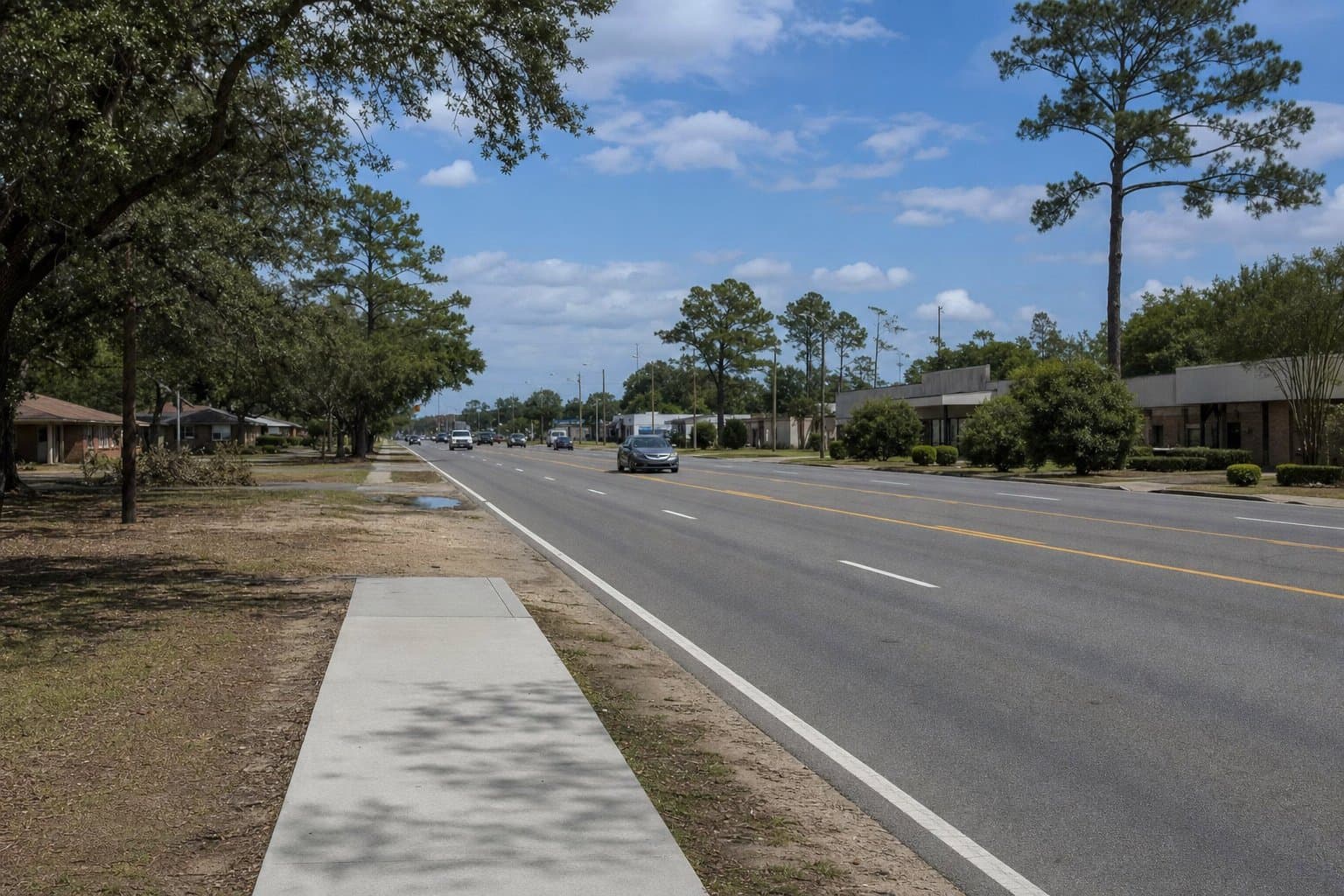
- Sidewalk coverage on this corridor is discontinuous, which forces pedestrians into the travel lane and is a recurring factor in liability disputes.
- Hit-and-run drivers on Peachtree Dunwoody typically flee toward GA-400 or south into Buckhead, which makes uninsured-motorist (UM) coverage on your own auto policy the most reliable recovery source.

This guide covers pedestrian and bicycle crashes on Peachtree Dunwoody Road between Mayson Park in Buckhead Forest and Lynwood Park in Brookhaven — a two-lane, 35 mph residential corridor in the 30342 ZIP that functions as a daily commuter cut-through to Pill Hill. If you were hit while walking or riding on this stretch, Georgia's two-year statute of limitations and modified comparative-negligence rule control your case, and the city/county boundary between Buckhead and Brookhaven decides which police agency wrote your report and which courthouse hears your claim.
Why This Stretch Is a Pedestrian and Cyclist Problem
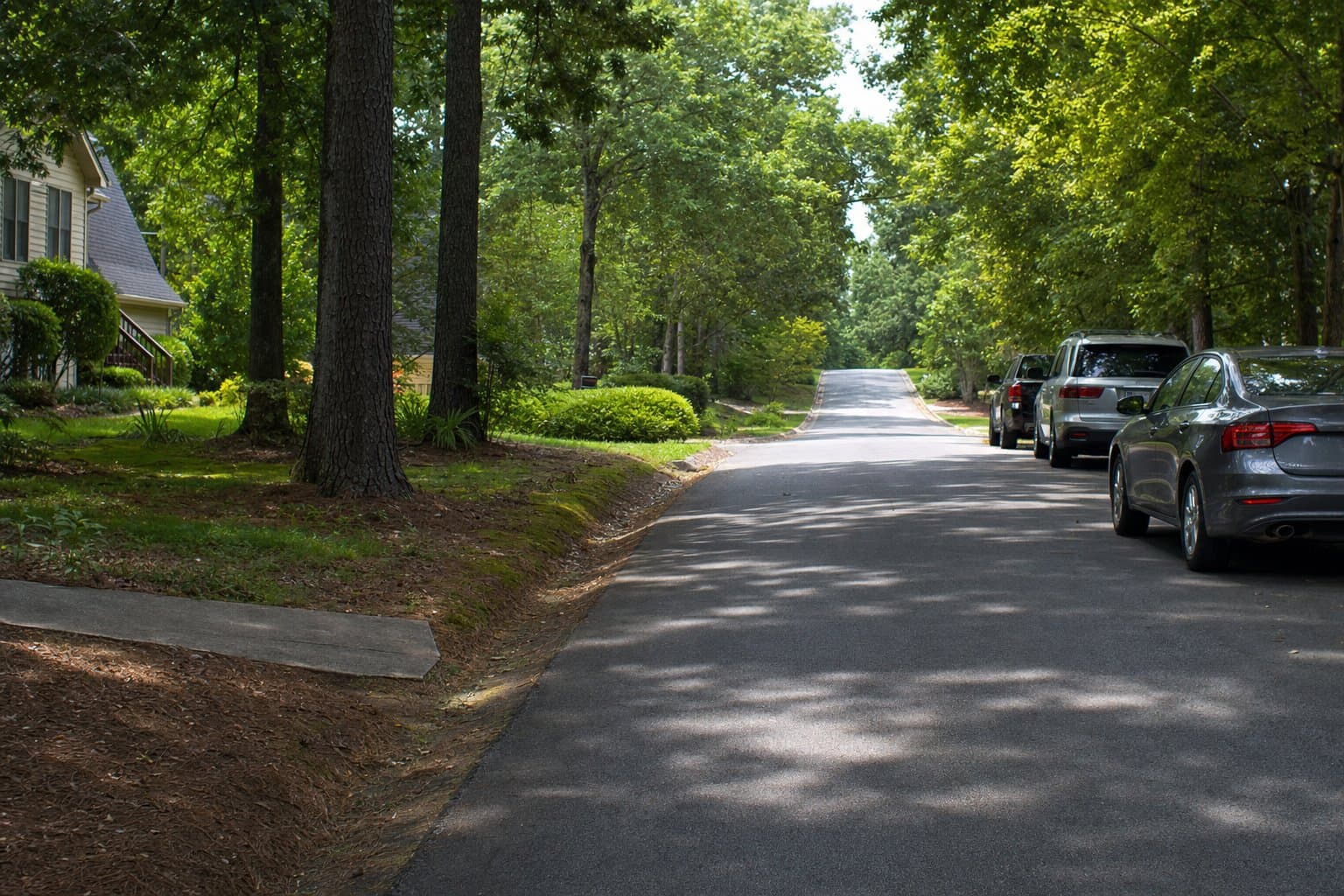
The Peachtree Dunwoody corridor between Mayson Park and Lynwood Park is a residential road being used as a commuter route it was never designed for. The posted speed is 35 mph. Drivers cutting through from Brookhaven to the Pill Hill hospital cluster — Northside, Emory Saint Joseph's, and Children's Healthcare of Atlanta - Scottish Rite, all about two miles north — routinely exceed it. Add Pill Hill shift changes at 7 a.m. and 7 p.m., game-day traffic from Hermance Stadium at Oglethorpe University, and weekend families walking into both parks, and conflict points multiply fast.
The central design failure is sidewalk continuity. Pedestrians walking into Mayson Park, parents pushing strollers toward Lynwood Park, and cyclists commuting south to Buckhead all get pushed into the travel lane wherever the sidewalk drops off. According to the Governors Highway Safety Association, the majority of pedestrian fatalities in the U.S. now happen on arterial roads, at night, and away from intersections — exactly the conditions this corridor produces. According to the Centers for Disease Control and Prevention, people walking are roughly 1.5 times more likely than vehicle occupants to be killed in a crash on a per-trip basis. Georgia Department of Transportation crash data consistently shows pedestrian fatalities concentrated on high-volume suburban arterials.
Mark Wade, Georgia Auto Law's lead attorney, has handled crashes on this exact corridor and notes that the sidewalk-gap pattern shapes how every case gets defended. Insurers argue the pedestrian or cyclist was "in the roadway" as if that fact alone settles fault — when the real question is whether a reasonable person had any safe alternative on that block. Photographs of where the sidewalk simply ends are often worth more to the claim than any witness statement.
Pedestrian, Bicycle, and Hit-and-Run Claims Compared
The legal path differs depending on whether you were walking, riding, or struck by a driver who fled.
| Factor | Pedestrian | Bicycle | Hit-and-Run / Uninsured |
|---|---|---|---|
| Statute of limitations | 2 years (O.C.G.A. § 9-3-33) | 2 years (O.C.G.A. § 9-3-33) | 2 years; UM contract terms also apply |
| Governing rules | O.C.G.A. §§ 40-6-91, 40-6-92 | O.C.G.A. § 40-6-294 | O.C.G.A. § 40-6-270 |
| Comparative-fault exposure | High — mid-block crossing argued as partial fault | Moderate — lane position and lighting | Low if lawfully positioned; turns on insurance |
| Primary insurance source | At-fault driver's auto liability | At-fault driver's auto liability | Your own UM/UIM coverage |
| Key evidence | Crosswalk markings, signal timing, sidewalk photos, driver speed | Bike-lane signage, lighting, gear, mechanical condition | 911 timestamp, debris, security-cam footage, plate fragments |
| Court (Buckhead side) | State or Superior Court of Fulton County | State or Superior Court of Fulton County | State or Superior Court of Fulton County |
| Court (Brookhaven side) | State or Superior Court of DeKalb County | State or Superior Court of DeKalb County | State or Superior Court of DeKalb County |
The critical row is the insurance source. When a driver flees on Peachtree Dunwoody — usually at night, toward the GA-400 ramps or south into Buckhead — there is no defendant policy to sue. Recovery comes from your own uninsured motorist coverage, which in Georgia is available even when you were walking or cycling at the time of the crash. A serious Atlanta pedestrian accident lawyer will pull every UM policy in the injured person's household, not just the one tied to a car in the driveway.
How Georgia's Comparative Negligence Rule Plays Out Here
Under O.C.G.A. § 51-12-33, Georgia is a modified comparative negligence state with a 50% bar. If a jury finds you 30% at fault, your damages drop by 30%. At 50% or more, you take nothing. That rule is why adjusters push two arguments hard: that the pedestrian crossed mid-block in violation of O.C.G.A. § 40-6-92, or that the cyclist failed to ride as far right as practicable under O.C.G.A. § 40-6-294.
Both arguments have answers, and both depend on facts that decay quickly. Whether a marked crosswalk existed, whether the sidewalk gap forced the pedestrian into the street, whether the cyclist's lane position was the only safe option given parked cars or storm grates — these are documented with photographs and scene measurements. Peachtree Dunwoody has been resurfaced and partially restriped in recent years; what existed at the moment of impact is what controls the case. Mark Wade routinely sends an investigator within 48 hours, because by the time a claim is denied six weeks later, the road may not look the same. That documentation is what separates a 30% comparative-fault finding from a 10% finding.
Have Questions About Your Case?
Get a free consultation with an experienced Georgia accident attorney.
Atlanta or Brookhaven: The City and County Boundary
The boundary between the City of Atlanta (Fulton County) and the City of Brookhaven (DeKalb County) runs through this corridor. Mayson Park sits inside Atlanta. Lynwood Park sits inside Brookhaven, which incorporated this area in 2012. The cluster center at Club Circle NE is in Fulton County, 30342, but the corridor crosses into DeKalb as you head north.
That boundary controls three things you cannot afford to get wrong:
- Police agency. Crashes on the Buckhead Forest side are worked by Atlanta Police Department Zone 2. Crashes on the Brookhaven side are worked by Brookhaven Police Department. Older Lynwood Park reports from before 2012 may show DeKalb County PD on the header, which creates confusion when ordering records.
- Court of filing. A Fulton-side crash is filed in the State Court of Fulton County or, for larger claims, the Superior Court of Fulton County. A Brookhaven-side claim is filed in the State Court of DeKalb County or Superior Court of DeKalb County. If you file in the wrong county and the statute runs during the dismissal-and-refile, the claim dies.
- Municipal notice. If your case names a city as a defendant for a roadway-design or sidewalk-maintenance defect, Georgia requires written ante litem notice within six months under O.C.G.A. § 36-33-5. The notice goes to a different clerk depending on whether you are suing the City of Atlanta or the City of Brookhaven.
A seasoned Atlanta personal injury attorney figures out which side of that line your crash is on before filing anything.
What to Do at the Scene
If you have just been hit on Peachtree Dunwoody:
- Call 911 immediately, even if you think you can walk away. Concussion and internal injuries often present hours later, and the dispatch timestamp anchors your medical record.
- Tell the responding officer exactly where you were struck so the right agency (Atlanta Police Zone 2 or Brookhaven PD) writes the report. Get the case number before you leave.
- Photograph the sidewalk on both sides of the road for 100 feet in each direction — the sidewalk gap is the case.
- Collect witness contact info, including drivers stopped behind the at-fault vehicle.
- If the driver fled, ask nearby homeowners about doorbell or security camera footage. Ring and Nest footage is often overwritten within 7 to 14 days.
- Do not give a recorded statement to the at-fault driver's insurer before talking to a lawyer.
- Seek medical treatment the same day and follow up — treatment gaps are the second-favorite defense argument after comparative fault.
This corridor unfortunately produces fatal pedestrian crashes as well. Wrongful-death claims carry the same two-year deadline under O.C.G.A. § 9-3-33.
Bicycle Crashes Specifically
Cyclists on Peachtree Dunwoody face a problem pedestrians do not: motorists treat lane position as the cause of any crash. O.C.G.A. § 40-6-294 gives cyclists the right to ride in the travel lane when it is too narrow to share safely with a motor vehicle — which is the case on stretches where the shoulder narrows or disappears. Adjusters do not concede it without a fight.
According to the Insurance Institute for Highway Safety, the majority of cyclist fatalities occur on major roads, outside intersections, with low-light and twilight conditions disproportionately represented. That pattern fits this corridor exactly. An experienced Atlanta bicycle accident lawyer works the lane-position question hard at the front of the case, because once it is conceded, comparative-fault exposure spikes.
Hit-and-Run on Peachtree Dunwoody
Drivers who strike a pedestrian or cyclist here sometimes flee — north toward the GA-400 entrances near Pill Hill, or south into Buckhead. O.C.G.A. § 40-6-270 makes leaving the scene a serious criminal offense, but criminal prosecution does not pay medical bills.
The civil path for hit-and-run accidents almost always runs through your own UM coverage, plus any UM coverage held by a resident relative. Georgia allows UM stacking in many policy configurations, and a competent Atlanta car accident attorney will inventory every available policy. Investigative work — pulling 911 audio, canvassing for camera footage, checking nearby body-shop records — has to start within days.
Who Pays Your Medical Bills
Georgia has no PIP on auto policies, so before the case resolves, medical bills usually get covered through a mix of your health insurance (which will assert a subrogation lien), med-pay coverage on your own auto policy, and in some cases letters of protection from treating providers.
Last reviewed: May 20, 2026
Frequently Asked Questions
How long do I have to file a pedestrian or bicycle injury claim in Georgia?
Two years from the date of the crash under O.C.G.A. § 9-3-33 for personal injury and wrongful death. Property-damage-only claims have four years under O.C.G.A. § 9-3-32. If you are suing the City of Atlanta or City of Brookhaven over a sidewalk defect, written ante litem notice is due within six months under O.C.G.A. § 36-33-5.
Can I still recover if I was crossing outside a crosswalk?
Often yes. Georgia's modified comparative negligence rule under O.C.G.A. § 51-12-33 reduces your recovery by your share of fault and bars it only at 50% or more. Mid-block crossings under O.C.G.A. § 40-6-92 add fault exposure but do not automatically defeat a claim — especially where the sidewalk is discontinuous and no reasonable alternative path existed.
What should I do if the driver who hit me fled?
Call 911, get the report number, and document the scene — debris, vehicle color, partial plate, direction of flight. Then notify your own auto insurer of a potential uninsured-motorist claim within the policy's reporting window. UM coverage applies even when you were walking or biking, and household-resident UM policies may stack.
Who pays my medical bills before the case resolves?
Usually a mix of your health insurance, med-pay on your own auto policy if you carry it, and sometimes letters of protection from treating providers. Georgia has no automatic PIP, so coverage planning matters. Health insurers will assert a lien against any settlement.
Does a missing or broken sidewalk make the city liable?
Sometimes, but these are hard claims. A sidewalk-maintenance claim against the City of Atlanta or City of Brookhaven requires written ante litem notice within six months under O.C.G.A. § 36-33-5 and proof the city had actual or constructive notice of the defect and failed to fix it. Photographs and prior complaint records become central.
Should I talk to the at-fault driver's insurance adjuster?
Not before you talk to a lawyer. Adjusters pull recorded statements that lock you into a version of events while you are still in pain and missing scene context. Anything you say can be used to argue comparative fault under O.C.G.A. § 51-12-33. You are not required by law to give the other driver's insurer a recorded statement.
Talk to a Georgia Auto Law Pedestrian-Injury Attorney
If you were hit on Peachtree Dunwoody Road — anywhere between Mayson Park and Lynwood Park, on either side of the Atlanta/Brookhaven line — Georgia Auto Law can take the case from the first scene visit through trial. Mark Wade is our lead attorney and handles serious pedestrian, bicycle, and hit-and-run cases on this corridor. Call us at (404) 418-7770 or visit our office at 120 Ottley Dr NE, Atlanta. There is no fee unless we recover for you.