Key Takeaways
- Georgia gives you two years from the crash date to file a motorcycle injury lawsuit under O.C.G.A. § 9-3-33 — fatal-crash claims generally run two years as well.
- Left-turn collisions are the single most dangerous conflict for riders on Cobb Parkway and Cumberland Boulevard, where drivers turn across an oncoming motorcycle's path.
- Under Georgia's modified comparative negligence rule (O.C.G.A. § 51-12-33), you can recover only if you are less than 50% at fault, and insurers routinely try to push blame onto riders.
- Georgia requires a DOT-compliant helmet for every rider (O.C.G.A. § 40-6-315); defense insurers raise helmet use to chip away at damages.
- Cobb County crash claims are filed in the State Court of Cobb County or Superior Court of Cobb County in Marietta.
- Interchange and stadium-area evidence — signal timing, business camera footage, skid and gouge marks — gets overwritten fast, so preserve it early.
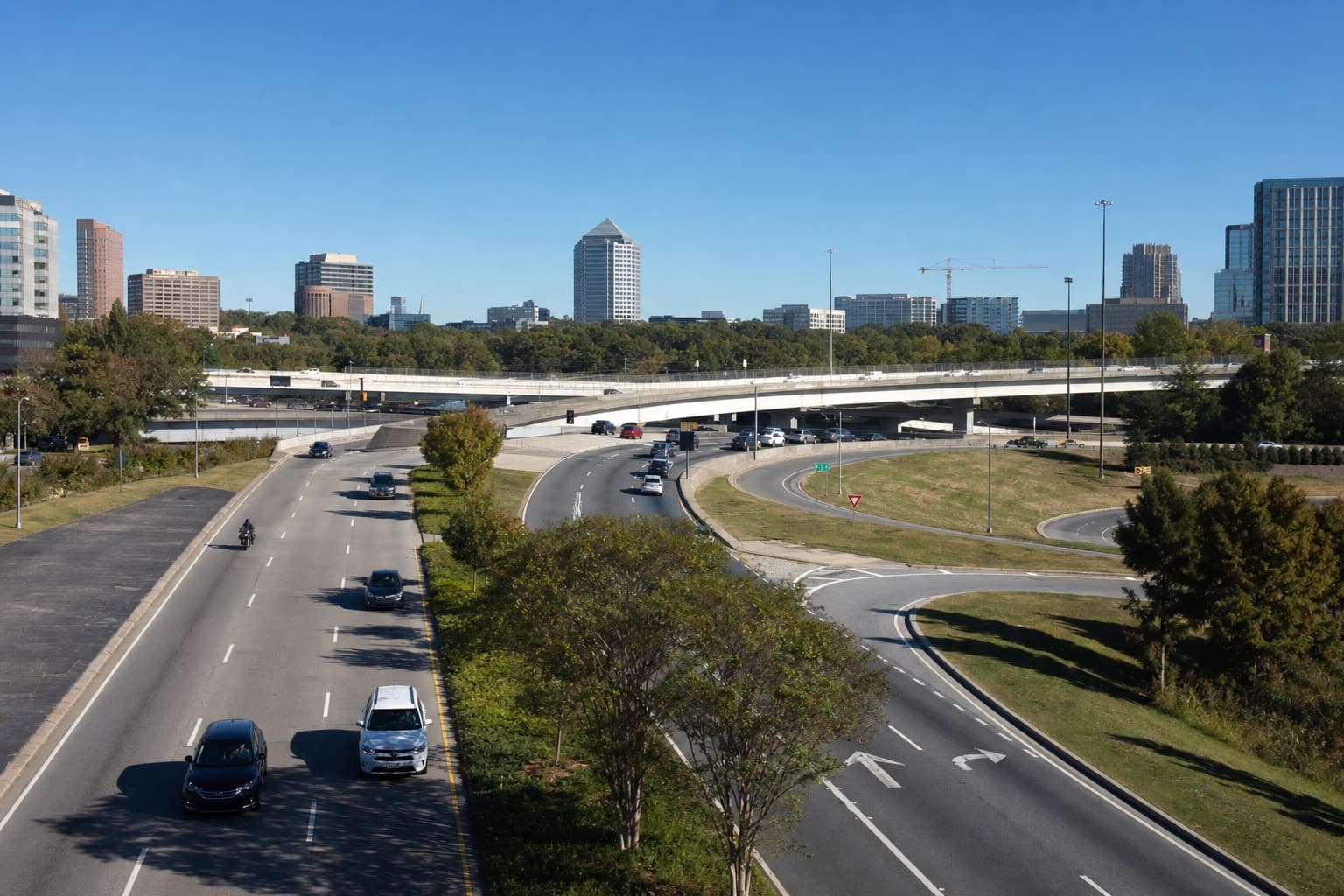
If you were hurt in a crash along the Cobb Parkway (US 41) corridor near the I-285 interchange, a Cumberland Cobb Parkway motorcycle accident lawyer can help you sort out fault, deadlines, and the insurance tactics that single out riders. This stretch of Cobb County — wrapping Cumberland Mall, Cobb Galleria Centre, and Truist Park — packs high-speed interstate merges next to constant retail turning traffic, and that mix is exactly where motorcyclists get hit. Below is a plain-English breakdown of how Georgia law treats these crashes and what you should do next.
Last reviewed: 2026-06-11
Why the Cobb Parkway and I-285 Interchange Is So Dangerous for Riders
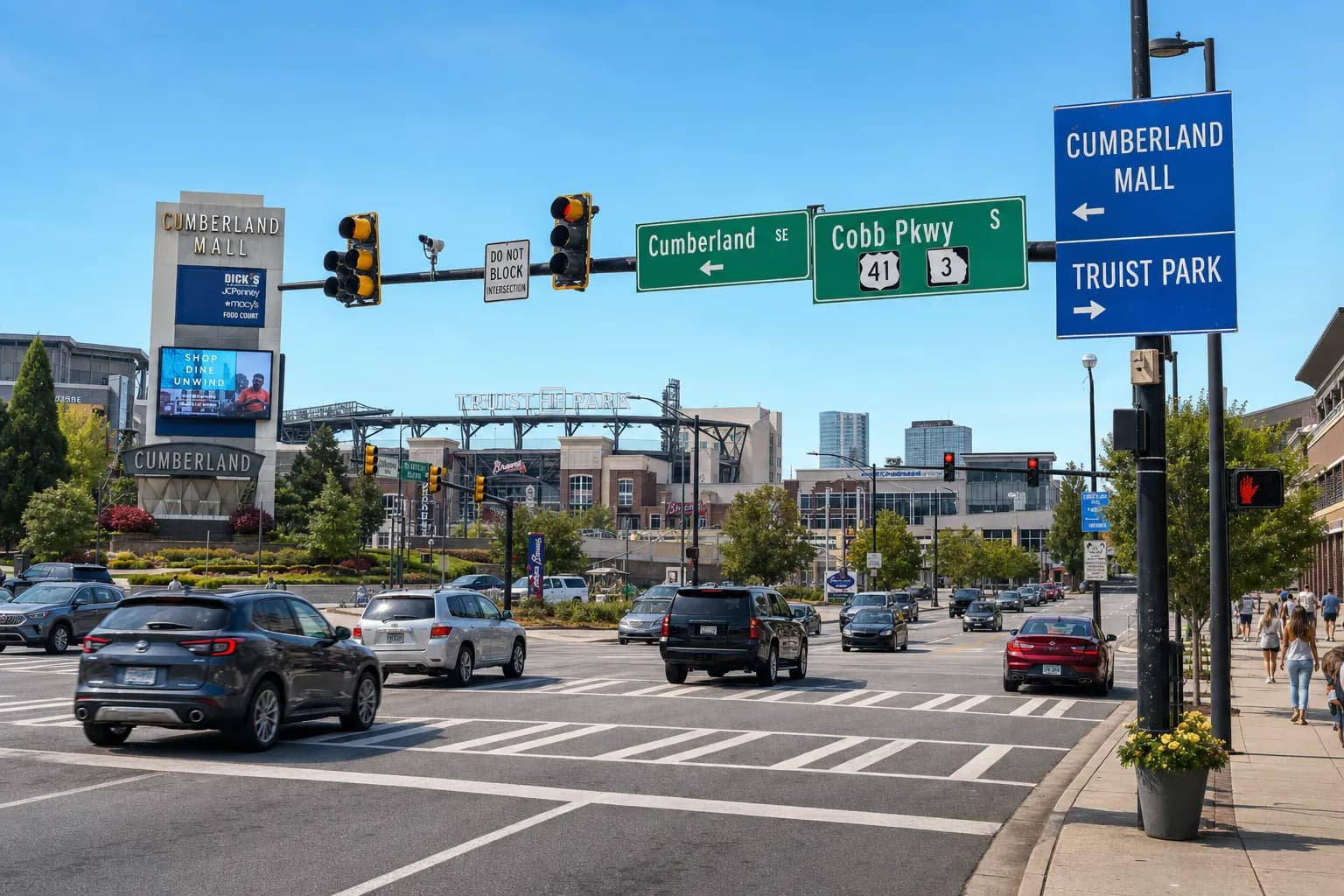
The Cobb Parkway/I-285 junction is one of metro Atlanta's busiest and most complex multi-lane interchanges, and it forces two very different kinds of traffic together. Cobb Parkway South (signed US 41 and GA 3) is a five-lane primary arterial posted at 45 mph, feeding directly onto and off of I-285 — "The Perimeter" — where traffic runs at 65 mph across four lanes. Riders moving between those speeds, in heavy weave zones, have almost no margin for a driver who does not see them.
Layer the destinations on top of that. Cumberland Mall sits roughly 0.18 miles from the corridor center and Cobb Galleria Centre about 0.43 miles out, generating near-constant turning and parking-lot-exit traffic across Cobb Parkway and Cumberland Boulevard. Truist Park and The Battery Atlanta, about 0.8 miles away, flood the area with stop-and-go traffic on dozens of game and concert nights a year. Wide arterials like Akers Mill Road SE, Cumberland Parkway SE, and Circle 75 Parkway SE add even more left-turn movements into the mix.
According to the National Highway Traffic Safety Administration (NHTSA), motorcyclists are roughly 22 times more likely to die in a crash than people in passenger vehicles, per mile traveled. On a corridor engineered for cars and trucks first, that risk concentrates wherever a driver has to judge an oncoming bike's speed — and gets it wrong.
Left-Turn Crashes: The Deadliest Conflict on Cobb Parkway
The most common — and most catastrophic — motorcycle crash on this corridor is the left-turn collision: a driver turning left across the path of a rider going straight. It happens at the Cobb Parkway intersections with Akers Mill Road and Cumberland Boulevard, at mall and Galleria entrances, and at the surface streets feeding the interstate ramps.
According to NHTSA crash data, in two-vehicle fatal motorcycle crashes where one vehicle is turning, about 42% involve the other vehicle turning left while the motorcycle goes straight. The driver almost always says the same thing: "I never saw the motorcycle." Georgia law puts the duty to yield on the turning driver, but proving it still takes corridor evidence — intersection geometry, signal phasing, and the rider's lane position.
If a turning driver hit you, our page on left-turn motorcycle accidents walks through how fault is established and why these cases hinge on physical evidence at the scene. For crashes inside the mall and Galleria intersections specifically, see our overview of intersection motorcycle accidents.
Lane-Change and Merge Conflicts at the I-285 Interchange
The second major hazard here is the lane-change or merge collision. At the Cobb Parkway/I-285 interchange, traffic weaves across multiple lanes to reach exits, on-ramps, and turn lanes within a short distance. A driver checking a mirror but not a blind spot can drift directly into a rider who is legally and visibly in the lane.
These are classic blind-spot cases, and they show up two ways on this corridor: surface-street lane-change collisions on Cobb Parkway itself, and highway merging accidents where arterials feed onto I-285 and speed differentials spike. Stop-and-go game-day congestion around Truist Park adds rear-end strikes to the picture, as drivers staring at brake lights fail to register a slowing or stopped motorcycle ahead.
Common Conflict Points on the Corridor
| Location / movement | Typical cause | Usually at fault |
|---|---|---|
| Cobb Parkway at Akers Mill Rd / Cumberland Blvd | Driver turns left across oncoming rider | Turning driver |
| Mall and Cobb Galleria entrances | Vehicle exiting retail lot misjudges bike speed | Entering/exiting driver |
| I-285 on/off ramps and weave zones | Lane change without checking blind spot | Merging driver |
| Truist Park / The Battery event traffic | Rear-end in stop-and-go congestion | Following driver |
| High-speed arterial-to-interstate transitions | Speed differential, sudden braking | Varies — needs reconstruction |
Have Questions About Your Case?
Get a free consultation with an experienced Georgia accident attorney.
How Georgia Law Decides Fault After a Cumberland Crash
Georgia uses modified comparative negligence under O.C.G.A. § 51-12-33 (<a href="https://law.justia.com/codes/georgia/title-51/chapter-12/article-2/section-51-12-33/" rel="noopener noreferrer">read the statute</a>). A rider can recover damages only if found less than 50% at fault, and any award is reduced by the rider's percentage of fault. If you are assigned 20% of the blame on a $100,000 case, you collect $80,000 — and if an insurer can push you to 50% or more, you collect nothing.
That math is exactly why insurers work so hard to pin fault on riders. They lean on stereotypes about speed and "lane splitting," even when the physical evidence tells a different story. As Mark Wade, Managing Partner of Georgia Auto Law, puts it, insurance companies apply a well-documented bias against motorcycle riders, and the firm counters that bias with hard evidence — accident reconstruction, biomechanical analysis, and a careful read of the scene rather than the adjuster's assumptions.
Because the corridor is dense with cameras and signal infrastructure, the proof you need often exists — for a while. Georgia DOT signal and timing data, business surveillance footage from the mall and Galleria, and skid or gouge marks on the pavement can confirm who had the right of way. Much of it is overwritten or paved over within weeks, so getting a Georgia motorcycle accident lawyer involved early can be the difference between a documented case and one driver's word against another's.
The Helmet Law and How Insurers Use It Against You
Georgia is a universal-helmet state. O.C.G.A. § 40-6-315 (<a href="https://law.justia.com/codes/georgia/title-40/chapter-6/article-13/part-2/section-40-6-315/" rel="noopener noreferrer">see the statute</a>) requires every motorcyclist and passenger to wear a DOT-compliant helmet. Wearing one is the law — and it protects you twice, because defense insurers routinely raise helmet use to argue your injuries should have been less severe.
That argument cuts against the safety data. According to NHTSA, helmets are about 37% effective at preventing rider fatalities and roughly 67% effective at preventing brain injuries. Even so, head trauma is common in motorcycle crashes despite a helmet, which is why we handle concussion and head injuries alongside the broken bones and fractures that define so many of these cases. If a crash on this corridor turns fatal, our work on fatal motorcycle accidents explains how Georgia's wrongful-death claims work for surviving families.
What to Do After a Crash on Cobb Parkway
The first hours matter. After a crash near the interchange:
- Get medical care. WellStar Windy Hill Hospital is about 1.5 miles north, and WellStar Kennestone Regional Medical Center — the regional trauma center — is roughly 8 miles north in Marietta. A medical record made the same day links your injuries to the crash.
- Call law enforcement and make sure a report is created. On this corridor, jurisdiction can involve Cobb County and local agencies, so an official report anchors the facts.
- Document the scene — photos of lane position, turn lanes, signals, and vehicle damage — and note nearby businesses whose cameras may have caught it.
- Do not give a recorded statement to the other driver's insurer before you talk to a lawyer.
- Preserve evidence early, before signal data and store footage cycle out.
The damages a rider can pursue — medical bills, lost income, future care, and pain and suffering — are the subject of our broader Georgia personal injury lawyer practice. Riders across nearby Smyrna and Vinings face the same Cobb County corridor risks.
Where Cobb County Motorcycle Cases Are Filed
A crash in the Cumberland/Vinings area falls under Cobb County jurisdiction. Personal-injury suits are filed in the State Court of Cobb County or the Superior Court of Cobb County, both in Marietta. Most cases settle with the at-fault driver's insurer before a lawsuit is necessary, but filing — or being ready to file — is what keeps an insurer honest. Georgia Auto Law works on a contingency fee: the consultation is free, and there is no fee unless we win.
Frequently Asked Questions
How long do I have to file a motorcycle accident claim after a Cobb Parkway crash?
Georgia's personal-injury statute of limitations is two years from the date of the crash under O.C.G.A. § 9-3-33 (<a href="https://law.justia.com/codes/georgia/title-9/chapter-3/article-2/section-9-3-33/" rel="noopener noreferrer">read it here</a>). A wrongful-death claim from a fatal motorcycle crash generally runs two years as well. Miss the deadline and you usually lose the right to sue, so do not wait.
A driver turned left in front of me near Cumberland Mall — who is at fault?
Georgia law puts the duty to yield on the driver turning left across oncoming traffic. According to NHTSA data, left-turning vehicles account for about 42% of fatal two-vehicle motorcycle crashes involving a turn. Even so, you still have to prove it with scene evidence, because the driver will often claim they never saw you.
Can I still recover if the insurer says I was partly to blame?
Yes, as long as you are found less than 50% at fault under O.C.G.A. § 51-12-33. Your award is reduced by your share of fault, so a 20% finding cuts a recovery by 20%. Because insurers push hard to inflate a rider's percentage, evidence and reconstruction matter enormously.
Does Georgia's helmet law affect my case?
Georgia requires a DOT-compliant helmet for all riders under O.C.G.A. § 40-6-315. Wearing one keeps you legal and, per NHTSA, is roughly 67% effective at preventing brain injuries. Defense insurers still raise helmet use to argue your injuries should have been less severe, which is one more reason to document your injuries fully.
What evidence should I preserve after an interchange crash?
Photograph your lane position, the turn lanes, signals, and all vehicle damage. Note any nearby businesses — the mall, the Galleria, restaurants — whose cameras may have recorded the crash. Georgia DOT signal data and private surveillance footage are often overwritten within weeks, so act quickly to preserve them.
Which hospital will I be taken to after a crash on this corridor?
WellStar Windy Hill Hospital sits about 1.5 miles north of the Cumberland corridor. For severe trauma, patients are often routed to WellStar Kennestone Regional Medical Center, the regional trauma center roughly 8 miles north in Marietta.
Where will my Cobb County motorcycle case be filed?
Crashes in the Cumberland/Vinings area are handled in Cobb County. Lawsuits are filed in the State Court of Cobb County or the Superior Court of Cobb County in Marietta, though most claims settle with the at-fault insurer before a suit is filed.
How much does it cost to hire a Cumberland Cobb Parkway motorcycle accident lawyer?
Georgia Auto Law handles motorcycle cases on a contingency fee. The initial consultation is free, and you pay no attorney fee unless we recover money for you.