Key Takeaways
- Georgia pedestrian injury claims must be filed within two years of the crash under O.C.G.A. § 9-3-33; wrongful death carries the same two-year clock.
- Every driver owes an independent duty of due care to any pedestrian on the roadway under O.C.G.A. § 40-6-93 — marked crosswalk or not.
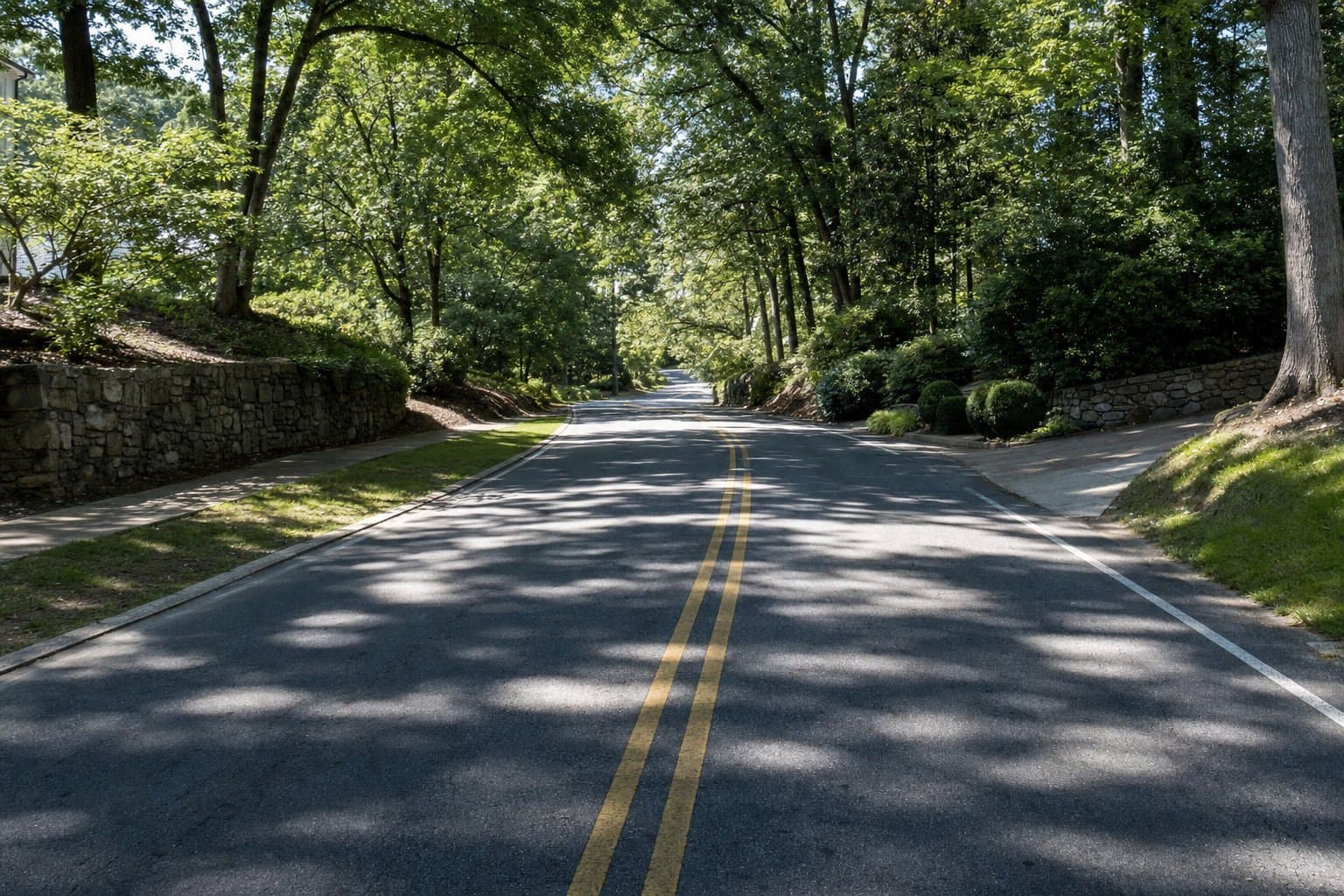
- Mount Paran Road NW is a two-lane secondary road posted at 35 mph, with three school campuses inside 0.9 miles feeding foot traffic onto it.
- Recovery is reduced by your share of fault and barred entirely at 50% under O.C.G.A. § 51-12-33 — the crosswalk argument is the fight.
- A claim against the City of Sandy Springs or Atlanta requires ante litem notice within six months under O.C.G.A. § 36-33-5.
- Residential doorbell and security video is the corridor's only real camera network, and most systems overwrite within days.
If you were struck while walking near Holy Spirit Preparatory School or anywhere along the Mount Paran Road Northwest corridor, a Sandy Springs Mount Paran Road pedestrian accident lawyer can pursue the at-fault driver's liability policy, your own uninsured motorist coverage, or both — and Georgia gives you two years from the date of injury to sue under O.C.G.A. § 9-3-33. The driver's insurer will argue you crossed where you shouldn't have. Georgia law puts an independent duty on the driver regardless.
Last reviewed: 2026-07-31
Why the Mount Paran Road Corridor Produces School-Hour Pedestrian Strikes
The risk here comes from a road built to residential scale carrying through-traffic past three schools. Mount Paran Road Northwest is a secondary route — two lanes, posted 35 mph — and the only road in this pocket of ZIP 30327 classified above residential, so everything moving through the neighborhood funnels onto it. Holy Spirit Preparatory School sits 0.21 miles from the Highcourt Road Northwest area, Warren T. Jackson Elementary School 0.69 miles out, and the Sutton Middle School Sixth Grade Campus 0.86 miles east. Three campuses compress child and parent foot traffic into two narrow weekday windows on a road with sparse marked crossings.
The surrounding streets make it worse. Highcourt Road Northwest and its neighbors are short, low-volume residential streets — the kind where a driver reversing out of a driveway meets a walker already in the travel lane, and where a driver unfamiliar with the grid makes an unplanned U-turn to reach a campus entrance. The identical pull-out geometry produces the failure-to-yield crashes a Sandy Springs motorcycle accident lawyer sees here.
According to NHTSA — the National Highway Traffic Safety Administration — 7,522 pedestrians were killed on U.S. roads in 2022, the highest annual total since 1981, and its Fatality Analysis Reporting System shows most of those deaths happening away from intersections. According to GOHS, Georgia's Governor's Office of Highway Safety, Georgia recorded 333 pedestrian fatalities in 2022, with Fulton County consistently among the state's highest-count counties.
The 35 MPH Line Between Injury and Death
Impact speed decides whether a struck pedestrian walks out of the hospital. According to IIHS crash research from the Insurance Institute for Highway Safety, the relationship between vehicle speed and pedestrian outcome is not linear — survival collapses across a narrow band that Mount Paran Road's posted limit sits directly on top of.
| Vehicle impact speed | Approximate risk of severe injury | Approximate risk of fatal injury |
|---|---|---|
| 20 mph | About 10% | About 1% |
| 30 mph | About 40% | About 10% |
| 40 mph | About 75% | About 50% |
According to CDC injury surveillance from the Centers for Disease Control and Prevention, pedestrians are roughly 1.5 times more likely than passenger-vehicle occupants to be killed in a traffic crash on a per-trip basis. A driver doing 45 in this 35 zone has moved a child from the survivable column into the fatal one — which is why fatal pedestrian accident claims brought by surviving family so often trace back to ten miles per hour.
What Georgia Law Demands of Drivers Around People on Foot
Georgia imposes duties on drivers that exist independently of where the pedestrian was standing. O.C.G.A. § 40-6-93 requires every driver to exercise due care to avoid colliding with any pedestrian on the roadway, to sound the horn when necessary, and to use proper precaution around children and obviously confused or incapacitated people. That last clause matters enormously in a school corridor. O.C.G.A. § 40-6-91 adds the crosswalk rule: a driver must stop and remain stopped for a pedestrian in a crosswalk on the driver's half of the roadway.
Two more duties attach during school hours. O.C.G.A. § 40-6-188 sets reduced speed limits inside posted school zones during arrival and dismissal, and O.C.G.A. § 40-6-163 requires drivers to stop for a school bus with its stop arm extended. A citation under either statute is admissible evidence of negligence and tends to end the fault argument before it starts.
The time and date of the strike are therefore load-bearing facts — they decide which statutes were in force at impact, so pin them from the crash report first. The statewide Georgia pedestrian accident claims practice area covers these duties outside school hours.
The Crosswalk Argument and Georgia's 50 Percent Fault Bar
Expect the insurer to open with O.C.G.A. § 40-6-92, which requires pedestrians crossing outside a marked or unmarked crosswalk to yield to vehicles. On a corridor with few painted crossings, nearly every pedestrian is technically outside one. The adjuster's goal is Georgia's modified comparative negligence rule under O.C.G.A. § 51-12-33: your damages drop by your percentage of fault and vanish entirely at 50%.
That argument is beatable, and the corridor supplies the counterweights. Where was the nearest marked crossing? Did a queued drop-off line block the sight line of the driver in the adjacent lane? Was the driver over 35, over a school-zone limit, or looking at a phone? Did a sidewalk simply end, forcing you into the roadway? A pedestrian's technical violation does not excuse a driver who failed to keep a proper lookout, and § 40-6-93 says so directly. The work is documentary — block-face photographs, measured sight lines, vehicle positions, speed evidence — collected while the scene still looks like it did.
Have Questions About Your Case?
Get a free consultation with an experienced Georgia accident attorney.
Evidence That Disappears in the First Week
Start with video, because it has the shortest shelf life. This corridor has no commercial frontage — no storefront cameras, no transit platforms, no parking decks. What exists is residential: doorbell cameras and home security systems along Mount Paran Road NW and the side streets, most of which overwrite on a rolling three-to-seven-day loop. A canvass in the first 48 hours is the highest-value investigative act available.
The medical record needs the same urgency. No hospital sits inside this neighborhood, so every seriously injured pedestrian leaves it by ambulance — most often to Grady Memorial Hospital, a Level I trauma center, roughly nine miles south, or to Northside Hospital Atlanta about four miles northeast. Mark Wade, Founder and Lead Attorney at Georgia Auto Law, tells clients the EMS run report and transport destination are worth more than most people realize: they timestamp the injury, document the mechanism, and pre-empt the "gap in treatment" argument an adjuster raises months later. Head injuries drive the largest verdicts on roads like this, which is why traumatic brain injury claims after a vehicle strike get worked up differently from broken bone and fracture injury claims.
Then get the crash report from the right agency. ZIP 30327 along Mount Paran Road NW straddles the Sandy Springs and City of Atlanta line, so the responding department determines where the report lives. Our Sandy Springs pedestrian accident lawyer team confirms the agency first, then pulls the report, the 911 audio, and any citation file.
Where a Mount Paran Road Pedestrian Claim Is Filed
Injury suits arising on this corridor are filed in Fulton County, most often in the State Court of Fulton County, which draws a county-wide jury pool rather than one from northwest Fulton. Wrongful death and higher-exposure claims go to the Superior Court of Fulton County. An out-of-state driver, motor carrier, or rideshare defendant can move the case to the U.S. District Court for the Northern District of Georgia, Atlanta Division.
The traffic citation travels a separate path — the Municipal Court of the City of Sandy Springs, or the Municipal Court of the City of Atlanta if the crash fell on the Atlanta side of the 30327 seam. That proceeding does not pay your medical bills; its value is evidentiary. One deadline overrides everything above: if a city entity is a defendant, ante litem notice must be served within six months under O.C.G.A. § 36-33-5, and settlement talks do not extend it. See the full footprint of the firm's Sandy Springs service area.
When the Driver's Policy Falls Short or the Driver Leaves
Your own auto policy is frequently the larger source of recovery. Georgia's minimum liability limit is $25,000 per person — an amount a single pedestrian hospitalization exhausts before the first surgery is billed. That makes uninsured motorist accident claims in Georgia and underinsured motorist claims when the at-fault policy runs out central rather than secondary. Whether your UM was written as add-on coverage, which stacks on top of the at-fault limits, or reduced-by, which offsets them, can be worth more than the liability policy itself. Georgia UM coverage follows you as a pedestrian — you do not have to be inside a car.
If the driver never stopped, O.C.G.A. § 40-6-270 makes leaving the scene a crime, and O.C.G.A. § 33-7-11(b)(2) lets you proceed against an unknown "John Doe" driver through your own UM coverage. That route depends on corroboration — physical evidence, paint transfer, debris, and the video canvass above. A Sandy Springs hit-and-run lawyer starts both tracks at once; see also how Georgia hit-and-run injury claims are investigated and our breakdown of mid-block pedestrian strikes on Roswell Road.
Frequently Asked Questions
How long do I have to file a claim after a Mount Paran Road crash?
Two years from the date of injury under O.C.G.A. § 9-3-33, and two years for wrongful death. If a city entity is a defendant, ante litem notice under O.C.G.A. § 36-33-5 is due within six months — a much shorter clock.
Can I still recover if I was crossing outside a crosswalk?
Yes, in most cases. O.C.G.A. § 40-6-92 gives the insurer a comparative-fault argument, but under O.C.G.A. § 51-12-33 your claim survives as long as your share of fault stays below 50%. The driver's independent duty of due care under O.C.G.A. § 40-6-93 applies whether or not you were in a crosswalk.
Which police department responds to a crash on Mount Paran Road NW?
It depends on which side of the municipal line the crash occurred on — ZIP 30327 straddles the Sandy Springs and City of Atlanta boundary. The responding agency determines where the report lives and which city receives an ante litem notice.
Does a school zone change the driver's liability?
Substantially. O.C.G.A. § 40-6-188 sets reduced speed limits in posted school zones during arrival and dismissal hours, and O.C.G.A. § 40-6-163 requires drivers to stop for a school bus with its stop arm extended. A citation under either statute is admissible in the civil case and usually collapses the driver's fault argument.
What if the driver had only minimum insurance or never stopped?
Your own uninsured and underinsured motorist coverage becomes the primary source of recovery under O.C.G.A. § 33-7-11, and it applies to you as a pedestrian. When the driver is never identified, § 33-7-11(b)(2) permits a John Doe claim, supported by physical evidence and neighborhood video rather than an eyewitness identification.
What does it cost to hire a lawyer for a case like this?
Nothing up front. Georgia Auto Law handles pedestrian claims on a contingency fee — the consultation is free, and no attorney's fees are owed unless we recover for you.
Talk to a Sandy Springs Mount Paran Road Pedestrian Accident Lawyer
Call (404) 662-4949 for a free consultation. If you or your child was struck on Mount Paran Road Northwest, Highcourt Road Northwest, or near any of the three school campuses here, the video, the citation file, and the crash report are the case — and the video has a shelf life measured in days. A Sandy Springs Mount Paran Road pedestrian accident lawyer at Georgia Auto Law will confirm the responding agency, canvass for footage, and open the UM claim while the evidence still exists. No fees unless we win.