Key Takeaways
- Georgia pedestrian injury and wrongful-death claims must be filed within two years of the crash under O.C.G.A. § 9-3-33.
- Georgia applies modified comparative negligence under O.C.G.A. § 51-12-33 — recovery is reduced by your share of fault and barred entirely at 50% or more.
- Roswell Road's 35 mph posted limit sits exactly on the IIHS pedestrian-survival threshold; at impact speeds above 30 mph the fatality risk rises sharply.
- Defense adjusters argue mid-block crossings outside a marked crosswalk under O.C.G.A. § 40-6-92 — block-face photographs, sight-line measurements, parked-car positions, and doorbell-camera footage are what move that percentage down, and the work has to happen within days.
- Drivers owe a heightened duty of due care to any pedestrian on the roadway under O.C.G.A. § 40-6-93, even outside marked crosswalks.
- Sandy Springs Municipal Court is traffic-only; Roswell Road pedestrian injury suits are filed in Fulton County State Court at 185 Central Ave SW, Atlanta, or Fulton County Superior Court.
- Trauma routing matters: Northside Hospital (Level III, 2.7 mi north), Children's at Scottish Rite (pediatric Level I, 2.5 mi), and Grady downtown (adult Level I, ~11 mi south) are the three centers a serious Roswell Road pedestrian case usually touches.
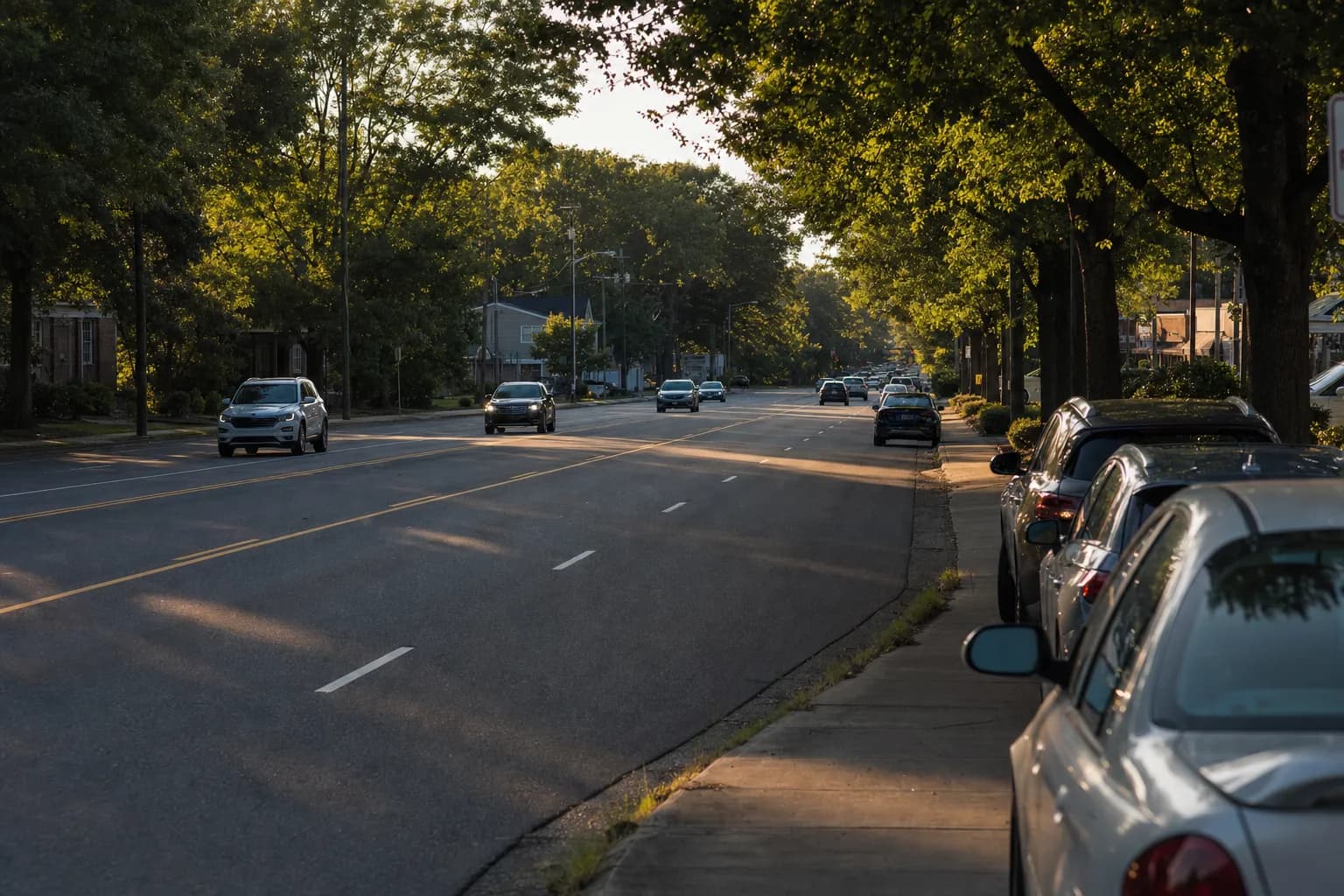
This guide is for anyone who needs a Sandy Springs Roswell Road pedestrian accident lawyer after being struck on the four-lane stretch of US 19 / GA 9 between Mystic Drive Northeast and Wieuca Road. Roswell Road's posted 35 mph limit, unsignalized mid-block crossings, sidewalk gaps, and school and park-access crossings create the precise conditions that drive most U.S. pedestrian fatalities — and the precise defense arguments your case has to beat.
Why Roswell Road Produces So Many Pedestrian Strikes
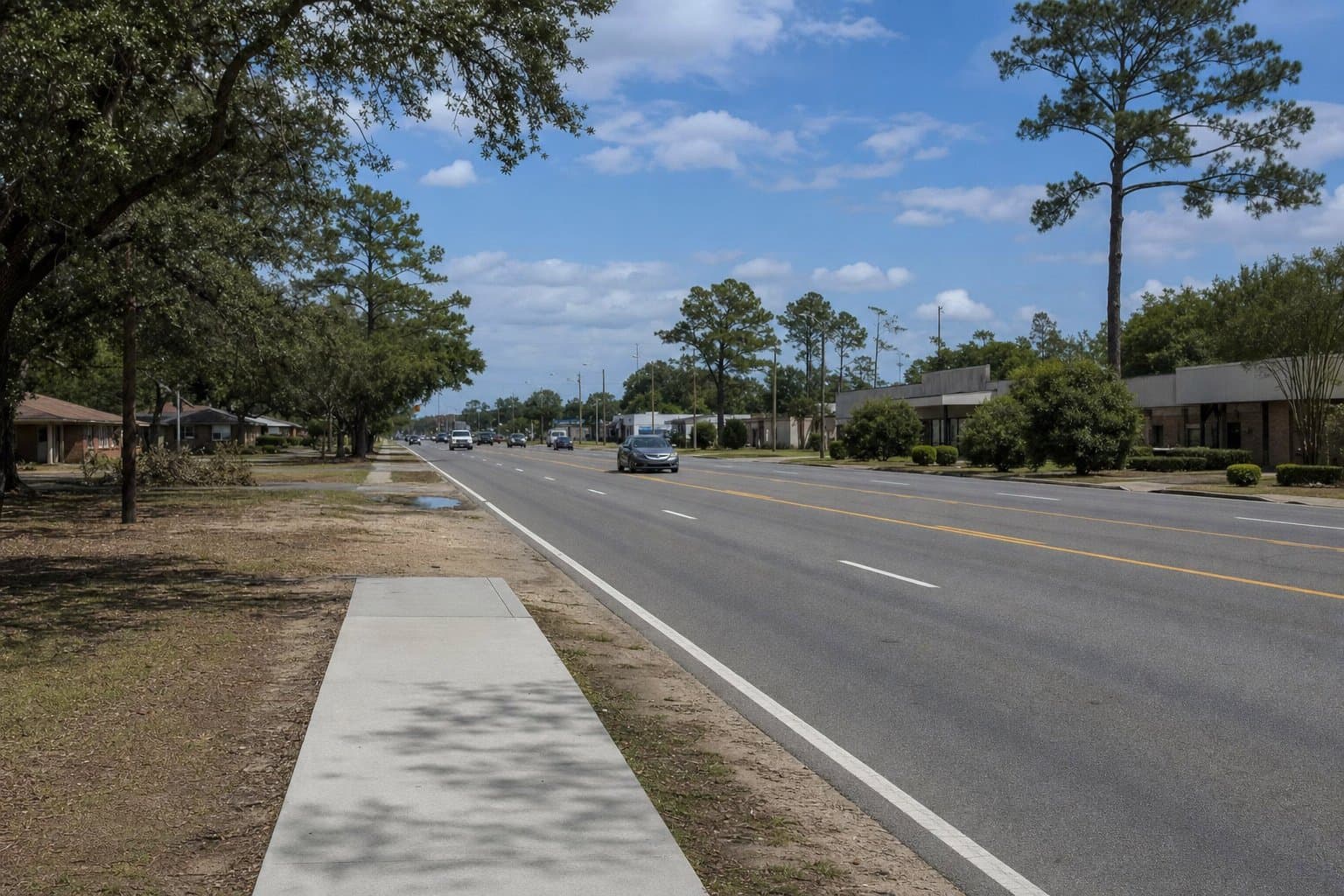
Roswell Road from Mystic Drive Northeast to Wieuca Road was not designed for the foot traffic it now carries. It is a four-lane primary arterial — carrying the US 19 and GA 9 designations — posted at 35 mph, with on-street parking, mid-block driveways, sidewalk gaps on entire block faces, and unsignalized crossings between residential streets and small-retail frontage. Drivers cutting between Buckhead and Sandy Springs treat the open lanes as a place to make up time. That is where people walking get hit.
The land use compounds the design problem. Liberty Guinn School (about 0.6 miles from the cluster center) creates a morning pedestrian surge around 7:30 a.m. and a dismissal surge around 3:00 p.m. Sutton Middle School Sixth Grade Campus (about 1 mile west) adds a second school-zone peak across Powers Ferry Road. Roswell-Wieuca Park, Chastain Memorial Park, the Northside Youth Organization fields, and Blue Heron Nature Preserve — all within a mile — pull families and walkers toward Roswell Road on weekday afternoons and weekends. Fountain Oaks Shopping Center on the corridor itself adds turning traffic across the lanes, and the Pill Hill medical complex two-and-a-half to three miles north generates a constant flow of patient-transport, rideshare, and shift-change traffic that arrives at Roswell Road's crossings at speed.
According to the National Highway Traffic Safety Administration, 7,522 pedestrians were killed on U.S. roads in 2022 — the highest annual total since 1981. According to the Governors Highway Safety Association's Spotlight on Pedestrian Safety, the majority of those fatalities now occur on arterial roads, at night, and away from intersections — the conditions Roswell Road produces between Mystic Drive and Wieuca. According to the Centers for Disease Control and Prevention, pedestrians are roughly 1.5 times more likely than vehicle occupants to be killed in a traffic crash on a per-trip basis, and adults 65 and older account for a disproportionate share of pedestrian deaths — relevant in a corridor that sits two-and-a-half miles south of three hospitals.
A Sandy Springs Roswell Road pedestrian accident lawyer who works this corridor knows the fight is rarely whether you were in the roadway. The fight is why, and what a reasonable driver should have done before contact.
The 35 mph Threshold: Why Speed Decides Survival
According to the Insurance Institute for Highway Safety, pedestrian survival rates fall sharply as vehicle impact speeds rise above 30 mph. The IIHS analysis of pedestrian crash outcomes shows the risk of severe injury for a struck adult roughly doubles between 23 mph and 32 mph, and the risk of death roughly doubles between 32 mph and 42 mph. Roswell Road's posted 35 mph limit sits squarely on that curve. A driver running five mph over the limit is no longer in the "likely to survive" band of the IIHS data — and Sandy Springs Police regularly cite Roswell Road drivers for going significantly more than five mph over.
| Vehicle Impact Speed | Approximate Risk of Severe Pedestrian Injury | Approximate Risk of Pedestrian Fatality |
|---|---|---|
| 16 mph (25 km/h) | About 10% | Under 5% |
| 23 mph (37 km/h) | About 25% | About 10% |
| 32 mph (50 km/h) | About 50% | About 25% |
| 40 mph (64 km/h) | About 75% | About 50% |
| 50 mph (80 km/h) | About 90% | Over 75% |
(Figures rounded from IIHS pedestrian impact-speed research and AAA Foundation for Traffic Safety analyses.)
The practical effect on a Roswell Road case is that the difference between 35 mph and 42 mph is not a technicality — it is the difference between a survivable injury and a wrongful-death claim. Mark Wade, lead attorney at Georgia Auto Law, points out that the precise impact speed is rarely captured in the responding officer's report. It has to be reconstructed from the crush profile, the throw distance, the stopping marks, and any event-data-recorder download from the striking vehicle, and that work begins within days of the crash, before tow lots dispose of the vehicle.
Mid-Block Crossings and Comparative Fault
Defense adjusters on Roswell Road cases reliably argue one thing: that the pedestrian crossed outside a marked crosswalk in violation of O.C.G.A. § 40-6-92, which requires pedestrians crossing at any point other than within a marked crosswalk or unmarked crosswalk at an intersection to yield to vehicles. That argument triggers Georgia's modified-comparative-negligence rule under O.C.G.A. § 51-12-33 — your recovery is reduced by your share of fault and is wiped out entirely at 50% or more.
What the defense does not lead with is O.C.G.A. § 40-6-93, which imposes on every driver the duty to exercise due care to avoid colliding with any pedestrian on the roadway, and the duty to give warning by sounding the horn when necessary. Section 40-6-93 applies even when the pedestrian is outside a marked crosswalk. Combined with O.C.G.A. § 40-6-91's right-of-way protections inside crosswalks, the statutory framework gives a well-documented pedestrian case real leverage.
The cases that win on this corridor turn on physical evidence collected fast.
| Defense Argument | What Defeats It | When It Must Be Collected |
|---|---|---|
| "Pedestrian crossed mid-block outside any crosswalk" (§ 40-6-92) | Block-face photographs showing sidewalk gaps that forced the pedestrian into the roadway; the distance to the nearest marked crosswalk | Within 7 days |
| "Driver could not have seen the pedestrian in time" | Sight-line measurements from the driver's eye height; positions of parked cars; tree-canopy and signage obstruction photos | Within 48-72 hours |
| "Pedestrian darted into the road" | Doorbell-camera footage from adjacent residences (Ring, Nest, Arlo); convenience-store CCTV; rideshare dashcam if a TNC vehicle was nearby | Within 7-14 days |
| "Driver was at the posted 35 mph limit" | Event-data-recorder download; crush profile; throw distance; skid mark measurements; nearby signal-timing data | Within 30 days |
| "Pedestrian was not visible in the dark" | Streetlight functionality records (Georgia Power outage logs); driver's headlight inspection | Within 14 days |
Mark Wade, lead attorney at Georgia Auto Law, has worked these claims on Roswell Road and emphasizes that the comparative-fault number assigned by an adjuster on day three is almost never the number a jury would have heard at trial — provided the evidence was preserved. Block-face photographs taken within 48 hours of the strike, sight-line measurements from the driver's actual eye height in the actual vehicle, parked-car positions documented before someone moves them, and doorbell-camera footage pulled before consumer systems overwrite are what take a "30% to 40% pedestrian fault" opening offer down to single digits — or, in the strongest school-zone cases, zero. Once the road is restriped, a parked car moves, or a Ring system rolls past its 14-day retention window, the evidence that controls your comparative-fault percentage is gone.
A Sandy Springs Roswell Road pedestrian accident lawyer who treats this work as routine — investigator dispatched the same day, drone documentation of the block face, signed witness declarations while memories are fresh — is what separates a recovered claim from a barred one.
Have Questions About Your Case?
Get a free consultation with an experienced Georgia accident attorney.
School-Zone and Park-Access Crossings
Pedestrian crashes inside posted school zones benefit from separate statutory protections. O.C.G.A. § 40-6-188 sets reduced school-zone speed limits during hours children are present, and O.C.G.A. § 40-14-8 authorizes school-zone speed-enforcement cameras whose citations are admissible against the driver in the civil case. The morning peak around 7:30 a.m. at Liberty Guinn and the afternoon dismissal peak around 3:00 p.m. produce nearly all of the school-zone strikes on this corridor. A school-zone speeding citation against the driver is the strongest single piece of liability evidence a pedestrian case can have — it cuts straight through any § 40-6-92 comparative-fault argument and usually pushes settlements faster and higher.
Park-access crossings are the other recurring fact pattern. Roswell-Wieuca Park, Chastain Memorial Park, Blue Heron Nature Preserve, and the Northside Youth Organization fields all feed pedestrian and cyclist traffic onto Roswell Road, and most of those crossings are unmarked. Chastain Park's amphitheater alone runs more than 40 shows during peak concert season, May through October, with a post-show surge in conditions defense adjusters love — low light, alcohol present in the corridor, drivers in unfamiliar territory. Pedestrians at these unmarked crossings still receive § 40-6-91 and § 40-6-93 protections; the work is documenting that pedestrians routinely cross at this point and that the driver should have anticipated it. Serious cases coordinate with our pedestrian accident attorneys on the broader practice-area pillar before adjusters lock in a story.
Trauma Routing, Fulton County Court, and the City Line
A pedestrian struck on Roswell Road between Mystic Drive Northeast and Wieuca Road is closer to the Pill Hill trauma complex than to almost any other Level I or Level III center in metro Atlanta. Northside Hospital sits 2.7 miles north as a Level III trauma center. Children's Healthcare of Atlanta at Scottish Rite is 2.5 miles north as a pediatric Level I — the right destination for any child struck at Liberty Guinn or Sutton. For catastrophic adult trauma, Grady Memorial Hospital downtown, about 11 miles south, is the regional adult Level I center. The routing decision is made by the EMS crew at the scene, and a Level I trauma activation generates a substantially richer medical record than a community-ED transport — and that record drives the damages portion of the case.
All of Roswell Road north of the Buckhead boundary sits inside Sandy Springs and Fulton County. Sandy Springs incorporated in 2005, and its municipal court hears only traffic citations — never personal injury claims. Civil pedestrian injury suits are filed in Fulton County State Court at 185 Central Ave SW, Atlanta, or in Fulton County Superior Court for larger or equity matters. Where Roswell Road crosses south of the Sandy Springs city line into Buckhead, Atlanta Police Department Zone 2 takes the report; in Sandy Springs proper, Sandy Springs Police Department investigates. Anyone who tells you a Roswell Road pedestrian injury claim can resolve in Sandy Springs Municipal Court is testing you. Adjacent cases on the Buckhead side are handled by Buckhead injury lawyers, and the cluster sits inside the broader Atlanta personal injury law firm market — one firm with a foothold in both Sandy Springs and Buckhead can carry a case across the city line without the cross-jurisdictional confusion that complicates cases at the Cobb or DeKalb edge.
What to Do at the Scene
If you or a family member was just hit on Roswell Road:
- Call 911 immediately. Concussion symptoms and internal injuries often appear hours later, and the dispatch timestamp anchors your medical record.
- Accept transport to the nearest appropriate trauma center — Northside, Scottish Rite (children), or Grady (catastrophic). Refusing transport is the single biggest mistake pedestrian victims make.
- If you can, photograph the block face on both sides of the road for 100 feet in each direction before anything moves. The sidewalk-gap photos, parked-car positions, and lighting are the case.
- Get the Sandy Springs Police case number (or APD Zone 2 if the crash was south of the city line) before leaving the scene.
- If a family member or your Sandy Springs Roswell Road pedestrian accident lawyer can canvass nearby homes for Ring and Nest footage, do it within 24 to 48 hours — most consumer systems overwrite within 7 to 14 days.
- If the driver fled, the criminal duties under O.C.G.A. § 40-6-270 and O.C.G.A. § 40-6-271 apply, but they do not pay your medical bills — civil recovery for hit-and-run crash claims runs through your own UM coverage.
- Do not give a recorded statement to the at-fault driver's insurer before speaking with a lawyer.
- Seek follow-up medical care the same day or the next, and follow the discharge instructions. Treatment gaps are the second-favorite defense argument after comparative fault.
Pedestrians struck inside Sandy Springs work with Sandy Springs car accident attorneys who already know the SSPD reporting practices and the Pill Hill trauma routing. Cyclists exiting Roswell-Wieuca Park or Blue Heron Nature Preserve onto Roswell Road should know that Georgia bicycle accident lawyer representation works the lane-position question hard before adjusters lock it in.
Last reviewed: May 26, 2026
Frequently Asked Questions
I was hit mid-block on Roswell Road — am I automatically at fault?
No. Defense adjusters will argue partial fault under O.C.G.A. § 40-6-92 because you were not in a marked crosswalk, but that argument does not end the case. Georgia's 50% comparative-fault bar under O.C.G.A. § 51-12-33 means your recovery survives as long as your share stays below 50%. Drivers also owe a heightened duty of due care under O.C.G.A. § 40-6-93 to any pedestrian on the roadway, marked crosswalk or not. Whether a sidewalk gap forced you into the road, where the nearest crosswalk actually was, whether the driver was over 35 mph, and whether parked cars blocked sight lines are the facts that move the percentage down — and they have to be documented within days.
What if there's no sidewalk on my side of Roswell Road?
The sidewalk gap is usually the strongest piece of evidence in your case, not a problem. Photograph it immediately — both directions from the impact point, the missing curb or paved walkway, and the distance to the nearest continuous sidewalk. A driver still owes O.C.G.A. § 40-6-93's duty of due care to any pedestrian on the roadway regardless of whether a sidewalk exists. Those sidewalk-gap photos are what defeat the "you should have walked somewhere else" argument adjusters use to push comparative fault up.
How fast do I need to document the scene after a Roswell Road crash?
Within days, not weeks. Doorbell-camera footage from Ring, Nest, and Arlo systems typically overwrites within 7 to 14 days. Parked-car positions change daily and are usually the difference between a clean sight-line argument and a contested one. Skid marks fade within weeks. Vehicle event-data-recorder data is at risk as soon as the vehicle is repaired or salvaged. The first 48 hours are the most important window, and a Sandy Springs Roswell Road pedestrian accident lawyer who works this corridor will dispatch an investigator the same day you call.
My child was hit walking to Liberty Guinn School in the morning. Does the school zone change the case?
Yes, substantially. O.C.G.A. § 40-6-188 sets reduced speed limits in posted school zones during hours children are present, and O.C.G.A. § 40-14-8 authorizes admissible school-zone speed-camera enforcement. A school-zone speeding citation against the driver is admissible in the civil case as evidence of negligence and usually pushes comparative-fault exposure to zero or near zero. School-zone child-pedestrian cases also typically settle faster than mid-block adult strikes because of that statutory leverage.
What court hears Roswell Road pedestrian injury cases?
Civil claims are filed in Fulton County State Court at 185 Central Ave SW, Atlanta, or in Fulton County Superior Court for larger or equity matters. Sandy Springs Municipal Court hears only traffic citations against the at-fault driver — it does not hear personal injury claims at any value.
The driver who hit me drove off after the strike. What now?
Call 911 to anchor the timestamp, get the SSPD or APD Zone 2 case number depending on which side of the city line you were on, and canvass for Ring and Nest footage within 24 to 48 hours. The driver's criminal duties under O.C.G.A. § 40-6-270 and § 40-6-271 are a separate proceeding that does not pay your bills. Civil recovery runs through your own uninsured motorist coverage under O.C.G.A. § 33-7-11, which is available to pedestrians and resident relatives in Georgia — not only to people inside a car.
Who pays my hospital bills at Northside or Scottish Rite while my case is pending?
Bills are usually covered through your health insurance, which will assert a subrogation lien against any settlement; any med-pay coverage on your own auto policy; and — for extensive treatment — letters of protection from treating providers that defer payment until the case resolves. Georgia does not require PIP, so there is no automatic auto-policy medical benefit unless you bought med-pay. A serious Georgia car accident lawyer coordinates those sources so you are not chased by collections while the claim is pending.
Talk to a Georgia Auto Law Pedestrian-Injury Attorney
If you or a family member was struck on Roswell Road in Sandy Springs between Mystic Drive Northeast and Wieuca Road, talk to a Sandy Springs Roswell Road pedestrian accident lawyer at Georgia Auto Law before you talk to any insurance adjuster. Mark Wade and our team have handled pedestrian, school-zone, park-access, and hit-and-run cases on this exact corridor. We know the Sandy Springs Police reporting practices, the Pill Hill trauma routing, the Fulton County State Court filing rules, and the design facts — sidewalk gaps, parked-car sight lines, signal timing, doorbell-camera retention windows — that drive comparative-fault numbers down on Roswell Road. Consultations are free and we work on a contingency fee: no fee unless we recover for you.