Key Takeaways
- You generally have two years from the date of a pedestrian injury to sue in Georgia (O.C.G.A. § 9-3-33); wrongful-death claims carry the same two-year limit.
- Drivers must yield to pedestrians in marked and unmarked crosswalks under O.C.G.A. § 40-6-91 — this duty applies all along Cheshire Bridge Road's intersections and driveways.
- Crossing outside a crosswalk does not end your claim; O.C.G.A. § 40-6-92 sets a yield duty, and Georgia's 50% comparative-fault rule (O.C.G.A. § 51-12-33) still allows recovery if you are less than half at fault.
- According to Georgia's Governor's Office of Highway Safety, pedestrian deaths make up a disproportionate share of state traffic fatalities, and Fulton County's dense arterials are a recurring hot spot.
- Most Fulton County pedestrian-injury suits are filed in the State Court of Fulton County; larger matters go to the Superior Court of Fulton County.
- Get treated immediately — Emory Wesley Woods, Emory University Hospital, and Piedmont Atlanta Hospital are all within roughly 2.5 miles of the corridor.
- A free consultation costs nothing, and Georgia Auto Law works on contingency — no fee unless we win.
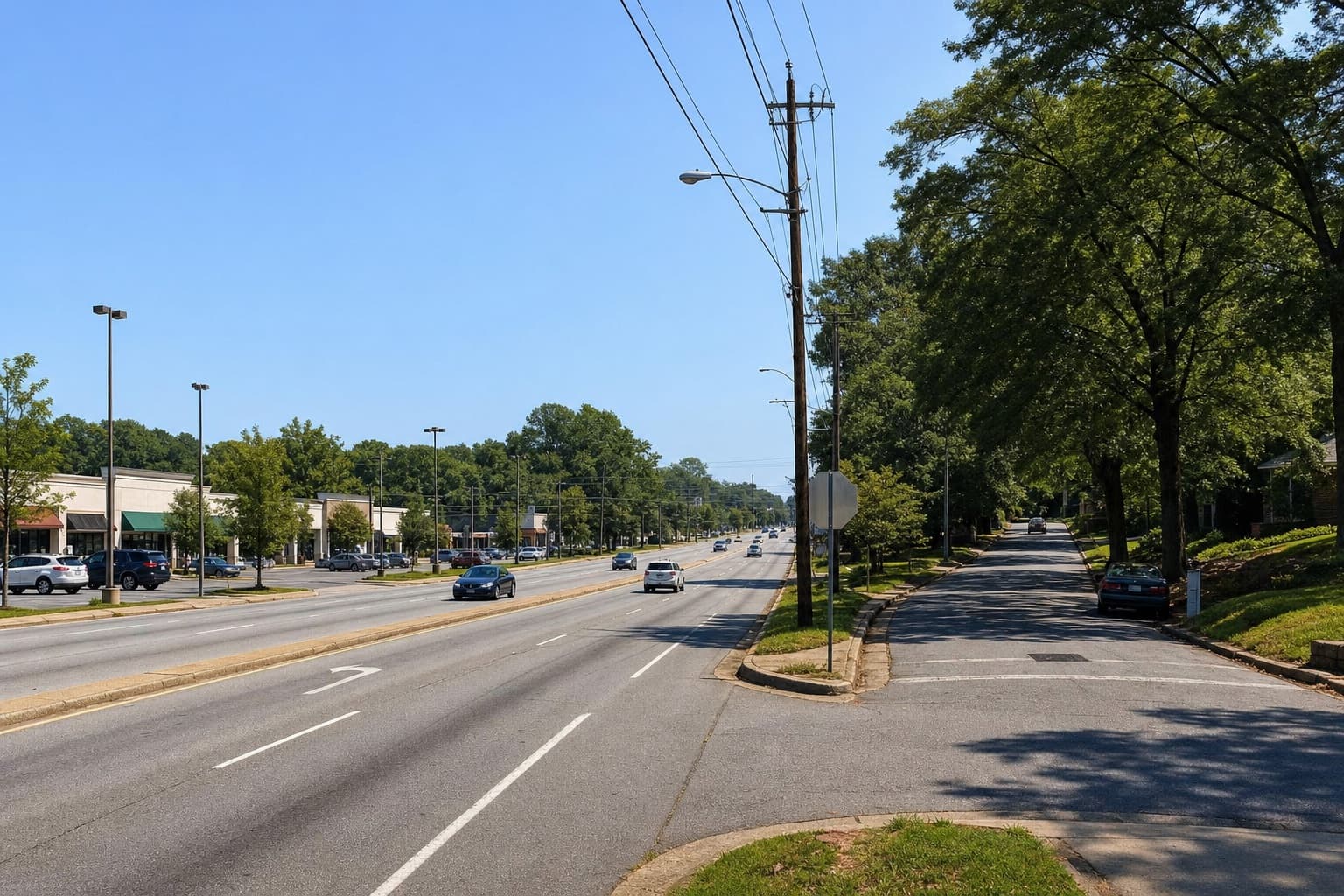
If you were struck on foot in Northeast Atlanta, a Cheshire Bridge Road pedestrian accident lawyer can tell you within the first conversation what most people want to know: yes, you likely have a claim, and yes, you generally have two years from the date you were hit to file suit in Fulton County (O.C.G.A. § 9-3-33). Cheshire Bridge Road is exactly where these collisions happen — a wide, fast commercial arterial threaded with continuous curb cuts, strip-mall driveways, and long gaps between marked crosswalks. That design forces people on foot to cross where there is no signal, and insurers seize on it to blame the victim. This guide explains how Georgia's crosswalk and right-of-way laws work on a corridor like this, what to do after a crash near Morningside, and how a Cheshire Bridge Road pedestrian accident lawyer builds the case the insurer hopes you can't.
Last reviewed: June 18, 2026
Why Cheshire Bridge Road Is So Dangerous for People on Foot
Cheshire Bridge Road runs through Piedmont Heights and the Lindridge-Martin Manor edge of Morningside-Lenox Park as a classic mid-century commercial arterial. It carries fast through traffic, yet it is lined with restaurants, shops, and service businesses, each with its own driveway — producing almost continuous curb cuts and turning movements but very few signalized crosswalks, spaced far apart.
For a pedestrian, that is the worst of both worlds. To reach a business across the street, you either walk a long detour to a signal or cross mid-block — exactly where drivers turning into and out of parking lots are scanning for gaps in traffic, not for people on foot. Vehicles turning across a pedestrian's path at these driveways and intersections are one of the most common crash patterns on the corridor.
The surrounding grid adds risk. Narrow, hilly residential streets in Morningside-Lenox Park feed onto higher-speed connectors like LaVista Road and Piedmont Avenue, creating blind curves and merge conflicts. Weekend trail traffic at the Morningside Nature Preserve and Lenox Wildwood Park, weekday surges near Piedmont Atlanta Hospital, evening restaurant crowds along the strip, and school arrival near Morningside Elementary all push more people on foot into the same congested space.
According to NHTSA research published by the National Highway Traffic Safety Administration, the risk of severe injury or death to a pedestrian climbs sharply with vehicle speed — a person struck at 40 mph is far more likely to be killed than one struck at 20 mph. On an arterial built for speed, that physics is unforgiving.
What Georgia Law Says About Crosswalks and Right-of-Way
Two statutes do most of the work in a pedestrian case on this corridor, and they often get argued in the same file.
O.C.G.A. § 40-6-91 governs crosswalks. Drivers must yield the right-of-way to a pedestrian crossing within a marked crosswalk or within an unmarked crosswalk at an intersection. "Unmarked crosswalk" matters: at most intersections, an invisible crosswalk legally exists across each leg even without painted lines. A driver who turns into your path at a Cheshire Bridge Road intersection cannot escape liability just because there was no paint on the pavement.
O.C.G.A. § 40-6-92 governs crossings outside a crosswalk. When a pedestrian crosses mid-block — as the corridor's design practically forces — the pedestrian must yield the right-of-way to vehicles. But "must yield" is not the same as "automatically at fault." Drivers still owe a duty of due care, and a driver who was speeding, distracted, or running a red light can be the one primarily at fault even when you crossed mid-block.
The pillar on pedestrian rights from our Georgia pedestrian accident lawyer team walks through the broader right-of-way framework, and our Atlanta pedestrian accident lawyer hub covers the city-specific issues that come up in Fulton County courts.
Comparative Fault: Why "You Were Jaywalking" Is Not the End of Your Case
The single most common insurer tactic in these cases is to argue that the pedestrian caused the crash by crossing outside a crosswalk. On Cheshire Bridge Road, where marked crosswalks are scarce, that argument comes up in nearly every claim.
Georgia uses modified comparative negligence under O.C.G.A. § 51-12-33. You can recover damages as long as you are less than 50% at fault, and your award is reduced by your own percentage of fault. So if a jury finds you 20% responsible for crossing mid-block but finds the driver 80% responsible for speeding and failing to keep a lookout, you still recover 80% of your damages.
That is why the investigation matters more than the insurer's first phone call. As Mark Wade, Founder and Lead Attorney at Georgia Auto Law, puts it, the worst mistake an injured pedestrian can make is accepting the insurer's framing that crossing outside a crosswalk automatically makes the crash their fault — the law requires apportioning fault among everyone involved, and a speeding or distracted driver often carries the larger share. We document driver speed, signal timing, sightlines, and lighting so the fault percentage reflects what actually happened, not what the adjuster wants to assume.
Have Questions About Your Case?
Get a free consultation with an experienced Georgia accident attorney.
Comparing the Two Pedestrian-Crossing Statutes
| Crossing in a crosswalk | Crossing outside a crosswalk | |
|---|---|---|
| Governing statute | O.C.G.A. § 40-6-91 | O.C.G.A. § 40-6-92 |
| Who must yield | The driver yields to the pedestrian | The pedestrian yields to vehicles |
| Applies to unmarked crosswalks? | Yes — at intersections even without paint | N/A |
| Can you still recover if hit? | Yes — driver is usually primarily at fault | Yes, if you are less than 50% at fault (O.C.G.A. § 51-12-33) |
| Common Cheshire Bridge Road scenario | Driver turning into a driveway across your path | Mid-block crossing between distant signals |
Injuries Are Often Catastrophic — Treat Them That Way
When a vehicle strikes a person, there is no airbag, frame, or seatbelt protecting the body. Pedestrian collisions on a corridor like Cheshire Bridge Road routinely cause traumatic brain injuries, spinal damage, multiple fractures, and internal trauma. According to CDC injury data from the Centers for Disease Control and Prevention, pedestrians are far more likely than vehicle occupants to be killed in a crash, and head injuries are a leading cause of those deaths.
Get evaluated immediately, even if you feel "okay" — closed head injuries and internal bleeding can present hours later. The corridor sits within roughly 2.5 miles of several major facilities, including Emory Wesley Woods Hospital (about 1.4 miles), Emory University Hospital (about 2.2 miles), and Piedmont Atlanta Hospital (about 2.3 miles). Prompt records also create the medical documentation a claim depends on.
If a head injury is involved, our traumatic brain injury lawyer page explains how these claims are valued and proven. In the worst cases, where a loved one does not survive, our team handles fatal pedestrian accidents under Georgia's wrongful-death framework — also subject to the two-year deadline.
What to Do After a Pedestrian Crash Near Cheshire Bridge Road
- Call 911 and get medical care. A police report and same-day treatment are the backbone of your claim.
- Document the scene if you safely can. Photograph the driveway or intersection, skid marks, your location, the vehicle, and the distance to the nearest marked crosswalk. The lack of a nearby crosswalk is evidence in your favor under the comparative-fault analysis.
- Identify witnesses and nearby cameras. Cheshire Bridge Road businesses often have exterior surveillance. That footage gets overwritten quickly — within days at many businesses — so it must be requested fast.
- Do not give a recorded statement to the driver's insurer. Adjusters use these to lock you into language that inflates your share of fault. Politely decline until you have counsel.
- Note the responding agency and county. Crashes on the corridor fall in Fulton County, so a resulting suit would typically be filed in the State Court of Fulton County, or the Superior Court of Fulton County for larger matters.
When the Driver Flees or Has No Insurance
Dense commercial corridors see elevated rates of hit-and-run and uninsured-driver crashes. If the driver who hit you fled or carried no coverage, Georgia law requires insurers to offer uninsured/underinsured motorist coverage under O.C.G.A. § 33-7-11, and your own UM policy frequently becomes the primary recovery source. Our overviews of hit-and-run accidents and uninsured motorist accidents explain those parallel tracks.
The corridor also mixes pedestrians with other vehicle types. MARTA Route 27 runs its length, putting riders and buses into the same congested space — see our work on MARTA bus accidents — and the hilly connectors create exposure for riders, addressed by our Georgia motorcycle accident lawyer team. For neighboring context, our Buckhead-area injury attorneys page covers the adjacent grid, and our Atlanta personal injury lawyer hub ties it together.
How a Cheshire Bridge Road Pedestrian Accident Lawyer Builds Your Case
A pedestrian claim on this corridor is won or lost on the fault percentage, and the fault percentage is won or lost on evidence gathered early. A Cheshire Bridge Road pedestrian accident lawyer moves fast to preserve surveillance footage before it is overwritten, maps the exact crossing location against the nearest marked crosswalk, retains a reconstruction expert when speed is disputed, and documents the corridor's design as context for why crossing outside a crosswalk was reasonable. According to GOHS reporting from Georgia's Governor's Office of Highway Safety, the state records hundreds of pedestrian fatalities each year, and arterial roadways with poor crossing access are a recurring factor — the same conditions present on Cheshire Bridge Road.
Frequently Asked Questions
How long do I have to file a pedestrian accident claim in Georgia?
Generally two years from the date of injury under O.C.G.A. § 9-3-33, and wrongful-death claims after a fatal pedestrian crash carry the same two-year limit. Because evidence like surveillance footage disappears quickly, do not wait until the deadline approaches to act.
I crossed where there was no crosswalk on Cheshire Bridge Road. Can I still recover?
Likely yes. Under O.C.G.A. § 40-6-92 you have a duty to yield when crossing outside a crosswalk, but that does not automatically make you at fault. Under Georgia's comparative-negligence rule (O.C.G.A. § 51-12-33), you can recover as long as you are less than 50% at fault, and a speeding or distracted driver often carries the larger share.
What if the driver who hit me drove off or had no insurance?
You may recover through your own uninsured/underinsured motorist coverage, which Georgia insurers must offer under O.C.G.A. § 33-7-11. We work to identify a fleeing driver through cameras and physical evidence while filing the UM claim so you are not left without a recovery source.
Which court would my Cheshire Bridge Road pedestrian case be filed in?
Because the corridor is in Fulton County, most pedestrian-injury suits are filed in the State Court of Fulton County, while the Superior Court of Fulton County handles larger or equity matters. Your lawyer determines the right venue based on the value and nature of the claim.
Should I talk to the driver's insurance company?
Not before speaking with an attorney. Adjusters frequently request a recorded statement and use your words to inflate your share of fault — especially when you crossed outside a marked crosswalk. You can decline politely and let your lawyer handle communications.
Where should I go for treatment after being struck near Cheshire Bridge Road?
Seek emergency care immediately. Several major facilities are within about 2.5 miles, including Emory Wesley Woods Hospital, Emory University Hospital, and Piedmont Atlanta Hospital. Prompt treatment protects both your health and the medical record your claim depends on.
How much does it cost to hire a Cheshire Bridge Road pedestrian accident lawyer?
The initial consultation is free, and Georgia Auto Law handles pedestrian cases on contingency — there is no fee unless we win. That structure lets injured pedestrians get experienced representation without paying anything up front.
Talk to a Cheshire Bridge Road Pedestrian Accident Lawyer Today
If you or a loved one was struck on foot in Morningside, Piedmont Heights, or anywhere along the Cheshire Bridge Road corridor, do not let the insurance company define the story. Call Georgia Auto Law at (404) 662-4949 for a free consultation. We are available 24/7, we work on contingency, and we know how Fulton County juries weigh these claims.