Key Takeaways
- Georgia personal-injury and wrongful-death claims must be filed within two years under O.C.G.A. § 9-3-33; property damage runs four years under § 9-3-32.
- Georgia is a modified comparative-negligence state under O.C.G.A. § 51-12-33 — recovery is reduced by your share of fault and barred entirely at 50% or more.
- Georgia's rideshare-insurance framework (O.C.G.A. § 33-1-24 and the TNC chapter) attaches a $1 million liability policy only when the driver is on-app and matched with a passenger; off-app, only the driver's personal auto policy applies — and most personal policies exclude commercial rideshare use.
- Pill Hill hospital lots and porte-cochère drop-off zones are private property; crashes inside the lots also raise premises-liability theories under O.C.G.A. § 51-3-1.
- Civil suits are filed in Fulton County State Court at 185 Central Ave SW, Atlanta; Sandy Springs Municipal Court hears traffic citations only.
- According to Uber's 2024 U.S. Safety Report, the company logged 2.1 billion U.S. trips between 2021 and 2022 and reported 153 motor-vehicle fatalities across those trips — most occurring at low-speed pickup, drop-off, and queue-lane events of exactly the kind that happen at Pill Hill three times a day.
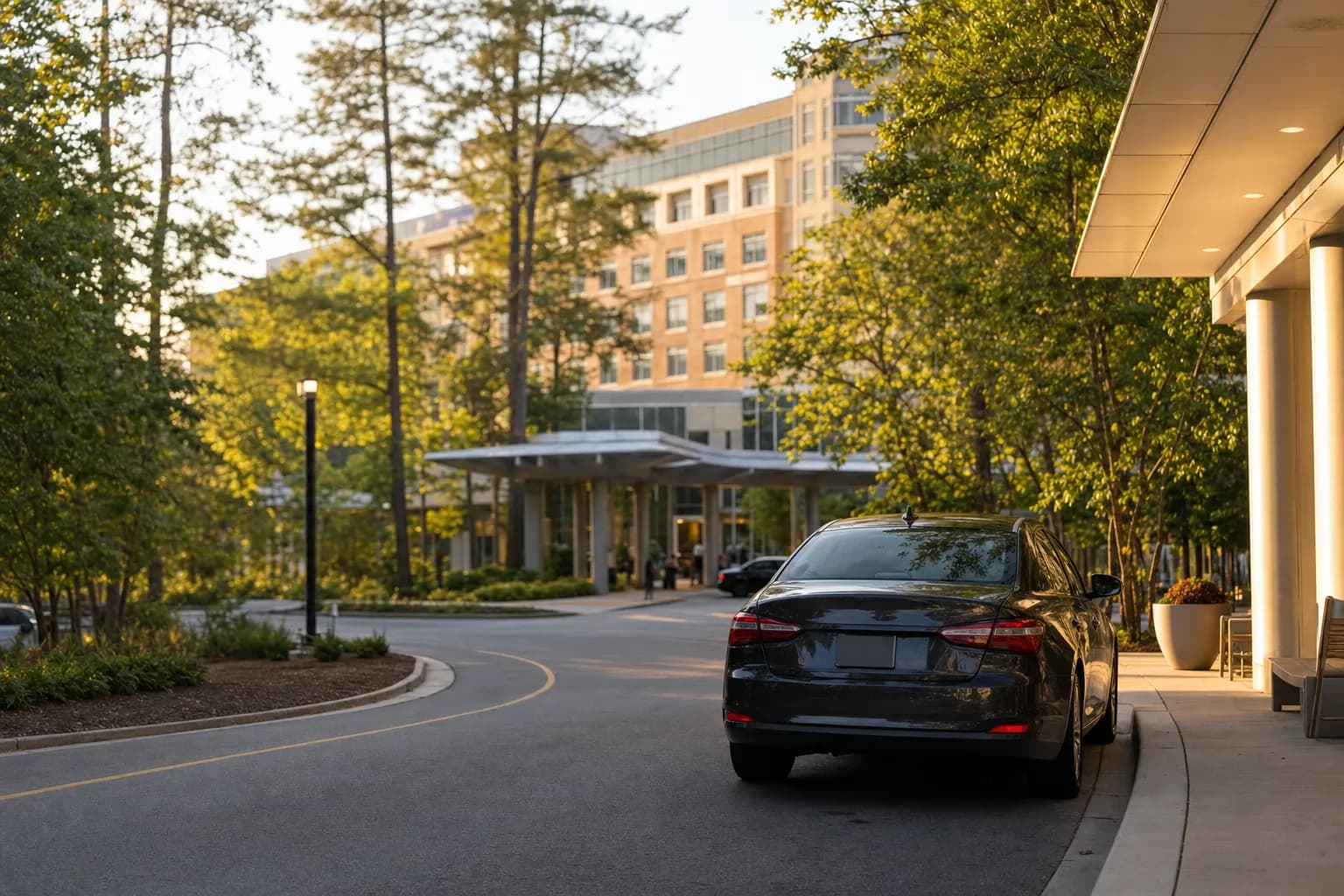
If you were hit at a hospital drop-off zone in the Pill Hill medical complex — Northside Hospital, Children's Healthcare of Atlanta at Scottish Rite, or Emory Saint Joseph's — and an Uber or Lyft was involved, a Sandy Springs Pill Hill Uber accident lawyer can tell you within minutes which insurance policy actually pays. The answer turns on the driver's app status at the second of impact, and the proof has a shelf life measured in hours, not weeks.
What a Sandy Springs Pill Hill Uber Accident Lawyer Actually Does in the First 72 Hours
A Sandy Springs Pill Hill Uber accident lawyer does three things fast: locks the driver's app status at the moment of impact, captures the trip record before Uber or Lyft can refresh or close it, and routes the injured passenger or pedestrian to the trauma center that matches the injury — Northside (Level III adult), Children's at Scottish Rite (pediatric Level I), Emory Saint Joseph's (specialty), or Grady downtown (adult Level I) for catastrophic cases. Everything else — police reports, recorded statements, adjuster contact — waits until those three are done.
Three large hospitals running three shift changes a day pull constant Uber and Lyft volume onto Johnson Ferry Road and Peachtree Dunwoody Road. According to the National Highway Traffic Safety Administration, U.S. traffic deaths remained above 40,000 annually through 2022 and 2023, with vulnerable road users — pedestrians, cyclists, and people stepping out of stopped vehicles — a rising share. Hospital drop-off curbs concentrate exactly that exposure: passengers door-out into moving lanes, drivers queue and rear-end the car in front, and pedestrians cross mid-block between a parked rideshare and the porte-cochère.
The legal complication is that the driver who hit you, the driver who dropped you off, and the platform behind the app may each carry different coverage, and the policy that pays depends on a screen state that the app refreshes the moment the trip ends. Sandy Springs-based victims often end up needing a Sandy Springs rideshare accident lawyer who already knows which side streets the rideshares cut through and how to lock the trip evidence before it disappears.
Why Pill Hill Generates So Many Rideshare Crashes
Pill Hill is the name locals use for the cluster of three large hospitals on Johnson Ferry Road and Peachtree Dunwoody Road in Sandy Springs: Northside Hospital, Children's Healthcare of Atlanta at Scottish Rite, and Emory Saint Joseph's Hospital. All three sit within about three miles of the Mystic Drive Northeast corridor where the broader Roswell Road / Pill Hill traffic pattern starts, and all three run shift changes at roughly 7 a.m., 3 p.m., and 11 p.m. Those three peaks push hundreds of patients, visitors, and shift workers through narrow porte-cochère drop-off lanes designed in an era before app-dispatched rideshare existed.
According to the Centers for Disease Control and Prevention's WISQARS injury data, motor-vehicle traffic remains a top-five cause of unintentional injury in working-age adults in the U.S., and "struck by/against" events — the category that covers a pedestrian struck by a vehicle, including by an opening car door — are the second-highest mechanism of nonfatal hospital-treated injury. The WISQARS pattern plays out in miniature at every Pill Hill shift change: the rideshare queues in the curb lane, a hurried driver tries to exit on the traffic side instead of the curb side, and the next car in the queue rear-ends the stopped vehicle.
According to the Governors Highway Safety Association's pedestrian-fatality reporting, the majority of U.S. pedestrian fatalities now occur on arterial roads at night, outside marked intersections. Johnson Ferry Road and Peachtree Dunwoody Road around the hospital campuses fit that profile: posted speeds in the 35 to 45 mph range, mid-block hospital access drives, and shift-change drop-offs that surge after dark. The common crash patterns at Pill Hill are:
- Queue-lane rear-ends as drivers stop at the porte-cochère while the car behind doesn't.
- Sideswipes as a rideshare pulls back into the travel lane after a drop-off.
- Pedestrians struck stepping out of a stopped rideshare on the driver's side instead of the curb side.
- Mid-block pedestrian strikes between the rideshare drop-off curb and the main hospital entrance.
- Premises-liability collisions inside the private hospital lots — confusing lane markings, overgrown sightlines at parking-deck exits, and ungated cross-traffic at the loading bays.
On-App vs. Off-App: The Insurance Question That Decides Who Pays
Georgia's transportation network company (TNC) framework, codified in O.C.G.A. § 33-1-24 and the related TNC chapter, requires Uber and Lyft to maintain liability coverage at three tiers based on the driver's app status. This is the single most important fact in any Pill Hill rideshare case, because the wrong tier can mean the difference between a $1 million policy and the driver's $25,000 minimum personal auto policy.
| Driver App Status | Description | Policy That Applies | Typical Limits |
|---|---|---|---|
| App off / driver not logged in | Personal use; no rideshare activity | Driver's personal auto policy only | Georgia minimum $25,000 / $50,000 bodily injury; many personal policies exclude commercial rideshare use entirely |
| App on, no trip accepted | Driver waiting for a request | TNC contingent liability coverage | $50,000 per person / $100,000 per accident / $25,000 property damage (Uber and Lyft both maintain) |
| Trip accepted, matched, or passenger in vehicle | On the way to pickup, with passenger, en route to drop-off | TNC commercial liability policy | $1,000,000 combined single limit (Uber and Lyft both maintain) |
The Pill Hill twist is that the moment of impact often happens in a gray zone — the driver has just dropped a passenger off at the Northside porte-cochère, the trip has technically ended, the app is refreshing, and the next request hasn't come through yet. A rear-end happens in the queue lane during that refresh. Was the driver on-app waiting (the middle tier) or had the app flipped back to off (the bottom tier)? The trip-record screenshot taken in the first ten seconds answers that question. Five minutes later, the app has refreshed and the screen no longer shows that exact state.
Mark Wade, lead attorney at Georgia Auto Law, points out that this is exactly where Uber and Lyft adjusters push back hardest. The platform's position is almost always that the trip ended before impact and only the driver's personal policy applies — which, in turn, almost always excludes commercial rideshare use, leaving the injured passenger or pedestrian with nothing. The counter-evidence is the contemporaneous screenshot, the platform's own trip-status timestamp data (subpoenaed in litigation), and the GPS ping records that show whether the vehicle was still in the active drop-off zone when the collision occurred. Mark Wade adds that this is why his standing advice to anyone in a Pill Hill rideshare crash is the same: before you call anyone, screenshot the trip screen, the driver name and license plate, and the receipt. Do it twice. The app will refresh, and the state of the screen at the moment of impact is the case.
Have Questions About Your Case?
Get a free consultation with an experienced Georgia accident attorney.
What You Should Do at a Pill Hill Drop-Off Crash
If you were just hit at a Pill Hill drop-off zone — whether you were a rideshare passenger, the driver of another car, or a pedestrian crossing between the rideshare curb and the hospital door — work the list in order:
- Call 911 immediately. Even if injuries seem minor, the dispatch timestamp anchors your medical record and your insurance file.
- Screenshot the Uber or Lyft app before doing anything else. Capture the trip status (in-progress, completed, etc.), the driver name and photo, the license plate, the vehicle make and model, the route map, and the receipt. Screenshot twice — the app refreshes, sometimes within seconds of arrival.
- Photograph the drop-off curb, the porte-cochère lane markings, the position of the cars at rest, and any debris field. Pill Hill drop-off zones are private property; the lane markings, signage, and traffic flow are evidence under O.C.G.A. § 51-3-1 if a premises theory applies.
- Get the badge number and unit number of any hospital security officer who responded. Hospital security often arrives before Sandy Springs Police on private property, and their incident report is discoverable.
- Tell Sandy Springs Police the precise address — the hospital entrance you were at, not just "the hospital." Pill Hill is three large campuses; a vague report goes to the wrong file.
- If you were the rideshare passenger, do not sign anything Uber or Lyft sends you. The platform will offer a "support" workflow that often includes a release of claims buried in the click-through.
- Get treatment the same day. Pill Hill puts world-class trauma care fifty feet away — Northside Hospital (Level III adult trauma) for serious adult injuries, Children's Healthcare of Atlanta at Scottish Rite (pediatric Level I trauma) for kids, Emory Saint Joseph's for specialty cardiology and neurosurgery, and Grady Memorial Hospital downtown (adult Level I trauma, about 11 miles south) for catastrophic adult cases.
- Open a parallel UM claim under O.C.G.A. § 33-7-11 against your own auto policy. Georgia UM coverage reaches pedestrians and rideshare passengers, not just drivers — and it stacks behind the TNC policy if the rideshare policy is contested.
The last point catches people. Most rideshare passengers do not realize that their own household's uninsured/underinsured motorist coverage may pay if the TNC denies coverage or if another driver involved in the crash is uninsured. A claim under uninsured motorist coverage does not require you to have been in your own car at the time of the collision.
Where Pill Hill Rideshare Cases Get Filed and Who Investigates
Pill Hill sits inside the City of Sandy Springs, which incorporated in 2005. Its municipal court is traffic-only — no personal-injury suits. Civil claims arising from a Pill Hill rideshare crash are filed in Fulton County State Court at 185 Central Ave SW, Atlanta, or, for larger or equity matters, Fulton County Superior Court. Sandy Springs Police Department handles crash investigations on the Sandy Springs side; APD Zone 2 picks up where the corridor crosses into Buckhead, and crashes near the city boundary occasionally produce parallel reports.
The driver who hit you may live across the metro. The rideshare platform is headquartered out of state. None of that changes Georgia jurisdiction or the two-year filing deadline under O.C.G.A. § 9-3-33. Cases that begin at a Pill Hill drop-off and end at a Buckhead emergency room are routinely handled by adjacent Buckhead injury lawyers inside the same broader Atlanta personal injury law firm market, with the same Fulton County State Court venue.
Cyclists who use the Roswell-Wieuca and Blue Heron trail connectors and then ride the Johnson Ferry Road shoulders toward the hospital campuses face a related but distinct risk profile — a Georgia bicycle accident lawyer handles those claims with the same trip-screenshot urgency when a rideshare is the striking vehicle.
How the Trauma Routing Choice Shapes the Claim
Mark Wade, lead attorney at Georgia Auto Law, often tells clients that the hospital where you are treated in the first hour after a Pill Hill crash shapes the medical record that drives the case six months later. The Pill Hill geography is unusual in that it puts three major hospitals within a half-mile of each other, each with a different specialty. Choosing the right one is medical, not legal — but the choice affects what records exist and how clean the causation story reads to a defense expert later.
According to the American College of Surgeons trauma-center verification framework, Level I and Level II centers are required to have in-house trauma surgeons and full surgical subspecialties available around the clock; Level III centers provide initial trauma evaluation and stabilization and transfer to higher-level care when needed. Northside Atlanta is verified at Level III for adult trauma — adequate for stabilization and most non-catastrophic injuries. Children's Healthcare of Atlanta at Scottish Rite holds pediatric Level I — the appropriate destination for any child injured at a Pill Hill drop-off. Adult catastrophic injuries — open-book pelvis, traumatic brain injury, penetrating chest trauma — usually require Grady Memorial Hospital downtown, Atlanta's Level I adult trauma center about 11 miles south.
The choice is rarely made consciously at the scene; it is made by the EMS unit that responds. Documenting that decision — and the time stamps on the transfer if one occurred — is part of the early case file.
Last reviewed: May 26, 2026
Frequently Asked Questions
I was a passenger in an Uber that crashed at Pill Hill — who pays?
If the driver was on-app and you were a matched passenger at the moment of impact, Uber's $1 million TNC commercial liability policy is the primary source under Georgia's rideshare framework (O.C.G.A. § 33-1-24 and the TNC chapter). If the trip had ended and the app had flipped to "available" with no new trip accepted, you fall to the contingent tier — $50,000 per person / $100,000 per accident. Screenshot the trip screen immediately; that screen state at the second of impact decides which tier applies. Then call a Georgia car accident lawyer before you talk to Uber's support workflow.
What if the Uber driver wasn't on a trip when the crash happened?
If the driver was logged out of the app entirely, only their personal auto policy applies — and most personal auto policies in Georgia exclude commercial rideshare use, which can void coverage even though the driver wasn't currently on a trip. If the driver was on-app but not yet matched with a passenger, Uber and Lyft each maintain contingent liability coverage at $50,000 per person / $100,000 per accident / $25,000 property damage. That coverage is real but limited, and disputes about whether the driver was actually on-app vs. off-app are common — the platform's own trip-status logs settle it, and those are subpoenaed in litigation.
Does my health insurance pay before Uber's policy does?
Generally yes — your health insurance is billed first for emergency care at Northside, Scottish Rite, Emory Saint Joseph's, or Grady, and your insurer will assert a subrogation lien against any settlement you later recover from Uber's $1 million policy or the at-fault driver. Georgia does not require PIP, so there is no automatic auto-policy medical benefit unless you bought med-pay coverage on your own policy. An experienced lawyer coordinates health insurance, med-pay, letters of protection from treating providers, and the eventual liability recovery so the lien math doesn't swallow your settlement.
How long do I have to file a claim after a Pill Hill rideshare crash?
Two years from the date of the crash for personal injury or wrongful death under O.C.G.A. § 9-3-33; four years for property damage only under O.C.G.A. § 9-3-32. The TNC insurance policy does not extend that deadline — and most platforms will require notice of the claim much sooner than two years to preserve coverage. If a MARTA bus was also involved (unusual at Pill Hill drop-offs but possible on Peachtree Dunwoody Road), the six-month ante litem notice under the O.C.G.A. § 36-33-5 framework also runs.
The Uber driver hit a pedestrian outside Northside while I was the passenger — am I liable?
No. As a passenger you have no control over the driver and no duty to the pedestrian. The injured pedestrian's claim runs against the driver and, if the driver was on-app with you matched as the passenger, against Uber's $1 million TNC policy. You may be a witness, and your account of where the driver was looking and whether the driver was on the phone matters — but you have no personal exposure. If you were also injured, you have your own claim against the same policy.
Does Georgia's comparative-negligence rule affect a rideshare drop-off case?
Yes. Under O.C.G.A. § 51-12-33, an injured party at 50% or more fault recovers nothing, and any recovery below that is reduced by their fault percentage. In Pill Hill drop-off cases the defense usually argues that the passenger door-opened into a moving lane in violation of basic care, or that the pedestrian crossed mid-block outside any marked crosswalk. Lane-marking photos, porte-cochère sightlines, and the platform's GPS data — locked early — move those percentages down before they harden in the adjuster's file.
Where do I file a lawsuit if Uber or Lyft denies the claim?
In Fulton County State Court at 185 Central Ave SW, Atlanta, for most cases, or Fulton County Superior Court for larger or equity matters. Sandy Springs Municipal Court is traffic-only and cannot hear an injury suit. Out-of-state platforms cannot pull a Georgia rideshare case into federal court automatically — the diversity analysis depends on the driver's residency and the parties involved. Local sibling claims tied to the same corridor — for example, hit-and-run crash claims where a non-rideshare driver strikes someone exiting a rideshare and flees — are filed in the same Fulton County venue.
Talk to a Sandy Springs Pill Hill Uber Accident Lawyer Today
If you or a family member was injured in an Uber or Lyft crash at a Pill Hill drop-off — at Northside, Scottish Rite, Emory Saint Joseph's, or on the Johnson Ferry Road / Peachtree Dunwoody Road approach — talk to a Sandy Springs Pill Hill Uber accident lawyer at Georgia Auto Law before you talk to Uber support, Lyft support, or any insurance adjuster. Mark Wade and our team handle Uber and Lyft rideshare accidents across Fulton County, work directly with the Pill Hill trauma centers on coordinated care, and know which Sandy Springs Police reporting practices and Fulton County State Court filing rules apply to your case. Connect with the Sandy Springs car accident attorneys at Georgia Auto Law for a free consultation — no fee unless we recover for you.