Key Takeaways
- Georgia pedestrian injury and wrongful-death claims must be filed within two years of the crash under O.C.G.A. § 9-3-33.
- Georgia applies modified comparative negligence under O.C.G.A. § 51-12-33 — recovery is reduced by your share of fault and barred entirely at 50% or more.
- Drivers owe a heightened duty of due care to any pedestrian on the roadway under O.C.G.A. § 40-6-93, even at unmarked crossings between hospital driveways.
- Defense adjusters argue mid-block crossings outside a marked crosswalk under O.C.G.A. § 40-6-92 — hospital security-camera footage, driveway sight-line measurements, and block-face photographs taken within days are what move that percentage down.
- ZIP 30342 straddles three police jurisdictions (Atlanta Police Department Zone 2, Sandy Springs Police Department, Brookhaven Police Department) — the responding agency controls how fast the crash report becomes available.
- Civil pedestrian injury suits at Pill Hill are filed in Fulton County State Court at 185 Central Ave SW, Atlanta, or Fulton County Superior Court for higher-value claims.
- Trauma routing is built into the corridor: Northside (Level III, on-corridor), Scottish Rite (pediatric Level I, on-corridor), Emory Saint Joseph's (on-corridor), and Grady downtown (adult Level I, about 11 miles south) are the four centers a Pill Hill pedestrian case usually touches.
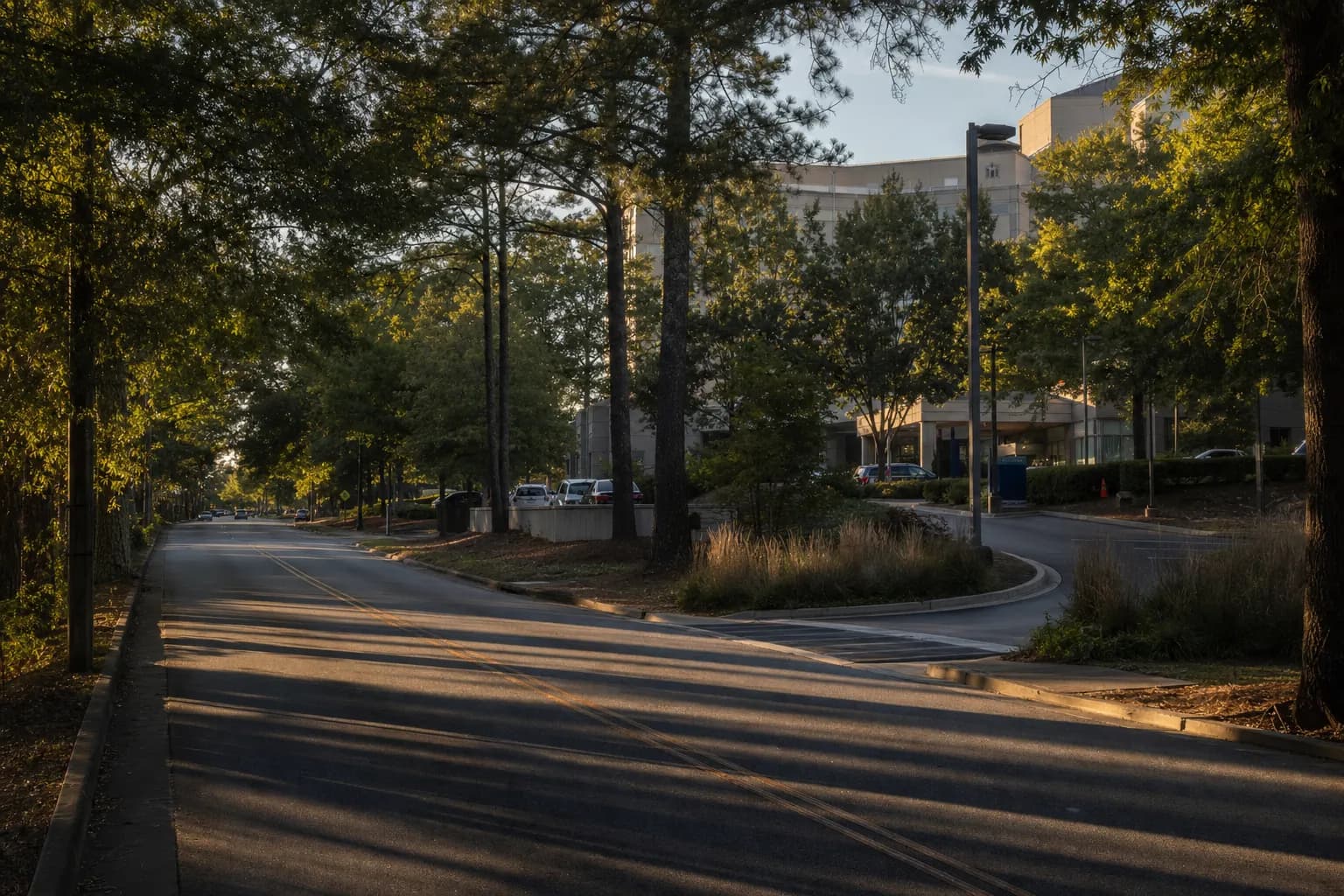
This guide is for anyone who needs a Pill Hill Peachtree Dunwoody pedestrian accident lawyer after being struck while walking between Northside Hospital, Children's Healthcare of Atlanta at Scottish Rite, and Emory Saint Joseph's Hospital. The two-lane, 35 mph hospital corridor in ZIP 30342 funnels staff, patients, and visitors across unsignalized commercial driveways during 7 a.m., 3 p.m., and 11 p.m. shift turnovers — exactly the geometry that produces hospital-area pedestrian strikes and the defense arguments your claim must beat.
Why Pill Hill's Peachtree Dunwoody Corridor Produces Pedestrian Strikes
A Pill Hill Peachtree Dunwoody pedestrian accident lawyer who works this corridor will tell you the strike pattern here is unlike any other in metro Atlanta. Peachtree Dunwoody Road through the hospital cluster is a two-lane secondary road posted at 35 mph that was never built to carry the pedestrian load three large medical campuses generate every day. Northside Hospital Atlanta sits on the corridor. Children's Healthcare of Atlanta at the Scottish Rite campus sits roughly a mile north. Emory Saint Joseph's Hospital sits just east. Hospital staff cross between buildings during shift changes, patients walk from remote parking decks to entrance lobbies, and family members cross between campuses on foot when they cannot find the right garage. The conflict points cluster at the unsignalized driveway mouths between hospital lots — not at the few signalized intersections drivers expect.
That pedestrian-generator profile is what makes this corridor distinct from the residential park-access pattern further north between Mayson Park and Lynwood Park, or the four-lane school-zone arterial pattern on Roswell Road in Sandy Springs. At Pill Hill the people walking are nurses on twelve-hour rotations who just finished a shift, oncology patients walking to infusion appointments, and adult children crossing toward the ICU entrance in the dark. The drivers are other nurses arriving for the next shift, ambulances pulling into ER bays, valets cycling cars at the entry portico, and rideshare drivers double-parking to drop a patient. Our broader Atlanta pedestrian accident attorney framework applies to all three corridors, but the evidence playbook here is hospital-specific.
According to the National Highway Traffic Safety Administration, 7,522 pedestrians were killed on U.S. roads in 2022 — the highest annual total since 1981, and a 13% increase over the prior year. According to the Governors Highway Safety Association's Spotlight on Pedestrian Safety, the majority of those fatalities occur on arterial and secondary roads, away from intersections, at night — exactly the geometry of Peachtree Dunwoody between the Pill Hill driveways. According to the Centers for Disease Control and Prevention, pedestrians are roughly 1.5 times more likely than vehicle occupants to be killed in a traffic crash on a per-trip basis, and adults 65 and older account for a disproportionate share of pedestrian deaths — relevant in a corridor where the foot traffic skews toward elderly patients and their family members.
Shift-Change Surges: 7 a.m., 3 p.m., 11 p.m.
Hospital pedestrian risk is not constant. It spikes three times every twenty-four hours. Northside, Scottish Rite, and Emory Saint Joseph's operate overlapping nursing and clinical-staff rotations that turn over roughly at 7 a.m., 3 p.m., and 11 p.m. Each turnover puts hundreds of staff on the corridor at the same moment — some walking to the buildings from staff parking decks, some walking to cars after a twelve-hour shift, all crossing the same unsignalized driveway mouths the inbound shift is using to enter the campus. According to the American Hospital Association's workforce surveys and U.S. Bureau of Labor Statistics data for general medical and surgical hospitals, registered-nurse staffing at large urban facilities routinely runs several hundred RNs per twelve-hour shift. Three hospitals of Pill Hill's scale rotating at the same hours means roughly a thousand staff are in motion in the same fifteen-minute window — and the drivers crossing those pedestrians are themselves often fatigued from the shift that just ended.
Mark Wade, lead attorney at Georgia Auto Law, has handled hospital-corridor pedestrian claims and points out that the time of day matters in two ways adjusters miss. First, a strike at 7:05 a.m. or 11:10 p.m. is presumptively a shift-change crash, which puts the responsible employer's foreseeability in play if the driver was a fatigued employee leaving a twelve-hour shift. Second, the security-camera systems at all three hospitals are configured to retain campus-driveway footage during shift turnovers because of theft and badge-access concerns — meaning a Pill Hill Peachtree Dunwoody pedestrian accident lawyer who issues preservation letters within forty-eight hours can usually obtain driveway-camera footage that ends a "pedestrian darted out" defense.
The Sight-Line Problem Drivers Have Leaving Hospital Lots
Drivers exiting Pill Hill hospital lots onto Peachtree Dunwoody have a fundamental scanning bias: they are looking left for oncoming through-traffic, not down the sidewalk for pedestrians crossing in front of them. The commercial-driveway density compounds the problem. Inside roughly a mile of hospital frontage, Peachtree Dunwoody intersects more than a dozen driveways — main entrances, ER access roads, valet portico ramps, and staff-only service drives. Each driveway is its own sight-line failure. A driver pulling out of a Northside service drive is angled to clear oncoming traffic and rarely scans the sidewalk to the right at all.
That is the precise scenario O.C.G.A. § 40-6-93 was written for — the section imposes on every driver the duty to exercise due care to avoid colliding with any pedestrian, and the duty to give warning by sounding the horn when necessary. Section 40-6-93 applies whether or not the pedestrian is in a marked crosswalk. Combined with O.C.G.A. § 40-6-91's right-of-way protections inside crosswalks, the statute gives a well-documented hospital-corridor case real leverage. The hard work is documenting the sight line from the driver's actual eye height in the actual vehicle, with the same landscaping, parked cars, and signage that existed at the moment of impact — and that work has to happen within days, before a hospital trims a hedge or restripes its valet lane.
Have Questions About Your Case?
Get a free consultation with an experienced Georgia accident attorney.
Defense Arguments Specific to Hospital-Corridor Crossings
Defense adjusters on Pill Hill cases reliably lead with two arguments. The first is O.C.G.A. § 40-6-92 — that the pedestrian was crossing between unmarked driveways outside any crosswalk and therefore had a duty to yield. The second is "the staff member was wearing scrubs at night and was effectively invisible." Both are answerable when the right evidence is collected fast.
| Defense Argument | What Defeats It | When It Must Be Collected |
|---|---|---|
| "Pedestrian crossed between driveways outside any crosswalk" (§ 40-6-92) | Hospital security-camera footage showing the established staff walking path; signed witness declarations from co-workers who use the same crossing daily | Within 7-14 days |
| "Driver could not see the pedestrian leaving the hospital lot" | Driveway sight-line measurements from the driver's actual eye height; landscaping and parked-vehicle positions photographed before they change | Within 48-72 hours |
| "Pedestrian was invisible in scrubs at night" | Streetlight and driveway-lighting condition records; manufacturer reflectivity specifications for medical uniforms; vehicle headlight inspection | Within 14 days |
| "The driver was at the posted 35 mph limit" | Event-data-recorder download from the striking vehicle; crush profile; throw distance; nearby signal-timing data | Within 30 days |
| "Shift-change is not a foreseeable hazard" | Hospital staffing records showing twelve-hour rotation; prior near-miss incident reports; OSHA-style log entries for the driveway | Within 60 days |
The hospital-driveway sight-line table is the difference between a 30% to 40% pedestrian-fault opening offer and a single-digit finding — or zero in the strongest shift-change cases. By the time a claim is denied six weeks after the crash, the hedge has been trimmed, the camera retention window has closed, and the parked car in the third row of the staff deck is somewhere else.
Mark Wade, lead attorney at Georgia Auto Law, emphasizes that hospital security teams are professional operations — they preserve footage when properly asked and refuse when asked informally by an injured employee. A timely, attorney-issued preservation letter routed to the hospital's risk-management department is the single highest-leverage action in the first week of a Pill Hill pedestrian claim. The same letter that preserves Northside, Scottish Rite, or Emory Saint Joseph's driveway footage also preserves badge-access logs that can place the driver and the pedestrian on the corridor at the same minute — evidence the adjuster will never volunteer.
Pedestrian-Generator Profile: How Pill Hill Differs from Park and School Crossings
A Pill Hill pedestrian case looks different from a residential or school-zone case because the population walking the corridor is different. The evidence playbook is not the same as a park-access or school-arterial case.
| Crossing Type | Primary Pedestrian Generator | Peak Hours | Defining Evidence | Common Statute |
|---|---|---|---|---|
| Hospital corridor (Pill Hill, Peachtree Dunwoody) | Staff between buildings, patients from parking decks, visitors between campuses | 7 a.m., 3 p.m., 11 p.m. shift changes; 7-11 a.m. outpatient appointments | Hospital security-camera footage; driveway sight-line measurements; badge-access logs | § 40-6-93 due-care duty at unmarked crossings |
| Residential / park corridor (Mayson Park, Lynwood Park) | Park users, families, cyclists | Weekends; weekday afternoons | Sidewalk-gap photographs; doorbell-camera footage; municipal sidewalk-maintenance records | § 36-33-5 ante litem if naming the city |
| Four-lane school arterial (Roswell Road, Sandy Springs) | School-zone children, retail patrons | 7:30 a.m. drop-off; 3 p.m. dismissal; weekend retail | School-zone speed-camera citations; signal-timing data; bus-stop locations | § 40-6-188 school-zone reduced speed; § 40-14-8 camera enforcement |
The Pill Hill case turns on hospital security infrastructure and shift-pattern foreseeability. The Mayson Park / Lynwood Park case turns on municipal sidewalk continuity. The Roswell Road case turns on the school zone and the IIHS impact-speed curve. A Pill Hill Peachtree Dunwoody pedestrian accident lawyer who runs a Roswell Road school-zone playbook on a Northside shift-change case will under-document the security-footage angle and over-invest in speed-camera analysis the corridor doesn't have.
Three Police Departments, One ZIP, One Civil Court
ZIP 30342 straddles three municipalities. The City of Atlanta covers most of the corridor between the hospitals — Atlanta Police Department Zone 2 is the responding agency. Sandy Springs Police Department covers the segments north of the Atlanta city line where Peachtree Dunwoody runs through Sandy Springs. Brookhaven Police Department covers the eastern edge of the ZIP, including Lynwood Park. The boundary lines cut through this corridor with no notice to a person lying injured at the curb, and reports filed with the wrong agency delay the investigation by days or weeks.
For civil pedestrian injury suits, jurisdiction is simpler: every part of Pill Hill inside Fulton County — all of the City of Atlanta portion and all of the Sandy Springs portion — files in Fulton County State Court at 185 Central Ave SW, Atlanta, or in Fulton County Superior Court for higher-value or equity matters. The municipal courts in Atlanta, Sandy Springs, and Brookhaven handle traffic citations only; they never hear personal injury claims. Cases inside Brookhaven (DeKalb County) file in DeKalb State Court or DeKalb Superior Court. Anyone who tells you a Pill Hill pedestrian claim can resolve in a municipal court is testing you.
Adjacent representation matters. Pedestrians struck on the Sandy Springs side often work with Sandy Springs car accident lawyer counsel that already knows SSPD reporting practices and Pill Hill trauma routing. The south end near the Buckhead boundary draws on Buckhead Atlanta auto accident lawyer coverage, and the eastern Brookhaven edge engages Brookhaven personal injury attorney counsel for the cross-county filing. One firm with a foothold across all three municipalities can carry a case across the city lines without the cross-jurisdictional confusion that complicates corridors at the Cobb or Gwinnett edge.
Trauma Routing Built Into the Corridor
A pedestrian struck on Peachtree Dunwoody at Pill Hill is, by definition, already at the hospital. Northside Hospital Atlanta is a Level III trauma center directly on the corridor. Children's Healthcare of Atlanta at Scottish Rite is a pediatric Level I trauma center about a mile north — the right destination for any child struck on the corridor. Emory Saint Joseph's Hospital sits just east. For catastrophic adult trauma, Grady Memorial Hospital downtown — Atlanta's adult Level I trauma center about eleven miles south — remains the regional destination, and the EMS crew at the scene makes the routing call.
A Level I trauma activation at Grady generates a substantially richer medical record than a community-ED transport, and that record drives the value of the claim. Pill Hill pedestrian victims commonly present with concussion injuries after a crash and with broken bones and orthopedic injuries from a vehicle crash — both injury types that require specific documentation early in treatment to support full damages later.
What to Do at the Scene
If you or a family member was just hit on Peachtree Dunwoody at Pill Hill:
- Call 911 and accept transport. You are on the hospital corridor; concussion symptoms and internal injuries often appear hours later, and the dispatch timestamp anchors your medical record.
- Tell the responding officer exactly where you were struck so the right agency (APD Zone 2, Sandy Springs PD, or Brookhaven PD) writes the report. Get the case number before transport if possible.
- Tell the trauma team and the officer the name of the hospital whose driveway you were crossing. That fact triggers preservation for the right security-camera system.
- If physically able, photograph the driveway mouth in both directions for 100 feet before anything moves — sight-lines, parked-vehicle positions, and landscaping are the case. If you cannot, ask a family member to do it within 24 hours.
- Identify any hospital staff who witnessed the strike. Co-workers who use the same crossing daily are the strongest witnesses because they can testify to the established walking path.
- Do not give a recorded statement to the at-fault driver's insurer before speaking with a lawyer.
- Seek follow-up medical care the same day or the next, and follow discharge instructions. Treatment gaps are the second-favorite defense argument after comparative fault.
If the driver fled, the criminal duties under O.C.G.A. § 40-6-270 apply, but they do not pay your medical bills — civil recovery for hit-and-run crashes on the corridor runs through your own uninsured motorist coverage in Georgia. If the striking vehicle was a rideshare driver dropping off a patient at the hospital entry, Uber and Lyft accident claims in Atlanta involve a different insurance stack than a private-passenger crash. Cyclists hit on the corridor have separate analysis under our bicycle accident lawyer in Atlanta framework, and the corridor sits inside the broader Atlanta personal injury law firm market.
Last reviewed: May 26, 2026
Frequently Asked Questions
I was crossing between hospital buildings when I was hit — am I at fault?
Not automatically. Georgia uses modified comparative negligence under O.C.G.A. § 51-12-33: your recovery is reduced by your share of fault and only barred entirely at 50% or more. Walking between hospital buildings on an established staff or visitor path is not the same as darting into traffic. The case turns on what a reasonable driver exiting that specific hospital driveway should have seen and done under O.C.G.A. § 40-6-93's due-care duty. Hospital security-camera footage showing the established crossing path, declarations from co-workers, and driveway sight-line measurements typically push the comparative-fault percentage well below 50% — in shift-change cases, often to single digits or zero.
What if there's no marked crosswalk between the hospital driveways?
A marked crosswalk is not required for you to recover. O.C.G.A. § 40-6-93 imposes on every driver the duty to exercise due care to avoid colliding with any pedestrian on the roadway, with or without a crosswalk. The defense will lead with O.C.G.A. § 40-6-92's requirement that pedestrians crossing outside a crosswalk yield to vehicles, but that statute does not eliminate the driver's due-care duty. The fight in unmarked-crossing cases is documenting that pedestrians routinely cross at this point — and a Pill Hill Peachtree Dunwoody pedestrian accident lawyer working this corridor knows the hospital staff walking paths are exactly that kind of established, documentable crossing.
Does hospital security footage matter to my case?
Yes — it is usually the single most important piece of evidence. Northside, Scottish Rite, and Emory Saint Joseph's all run professional security operations with cameras covering campus driveways, valet porticos, parking-deck approaches, and ER entries. Retention windows are typically measured in days to a few weeks. A preservation letter to the right hospital's risk-management department within 48 hours can secure footage that ends the "pedestrian darted out" defense permanently. Without that letter, the footage is gone.
How long do I have to file a pedestrian injury claim from a Pill Hill crash?
Two years from the date of the crash under O.C.G.A. § 9-3-33 for personal injury and wrongful death. Property-damage claims have a four-year window under O.C.G.A. § 9-3-32. If you are suing the City of Atlanta, City of Sandy Springs, or City of Brookhaven over a roadway or sidewalk defect, written ante litem notice is due within six months. Two years sounds long, but the evidence — security footage, doorbell cameras, landscaping conditions — does not last anywhere near that long.
My family member died at the scene on Peachtree Dunwoody — what claim do we file?
Georgia wrongful-death claims from a pedestrian crash carry the same two-year statute under O.C.G.A. § 9-3-33. The claim is brought by the surviving spouse (or children if there is no spouse), with separate estate claims for the decedent's medical expenses, conscious pain and suffering, and funeral costs. Pill Hill fatal-pedestrian cases benefit from the same hospital security-camera and shift-change evidence as the injury cases — the difference is the damages model and the parties of record.
Should I talk to the driver's insurance adjuster?
Not before you talk to a lawyer. Adjusters on Pill Hill cases routinely call within 24 to 48 hours of the strike, while the pedestrian is still hospitalized. They request recorded statements that lock you into a version of events while you are in pain, on medication, and missing scene context. Anything you say can be used to argue comparative fault under O.C.G.A. § 51-12-33. Georgia law does not require you to give the at-fault driver's insurer a recorded statement.
What if I was hit by a hospital employee leaving work after a twelve-hour shift?
That fact pattern adds a second potential defendant. If the driver was a hospital employee whose fatigue stemmed from a twelve-hour shift the employer required, foreseeability of the strike during shift-change hours becomes relevant — particularly if the strike occurred on the hospital's own driveway. Standard-of-care expert work, staffing-record discovery, and prior near-miss reports become central. The employer-liability theory often involves substantially higher available insurance on a commercial policy than on the driver's personal auto policy.
Talk to a Pill Hill Peachtree Dunwoody Pedestrian Accident Lawyer
If you were struck while walking on Peachtree Dunwoody Road through the Pill Hill medical corridor — anywhere between Northside Hospital, Children's at Scottish Rite, and Emory Saint Joseph's — Georgia Auto Law can take the case from the first preservation letter through trial in Fulton County State Court or Superior Court. Mark Wade is our lead attorney and personally handles serious hospital-corridor pedestrian, shift-change, and fatal-pedestrian cases on this stretch. A Pill Hill Peachtree Dunwoody pedestrian accident lawyer's first 48 hours decide the case — call us at (404) 418-7770 or visit our office at 120 Ottley Dr NE, Atlanta. There is no fee unless we recover for you.