Key Takeaways
- The East Palisades trailhead approach roads — Indian Trail Road, Whitewater Creek Road, Northridge Road — are narrow, no-shoulder, no-sidewalk residential streets that funnel weekend foot traffic and Atlanta-bound commuters into the same chokepoints.
- Georgia's personal-injury statute of limitations is two years under O.C.G.A. § 9-3-33. If a National Park Service vehicle, employee, or dangerous condition contributed to a crash on federal land, a separate Federal Tort Claims Act administrative notice under 28 U.S.C. § 2675 carries its own two-year deadline.
- Drivers owe pedestrians due care under O.C.G.A. § 40-6-93, must yield in crosswalks under O.C.G.A. § 40-6-91, and pedestrians crossing outside marked crosswalks must yield under O.C.G.A. § 40-6-92.
- Georgia is a modified comparative negligence state under O.C.G.A. § 51-12-33 — recovery is barred at 50% fault.
- Most Sandy Springs auto-injury suits are filed in Fulton County State Court. Sandy Springs Municipal Court hears traffic citations only — it is not a civil-injury forum.
- Nearest acute-care hospital is WellStar Windy Hill Hospital (2.58 miles); the nearest trauma-designated facility is Northside Hospital Atlanta (Level III, ~3 miles east on Johnson Ferry Road).

A Sandy Springs East Palisades pedestrian accident lawyer handles claims that begin on the narrow residential approach roads to the Chattahoochee River National Recreation Area — most often Indian Trail Road, Whitewater Creek Road, or Northridge Road — when a driver strikes someone walking to or from the East Palisades Unit trailhead. These claims are filed in Fulton County under Georgia's two-year statute of limitations (O.C.G.A. § 9-3-33) and can involve a federal-jurisdiction wrinkle if the crash happened inside the National Park Service boundary.
The East Palisades Trailhead Approach Roads: Why Pedestrians Get Hit Here
The East Palisades Unit of the Chattahoochee River National Recreation Area sits at the end of Indian Trail Road in northwest Sandy Springs, inside Fulton County and inside ZIP code 30339. There is no bus stop and no MARTA station within walking distance. Visitors either drive to the small federal lot at the end of Indian Trail Road or — when that lot fills, which happens nearly every weekend from October through April — they park along the residential streets and walk in.
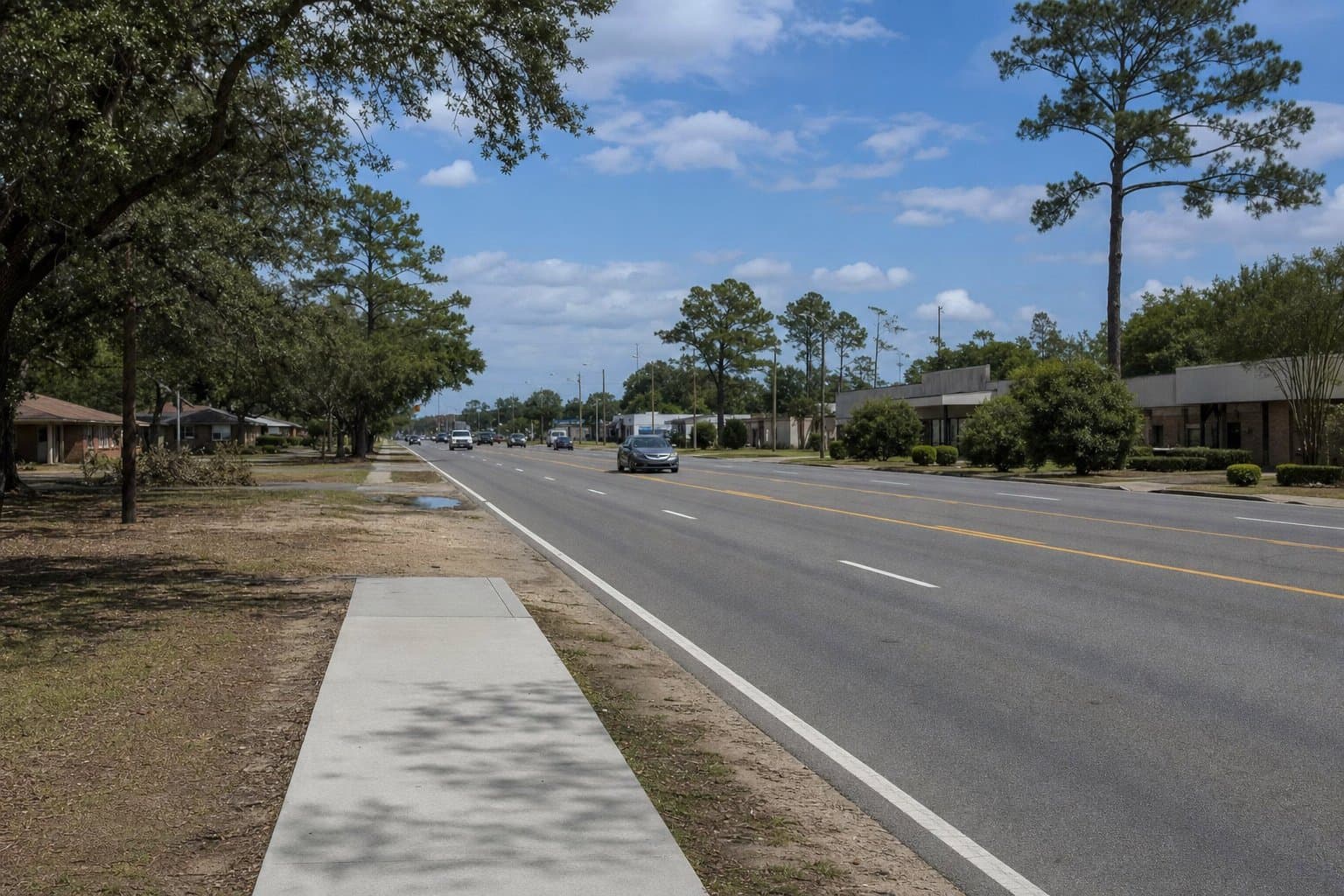
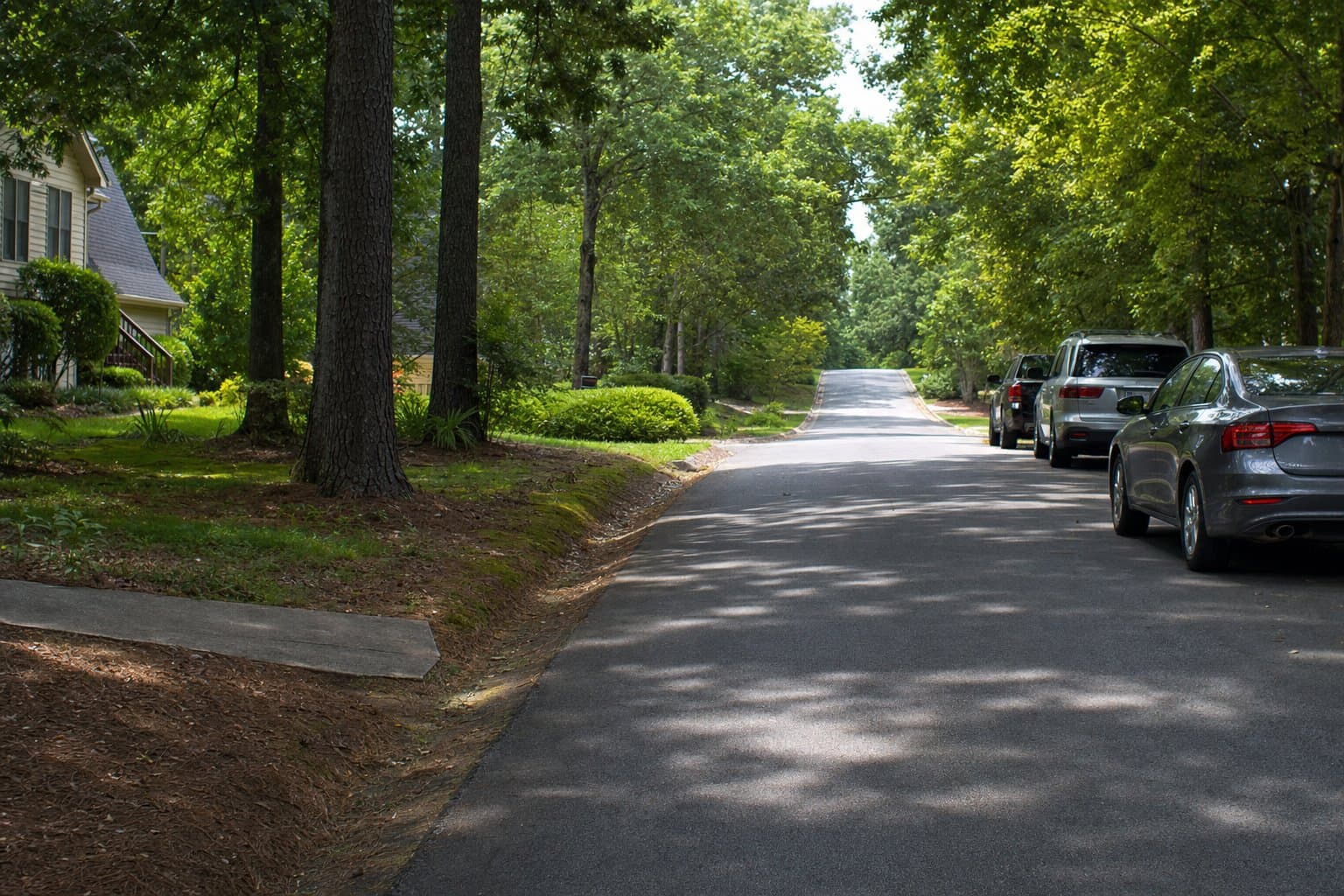
The approach roads share a hostile geometry for anyone on foot. Indian Trail Road, Whitewater Creek Road, and Northridge Road are two-lane residential streets without continuous sidewalks, without striped bike or pedestrian lanes, and with only intermittent gravel shoulders. The tree canopy that makes the neighborhood beautiful also drops light levels sharply at dawn and dusk — exactly when most hikers approach. Driveways cut into blind curves. Drivers running the Indian Trail shortcut between Mt. Vernon Highway and the river accelerate on the descents.
Add weekend rideshare drop-offs (Uber and Lyft drivers using Google Maps to take Indian Trail Road as a shortcut), Truist Park gameday spillover from across the river, and overflow parking from the Akers Mill Unit and Paces Mill Unit trailheads less than a mile away, and the result is an environment where a 35 mph posted limit routinely sees 45-plus mph traffic in a corridor where someone on foot is functionally invisible.
The Numbers: National and Georgia Pedestrian Trends
A Sandy Springs East Palisades pedestrian accident lawyer is working against statistical headwinds that have only steepened over the past decade.
According to the National Highway Traffic Safety Administration's Fatality Analysis Reporting System (FARS), 7,522 pedestrians were killed in U.S. traffic crashes in 2022 — the highest annual total since 1981 and roughly an 80% increase from the 2009 low.
According to the Governor's Office of Highway Safety, Georgia recorded 333 pedestrian fatalities in 2022, a year-over-year increase, with metro Atlanta corridors repeatedly flagged as elevated risk. Fulton County consistently ranks near the top of the state's pedestrian-fatality counts.
According to Smart Growth America's 2024 "Dangerous by Design" report, the Atlanta metro ranks among the top 20 most dangerous large U.S. metro areas for pedestrians, with the Pedestrian Danger Index driven by wide arterial roads designed for vehicle throughput rather than pedestrian survival — a description that fits the wider Mt. Vernon / Northside / I-75 grid that feeds Indian Trail Road.
According to the Insurance Institute for Highway Safety, the relationship between vehicle impact speed and pedestrian outcome is non-linear and brutal — survival drops sharply between 20 and 40 mph.
| Vehicle impact speed | Approximate risk of severe injury to struck pedestrian | Approximate risk of fatal injury |
|---|---|---|
| 20 mph | ~10% | ~1% |
| 30 mph | ~40% | ~10% |
| 40 mph | ~75% | ~50% |
| 50 mph | ~90%+ | ~75% |
Source: IIHS analysis of pedestrian-injury data. Figures are approximate ranges drawn from the study; individual outcomes vary with vehicle profile (SUV/truck vs. sedan), point of impact, and victim age.
The takeaway for an Indian Trail Road or Northridge Road crash is that the difference between a posted 35 mph zone and the 45-plus mph operating speed is the difference between a survivable injury and a fatality. That is why speed-camera footage, event-data-recorder (EDR) downloads from the striking vehicle, and any available doorbell or trailhead-lot security video are the first three pieces of evidence a Sandy Springs personal injury lawyer preserves.
What the Driver Owed You: Georgia's Pedestrian Statutes
Georgia's pedestrian-protection framework rests on three companion statutes. A defense insurer will try to flip each of them against you, so it matters that the firm handling the case knows them in tension with one another, not in isolation.
O.C.G.A. § 40-6-93 — Driver's duty to exercise due care. Every driver must exercise due care to avoid colliding with any pedestrian, give warning by sounding the horn when necessary, and exercise proper precaution upon observing any child or any obviously confused or incapacitated person upon a roadway. This is the workhorse statute for trailhead-area cases. It applies even when the pedestrian is crossing mid-block on Indian Trail Road, and it survives a finding that the pedestrian was partly at fault.
O.C.G.A. § 40-6-91 — Driver to yield in crosswalks. When traffic-control signals are not in place, the driver of a vehicle must stop and remain stopped to allow a pedestrian to cross the roadway within a crosswalk. Most of the approach roads to East Palisades do not have marked crosswalks, but Northside Drive past North Atlanta High School (0.93 miles south) does — and § 40-6-91 controls there.
O.C.G.A. § 40-6-92 — Crossing other than at crosswalk. A pedestrian crossing a roadway at a point other than within a marked crosswalk or an unmarked crosswalk at an intersection must yield the right of way. This is the statute the defense will invoke against an East Palisades pedestrian almost every time. The counter is § 40-6-93: yielding the right of way does not relieve a driver of the duty of due care.
Mark Wade, lead attorney at Georgia Auto Law, points out that the most common error pedestrians make after a trailhead-area crash is conceding partial fault to the responding officer at the scene. A statement like "I was probably out in the road a little" gets quoted verbatim in the Sandy Springs Police narrative and surfaces eighteen months later as exhibit one in the insurer's comparative-negligence argument. The right answer at the scene is to describe what you saw and what you did, not what you think you should have done.
Have Questions About Your Case?
Get a free consultation with an experienced Georgia accident attorney.
Where Your Case Will Be Filed: Fulton County, Not "Sandy Springs"
A pedestrian-injury suit arising from an Indian Trail Road or Whitewater Creek Road crash is, by default, filed in Fulton County State Court — the civil trial court with subject-matter jurisdiction over auto-injury cases and no monetary cap. Wrongful-death claims and cases joined with equitable relief go to Fulton County Superior Court. Sandy Springs Municipal Court handles citations for the traffic violation only; it is not a civil-injury forum, has no jurisdiction over your damages claim, and cannot order an insurer to pay.
The federal wrinkle: if the crash occurred inside the Chattahoochee River National Recreation Area boundary — and the East Palisades, Akers Mill, Paces Mill, and Bamboo Forest units all sit inside that boundary — and an NPS vehicle, an NPS employee, or a dangerous condition on NPS land contributed, the Federal Tort Claims Act governs the federal piece. Under 28 U.S.C. § 2675, you must present a written administrative claim to the agency before filing federal suit, with a two-year deadline that runs from the date of the crash. If the agency denies or sits on the claim for six months, you can file in the U.S. District Court for the Northern District of Georgia.
Most East Palisades pedestrian claims do not require FTCA analysis. The typical fact pattern is a private driver striking a hiker on the city street, and that is a clean state-court case in Fulton County against the driver and the driver's auto insurer. The FTCA issue arises only when the crash happens on federal land or involves federal conduct.
| Court | What it hears | Typical East Palisades pedestrian case relevance |
|---|---|---|
| Fulton County State Court | Civil cases (no monetary cap) | Default forum for an Indian Trail Road / Northridge Road / Whitewater Creek Road pedestrian-injury suit |
| Fulton County Superior Court | Wrongful death; equity; felony criminal | Used when the crash is fatal or joined with equitable relief |
| Sandy Springs Municipal Court | Traffic citations inside Sandy Springs city limits | The driver's failure-to-yield ticket is heard here. The court has no jurisdiction over your damages claim. |
| U.S. District Court — Northern District of Georgia | Federal-question and FTCA suits | Used only when NPS conduct or NPS-property condition contributed and the FTCA administrative claim has been exhausted |
The practical implication: do not waste a single one of your two years waiting on the outcome of a municipal-court traffic case to "see what the driver gets." Those calendars run on different clocks for different purposes.
The 50% Bar: Comparative Negligence in Trailhead-Area Cases
Georgia is a modified comparative negligence state under O.C.G.A. § 51-12-33. An injured pedestrian can recover only if found less than 50% at fault, and any recovery is reduced by their assigned percentage of fault. At 50% or more, recovery drops to zero.
Defense insurers in East Palisades cases lean on the same playbook nearly every time: the pedestrian was crossing mid-block (§ 40-6-92), was wearing dark clothing, was distracted by a phone, was walking with the flow of traffic instead of against it, or stepped from between parked cars. The counter is a methodical reconstruction — vehicle speed from EDR data, lighting and sightline analysis of the approach road, scene photographs taken before vegetation grows out, and where available the school-zone speed-camera footage from Northside Drive. The civil-claim file has to be built so that an adjuster looking at it sees not "the pedestrian wasn't in a crosswalk" but "even granting that, the driver was speeding on an unlit residential road with no shoulder and failed § 40-6-93."
Mark Wade notes that the firm's hardest-fought trailhead pedestrian cases turn on whether the law firm can shift the operative speed from the posted 35 mph to the actual 45-plus mph the corridor runs at — because once the impact speed is on the record, IIHS survival data does the rest of the work on the damages side.
What to Do After a Crash Walking To or From the Trailhead
- Call 911. Sandy Springs Police Department writes the report inside city limits. The crash case number is the spine of every later claim. Reports are typically available 5–7 business days from the Sandy Springs Records Unit.
- Get evaluated by a hospital. WellStar Windy Hill Hospital is closest (~2.6 mi); Northside Hospital Atlanta is the nearest trauma-designated facility (Level III). Concussion and internal-injury symptoms can present hours later — do not let EMS leave without documentation that you were offered transport.
- Photograph the scene before vegetation grows or weather changes. Indian Trail Road's sightlines change month-to-month. Lighting at the actual time of day matters.
- Identify witnesses immediately. Trailhead lots empty within hours. Doorbell cameras on the approach roads overwrite within 14 to 30 days — the Atlanta car accident attorneys at our firm canvas door-to-door inside 48 hours when the timing window matters.
- Notify your own auto-insurance carrier. Even as a pedestrian, your own policy may have med-pay and (if the driver fled) uninsured-motorist coverage available. Do not give a recorded statement before talking to counsel.
- Calendar the two-year statute under O.C.G.A. § 9-3-33 the day of the crash, and — if any NPS land or NPS conduct is in the picture — calendar the 28 U.S.C. § 2675 FTCA administrative-claim deadline next to it.
- Talk to a Georgia pedestrian accident attorneys team before the 30-day mark. The federal-jurisdiction question, evidence-preservation requests, and EDR-download preservation letters all need to go out inside that first month.
A Sandy Springs East Palisades pedestrian accident lawyer should also be tracking the dominant catastrophic-injury patterns from these crashes: closed-head injury and concussion (often presenting on Day 2 or 3, sometimes routed through a traumatic brain injury attorney), spinal injuries from the secondary impact with the pavement, and lower-extremity broken bones and fractures — the so-called bumper-fracture pattern in adult pedestrian strikes. Cyclist crashes and hit-and-run incidents on these same roads have their own evidentiary playbooks and are handled in separate analyses; this guide focuses on pedestrians on foot.
Last reviewed: May 26, 2026
Frequently Asked Questions
What should I do first if a driver hit me walking on Indian Trail Road or near the East Palisades trailhead?
Call 911 so Sandy Springs Police generates a crash report — that report is the spine of every later claim. Accept transport to a hospital or document refusal in writing; concussion and internal-injury symptoms often present hours later. Photograph the scene at the actual time of day, identify witnesses (trailhead lots empty within hours), and preserve any doorbell or storefront video on the approach road before it overwrites in 14 to 30 days. Notify your own auto-insurance carrier, but do not give a recorded statement before speaking to a lawyer.
How long do I have to file a Sandy Springs East Palisades pedestrian accident claim?
Two years from the date of the crash under O.C.G.A. § 9-3-33. If the crash occurred on Chattahoochee River National Recreation Area land and a National Park Service vehicle, employee, or condition contributed, you must also present a Federal Tort Claims Act administrative claim under 28 U.S.C. § 2675 — that carries its own two-year deadline running from the date of the crash, and missing it is generally fatal to the federal piece. Do not rely on tolling provisions; file inside two years.
Was I at fault because I wasn't in a crosswalk?
Not automatically. Pedestrians crossing outside a marked crosswalk must yield the right of way under O.C.G.A. § 40-6-92, but yielding does not relieve a driver of the duty of due care under O.C.G.A. § 40-6-93. Defense insurers will argue mid-block crossing pushes you past Georgia's 50% comparative-fault bar under O.C.G.A. § 51-12-33, but a properly built case reconstructs vehicle speed, sightlines, and lighting to keep the operative fault percentage well below 50%.
Will my Sandy Springs pedestrian case go to Sandy Springs Municipal Court?
No. Sandy Springs Municipal Court hears the traffic citation against the driver — it has no jurisdiction over your civil damages claim. Most Sandy Springs auto-injury suits are filed in Fulton County State Court (civil cases, no monetary cap). Fatal cases or claims joined with equitable relief go to Fulton County Superior Court. If federal jurisdiction is implicated, the federal piece runs through the U.S. District Court for the Northern District of Georgia after the FTCA administrative claim is exhausted.
Is a crash inside the Chattahoochee River National Recreation Area different from a crash on Indian Trail Road?
It can be. A crash entirely on a Sandy Springs city street is a clean state-court case in Fulton County. A crash inside the NRA boundary — at the East Palisades, Akers Mill, Paces Mill, or Bamboo Forest units — can implicate federal jurisdiction if an NPS vehicle, employee, or dangerous condition contributed. The FTCA notice deadline under 28 U.S.C. § 2675 is calendared separately from the Georgia statute of limitations. The first 30 days of the case are spent figuring out which side of that line the facts fall on.
What if the driver was speeding well above the posted 35 mph limit on the approach road?
Speed is one of the two or three highest-leverage facts in a pedestrian case because the IIHS data shows survival drops sharply between 20 and 40 mph. Sandy Springs uses school-zone speed cameras on Northside Drive past North Atlanta High School — that footage can be subpoenaed. The striking vehicle's event-data recorder (EDR / "black box") records pre-impact speed for several seconds before impact; a preservation letter from your lawyer inside 30 days is what keeps that data from being overwritten. Doorbell video on Indian Trail Road and Whitewater Creek Road also helps reconstruct operating speed.
Will I have to pay anything up front for a Sandy Springs East Palisades pedestrian accident lawyer?
No. Pedestrian-injury cases at Georgia Auto Law are handled on a contingency-fee basis — the firm advances the costs of investigation, expert witnesses, and litigation, and the fee comes out of the recovery only if the case settles or wins. Consultations are free. There is no charge if there is no recovery.
Talk to a Sandy Springs East Palisades Pedestrian Accident Lawyer
If you or a family member was struck while walking on Indian Trail Road, Whitewater Creek Road, Northridge Road, or anywhere near the Chattahoochee River National Recreation Area trailheads in Sandy Springs, Georgia Auto Law can help. We are Sandy Springs car accident lawyers who handle pedestrian-injury claims throughout Fulton County, calendar both the state two-year statute and any federal FTCA deadline, and litigate in Fulton County State Court, Fulton County Superior Court, and the U.S. District Court for the Northern District of Georgia when the facts require it. Consultations are free and you pay nothing unless we recover for you.
Disclaimer: This article is for general informational purposes only and is not legal advice. Reading it does not create an attorney-client relationship. Statutory deadlines — including the two-year personal-injury statute of limitations under O.C.G.A. § 9-3-33 and the Federal Tort Claims Act administrative-notice deadline under 28 U.S.C. § 2675 — are time-sensitive. Statistics cited are drawn from publicly available reporting by NHTSA, the Governor's Office of Highway Safety, Smart Growth America, and the Insurance Institute for Highway Safety as of the "Last reviewed" date above; figures update annually. Consult a qualified Georgia personal-injury attorney about your particular situation as soon as possible.