Key Takeaways
- A Sandy Springs East Palisades hit and run lawyer almost always opens civil recovery through the victim's own UM/UIM policy under O.C.G.A. § 33-7-11 — not by waiting for police to find the fleeing driver.
- The trailhead approach roads (Indian Trail Road, Whitewater Creek Road, Northridge Road) are unlit two-lane residential streets with multiple escape routes back to GA-400, Mt. Vernon Highway, or Roswell Road inside two miles.
- Georgia UM coverage under O.C.G.A. § 33-7-11 reaches pedestrians and cyclists — not just drivers and passengers inside the insured car — and stacks across resident-relative policies.
- Georgia's two-year statute of limitations under O.C.G.A. § 9-3-33 controls your injury claim; UM policy notice deadlines often run much sooner.
- The fleeing driver's criminal duties under O.C.G.A. §§ 40-6-270 and 40-6-271 describe what should have happened — those statutes do not pay your medical bills.
- Doorbell-camera canvassing within 24 to 48 hours is the single highest-leverage step in any East Palisades hit-and-run case; most residential systems overwrite footage within 7 to 14 days.
- Sandy Springs Police Department writes the report; Sandy Springs Municipal Court is traffic-only. Civil claims are filed in Fulton County State Court at 185 Central Ave SW, Atlanta.

A Sandy Springs East Palisades hit and run lawyer represents people struck by a fleeing driver on the residential approach roads leading into the Chattahoochee River National Recreation Area — Indian Trail Road, Whitewater Creek Road, and Northridge Road. Most cases never identify the at-fault driver, so civil recovery runs through the victim's own uninsured motorist coverage under O.C.G.A. § 33-7-11, and the doorbell footage that supports it overwrites within 7 to 14 days.
What a Sandy Springs East Palisades Hit and Run Lawyer Actually Does
A Sandy Springs East Palisades hit and run lawyer represents people struck on the residential approach roads that feed the East Palisades Unit of the Chattahoochee River National Recreation Area — Indian Trail Road, Whitewater Creek Road, and Northridge Road — by a driver who left the scene. The clients we see in these cases were rarely inside a car. They were runners finishing a sunrise loop, cyclists rolling out of the trailhead lot, or hikers walking back to a parked car. The driver who hit them was often gone before anyone could read a plate.
The legal work that follows looks very little like a routine car-accident case, because there is usually no identified defendant. Recovery happens through the victim's own uninsured motorist (UM) coverage under O.C.G.A. § 33-7-11 and through a tightly compressed evidence canvass — not through normal liability litigation. According to the AAA Foundation for Traffic Safety's annual hit-and-run analysis, more than one in five U.S. pedestrian fatalities involves a fleeing driver, with the fatal hit-and-run rate rising steadily since 2009 and concentrated on multilane arterials and unlit residential streets at night. The East Palisades approach roads fit that second profile precisely.
Why the Trailhead Approach Roads Make Flight Easy
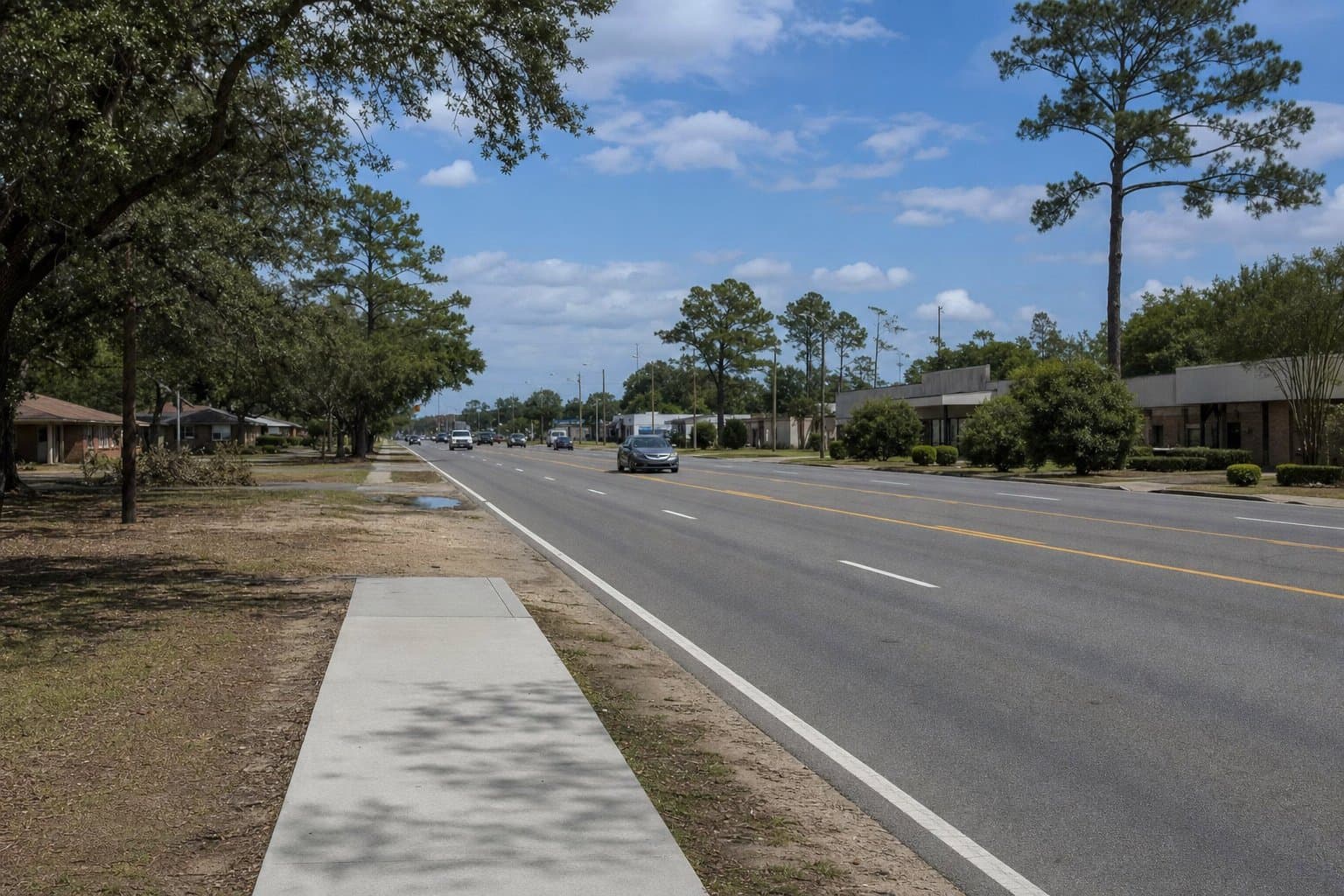
The East Palisades Unit sits at the end of Indian Trail Road, a narrow residential dead-end that empties into a small federal parking lot tucked against the river bluff. Whitewater Creek Road and Northridge Road feed that lot from the north and east. All three roads share the same design pattern: two travel lanes, no sidewalks, no real shoulders, dense tree canopy, no streetlights, and house setbacks deep enough that windows do not face the road. A pedestrian or cyclist struck on any of these roads at 6:30 a.m. or 8:30 p.m. is almost certainly out of sight of any human witness within seconds.
The escape geometry is what really shapes the case. A driver who strikes someone on Indian Trail Road can be on Northside Drive in under 90 seconds, on Mt. Vernon Highway in three minutes, on Roswell Road in four, or on the GA-400 ramps at the Northridge Road interchange in well under five. Each route opens onto a much larger road network — north toward Roswell, west into Cobb County, south into Buckhead — where any single vehicle disappears into normal commuter flow.
According to the National Highway Traffic Safety Administration, U.S. traffic fatalities remained above 40,000 in 2022 and 2023, with vulnerable road users claiming a rising share of that total. The Governors Highway Safety Association reports that Georgia consistently ranks above the national average for pedestrian fatalities, and that most occur on roads without sidewalks, at night, away from marked crosswalks. The National Park Service has documented that the Chattahoochee River National Recreation Area, including the East Palisades Unit, draws more than three million visits annually with peak loads on weekend mornings and early evenings — the exact timing windows when hit-and-run incidents on the approach roads cluster.
Mark Wade, lead attorney at Georgia Auto Law, frames the residential pattern this way: the Roswell Road / Chastain corridor produces hit-and-run cases through sheer post-event volume, while the East Palisades approaches produce them for the opposite reason — there is almost no one out there. A driver who hits a runner at first light on Northridge Road faces a quiet street, no streetlamps, almost no doorbell cameras within line of sight, and four exit ramps within two miles. By the time the next car comes through the vehicle is gone, and the only thing that decides whether the case ever names a defendant is whether someone canvassed the surrounding houses for Ring and Nest footage in the first 24 to 48 hours.
Who Gets Hit — and Why That Shapes Coverage
Most of the people struck on the East Palisades approach roads were not behind the wheel. They were on foot or on a bike, on the way to or from the trail. That distinction shapes which insurance policy pays.
Georgia's uninsured motorist statute, O.C.G.A. § 33-7-11, is broader than most claimants realize. UM coverage extends to the named insured and to resident relatives whether they are inside the insured car, inside someone else's car, on a bicycle, or on foot. A runner who has never been near her own vehicle on the morning she was struck still owns the UM coverage on the policy parked in her driveway — and on every other auto policy in her household. That coverage stacks across vehicles and across resident-relative policies, which is the single most important fact for a victim whose at-fault driver fled.
A vulnerable road user case also requires a different evidentiary build-out than a vehicle-on-vehicle collision: head, spine, pelvis, and lower-extremity injury patterns drive the damages model, and there is no vehicle damage profile to anchor the reconstruction.
Have Questions About Your Case?
Get a free consultation with an experienced Georgia accident attorney.
Criminal Duties vs. Civil Recovery: Why the Two Tracks Diverge
Under Georgia law, the fleeing driver had specific obligations the moment the crash happened. O.C.G.A. § 40-6-270 requires a driver involved in a crash causing injury, death, or significant property damage to stop immediately, return to the scene, and remain. O.C.G.A. § 40-6-271 requires the driver to give name, address, registration, and license information, and to render reasonable aid. Violation of either statute is a criminal offense — a felony where serious injury or death is involved.
Those statutes describe what should have happened. They do not pay your hospital bill or replace lost wages. The criminal prosecution (handled by the Fulton County DA or, for misdemeanor flight, the Solicitor) and the civil injury claim run on different tracks. A Sandy Springs East Palisades hit and run lawyer treats the criminal case as evidence — not as the recovery vehicle.
| Path | Statute / Source | What It Provides | Who Drives It | Deadline |
|---|---|---|---|---|
| Criminal prosecution of fleeing driver | O.C.G.A. §§ 40-6-270, 40-6-271 | Penalties, fines, possible felony; no compensation to victim | Fulton County DA / Solicitor; Sandy Springs PD | Statute of limitations for the criminal offense |
| Identified-driver civil claim | At-fault driver's auto liability policy | Medical bills, lost wages, pain and suffering | Your attorney | 2 years (O.C.G.A. § 9-3-33) |
| Uninsured motorist (UM/UIM) claim | O.C.G.A. § 33-7-11; your auto policy | Medical bills, lost wages, pain and suffering — even if driver is never identified | Your attorney + your own insurer | 2 years SOL plus UM policy notice and cooperation deadlines |
| Resident-relative UM stacking | O.C.G.A. § 33-7-11; each household auto policy | Adds available UM limits from other policies you live with | Your attorney | Same UM deadlines per policy |
| Medical bills paid in the meantime | Health insurance, med-pay, letters of protection | Treatment access while case is pending | Your attorney coordinates with providers | Provider lien rules; subrogation |
The two-year clock under O.C.G.A. § 9-3-33 is the outside fence on the civil case, but the operational deadlines inside a hit-and-run claim run much shorter. Most UM policies require prompt notice to the insurer, cooperation with the investigation, and a signed statement under oath inside a defined window. Missing those deadlines can void coverage that the two-year SOL would otherwise leave intact.
The 48-Hour Evidence Window — and Why It Decides the Case
The single most important step in any East Palisades hit-and-run case is the doorbell-camera canvass. Ring, Nest, Wyze, Eufy, and most utility-installed systems retain footage on rolling 7- to 14-day cycles before overwriting. By the time a victim is discharged from the emergency department, half of that window may already be gone.
The lawyer's first 48 hours on the case look like this: pull the Sandy Springs Police Department case number (the full report takes 5 to 7 business days via the SSPD Records Unit, but the number and assigned officer are available immediately); identify every residence and parked vehicle within a half-mile of the impact point along Indian Trail Road, Whitewater Creek Road, or Northridge Road; door-knock or hand-deliver preservation letters to those addresses; request preservation from the National Park Service for any East Palisades trailhead parking lot footage that may have captured a vehicle leaving at speed; and pull Georgia DOT traffic-camera retention from the nearest GA-400 ramps. Most of that work has to happen before the seven-day overwrite cycle, not before the two-year statute of limitations.
According to the AAA Foundation for Traffic Safety, identified-driver rates in hit-and-run pedestrian cases run below 30% nationally even with a meaningful police investigation, and the civil identification rate when no doorbell canvass occurs in the first 48 hours is much lower. An identified driver opens a third-party liability claim on top of the victim's UM claim, which can be material when serious injury exposure exceeds available UM limits.
Comparative Fault on a Dark Residential Road
Georgia's modified comparative negligence rule under O.C.G.A. § 51-12-33 lets a defense insurer — or your own UM carrier, which steps into the fleeing driver's shoes — reduce or bar recovery by pushing 50% or more of the fault onto the victim. On the East Palisades approach roads, the playbook is predictable: dark clothing, no rear light, outside the unmarked edge line, on the road during low-light hours.
A capable Sandy Springs East Palisades hit and run lawyer prepares for that argument before the UM carrier opens the file: preserve the victim's clothing and any reflective gear; document the lighting and weather at the precise time of impact; pull sunrise/sunset and astronomical-twilight data for the date; and secure any GPS or fitness-app records (Strava, Garmin Connect, Apple Health) that establish the victim's path and speed. The point is to keep the 50% bar from ever attaching — once the carrier evaluates the file with the victim past 50%, the case is essentially over.
Jurisdiction: Sandy Springs PD, Federal Land, and Where the Civil Case Is Filed
The geography around East Palisades has three overlapping authorities:
- Sandy Springs Police Department writes the crash report for any incident on the residential streets approaching the trailhead — Indian Trail Road, Whitewater Creek Road, Northridge Road, and the surrounding grid. Reports clear the SSPD Records Unit 5 to 7 business days after the crash.
- National Park Service has primary jurisdiction inside the federal recreation area boundary, which generally begins at the trailhead parking lot. An impact inside that boundary can pull a Federal Tort Claims Act notice (28 U.S.C. § 2675) into play with strict procedural deadlines.
- Georgia State Patrol works GA-400 itself; many fleeing drivers reach the ramp within minutes, and GSP traffic-camera retention is sometimes the only durable footage of the vehicle leaving the area.
The civil case is filed in Fulton County State Court at 185 Central Ave SW, Atlanta — the default forum for Sandy Springs auto-injury suits. Insurer panels know the venue and tend to evaluate jury exposure higher than in suburban counties. Fulton County Superior Court handles wrongful-death and equity claims; Sandy Springs Municipal Court is traffic-only.
Common Injuries on the Approach Roads
Pedestrians and cyclists struck by passenger vehicles on unlit residential roads at 30 to 45 mph cluster around a predictable injury profile: traumatic brain injuries from secondary impact with the pavement; back and spinal injuries (transverse process fractures, disc herniations, spinal-cord contusions); and broken bones and fractures (tibia/fibula, pelvis, scapula, distal radius from the bracing reflex). Concussion injury claims are nearly universal when the victim was thrown from a bicycle, even with helmet use.
Treatment for serious cases routes to WellStar Windy Hill Hospital (2.58 miles, closest acute care, not Level I), Northside Hospital Atlanta (about 3 miles east, Level III trauma), or Grady Memorial Hospital (Atlanta's Level I trauma center, the standard destination for severe TBI or polytrauma). Each injury pattern drives a different treatment timeline and damages model, which is why the lawyer's medical work-up has to start well before settlement discussion.
Frequently Asked Questions
The driver fled near the East Palisades trailhead — what do I do now?
Call 911 if anyone is injured. The Sandy Springs Police Department dispatch covers the residential approach roads. Get the case number from the responding officer before they leave the scene — the full report takes 5 to 7 business days through the SSPD Records Unit, but the case number unlocks an immediate doorbell-camera canvass. Take photos of the impact area, any debris from the fleeing vehicle (broken glass, plastic fragments, mirror housing), tire marks, and your own injuries and clothing. Then call a Sandy Springs East Palisades hit and run lawyer the same day — the seven-day doorbell-camera overwrite window is already running.
Does my own insurance pay even though the driver got away?
Yes, in almost every case. Georgia requires every auto policy to offer uninsured motorist coverage under O.C.G.A. § 33-7-11, and most Sandy Springs households carry it. UM steps into the at-fault driver's shoes when the driver is never identified. Recovery includes medical bills, lost wages, and pain and suffering — the same categories you would recover from an identified at-fault driver — up to the UM limits on your policy and any resident-relative policies that can be stacked.
What if I was a pedestrian, not in a car?
Georgia UM coverage under O.C.G.A. § 33-7-11 follows the named insured and resident relatives, not just the insured vehicle. If you were a runner struck on Whitewater Creek Road or a hiker walking the shoulder back to your car at the East Palisades trailhead, the UM coverage on the auto policy sitting in your driveway covers you. The same is true for resident-relative coverage on any policy in your household. Cyclists are covered on the same principle.
How long do I have to canvass for doorbell footage?
Operationally, you have 7 to 14 days, with the first 48 hours by far the most important. Most Ring, Nest, Wyze, Eufy, and utility-installed systems retain footage on a rolling cycle and overwrite without warning. A preservation letter delivered before the cycle resets can hold the footage; one delivered after is useless. The two-year statute of limitations under O.C.G.A. § 9-3-33 does not help — by the time it matters, the evidence is gone.
Why is Fulton County State Court the court I'll end up in?
Fulton County State Court at 185 Central Ave SW in Atlanta is the default forum for Sandy Springs auto-injury suits, with subject-matter jurisdiction over the claim and dockets that move. Fulton County Superior Court handles wrongful-death and equity claims. Sandy Springs Municipal Court is traffic-only — citations under O.C.G.A. §§ 40-6-270 and 40-6-271 pass through there, but no civil money claim is filed there.
Will I lose my recovery because I was running in the street at dawn?
You will face that defense. Georgia's modified comparative negligence rule under O.C.G.A. § 51-12-33 lets the UM carrier reduce your recovery by your percentage of fault and bar it entirely at 50% or more. The standard playbook — dark clothing, no reflective gear, off the white line, low-light timing — is predictable enough that your lawyer should be preparing for it from day one. Preservation of clothing, fitness-app GPS records, twilight data, and any available camera footage is what prevents the 50% bar from attaching.
Does it matter that part of the road is inside the National Recreation Area?
Sometimes. If the impact occurred on the city street (Indian Trail Road, Whitewater Creek Road, Northridge Road, or any other Sandy Springs residential road approaching the park), Sandy Springs PD has jurisdiction and the civil case proceeds normally. If the impact occurred inside the federal boundary — typically at the trailhead parking lot or on a federally maintained roadway inside the recreation area — the Federal Tort Claims Act notice under 28 U.S.C. § 2675 may come into play if a federal employee or NPS condition contributed. That notice has its own deadlines and procedural requirements separate from the two-year SOL.
Talk to a Sandy Springs East Palisades Hit and Run Lawyer
If you or a family member was struck by a fleeing driver on Indian Trail Road, Whitewater Creek Road, Northridge Road, or any of the residential approaches into the East Palisades Unit of the Chattahoochee River National Recreation Area, the most important thing you can do today is preserve the doorbell-camera footage on the surrounding blocks before it overwrites. The second most important is to confirm the full UM/UIM coverage on every auto policy in your household under O.C.G.A. § 33-7-11.
Georgia Auto Law represents hit-and-run victims across Sandy Springs and the broader Atlanta corridor. We are Sandy Springs car accident lawyers who handle trailhead-area cases regularly. Our practice covers the Atlanta car accident attorneys work that opens a hit-and-run claim, the uninsured-motorist coverage path that follows, and the broader Sandy Springs personal injury lawyer representation that ties them together. When the victim was a vulnerable road user, our Georgia pedestrian accident attorneys and Atlanta bicycle accident lawyers teams coordinate the medical and reconstruction work, with traumatic brain injury attorney, broken bones and fractures, and spinal injuries protocols on top.
Call (404) 662-4949 to talk through your case with a Sandy Springs East Palisades hit and run lawyer. The consultation is free, and the conversation is privileged.
Last reviewed: May 26, 2026