Key Takeaways
- A claim against MARTA requires written ante litem notice within six months of the incident. Miss it and the case is generally barred.
- For private-driver crashes (cars, Uber, Lyft, taxis), Georgia's personal-injury statute of limitations is two years under O.C.G.A. § 9-3-33.
- Under Georgia's modified comparative negligence rule (O.C.G.A. § 51-12-33), you can recover only if you are less than 50% at fault.
- Uber and Lyft carry tiered insurance based on app phase — off, on but waiting, or in an active trip.
- O.C.G.A. § 33-7-11 governs uninsured/underinsured motorist (UM/UIM) coverage — critical after a hit-and-run on Buford Highway or an underinsured at-fault driver.
- DeKalb County State Court and DeKalb County Superior Court (both in Decatur) hear these cases.
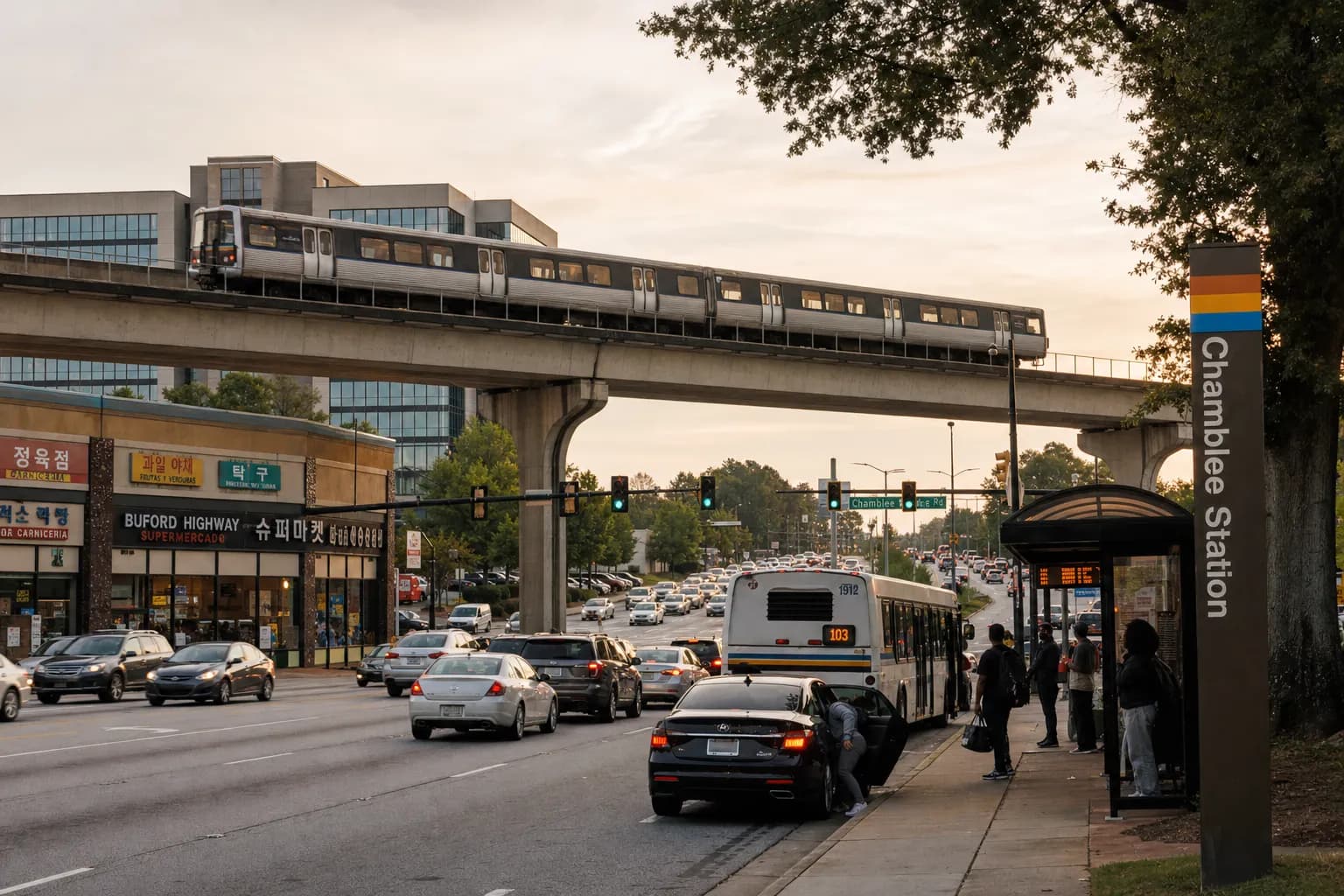
A Chamblee MARTA or rideshare accident claim is a Georgia personal injury case arising from a crash involving a MARTA bus or train, an Uber or Lyft vehicle, or another driver in the corridor surrounding the Chamblee MARTA station and Buford Highway. These claims are filed in DeKalb County courts under Georgia tort law — but a MARTA claim triggers a strict six-month ante litem notice that does not apply to a standard private-driver case.
The Chamblee Corridor: Why Crashes Cluster Here
The Chamblee MARTA station sits at one of metro Atlanta's busiest transit-and-roadway convergence points. Within a one-mile radius, the Gold Line, MARTA's surface bus network, Buford Highway (US 23 / GA 13 — seven lanes here), Chamblee Tucker Road, Peachtree Industrial Boulevard, and Dresden Drive all feed the same intersections. The U.S. Census Bureau's 2023 estimates put DeKalb County at more than 763,000 residents — Georgia's fourth-largest county — and the Atlanta Regional Commission has consistently flagged Buford Highway as one of the highest-risk multimodal roadways in metro Atlanta.
The Numbers: How Risky Is This Corridor?
Pedestrian fatalities are at a 40-year high — and Georgia is above the curve. According to the National Highway Traffic Safety Administration (NHTSA), 7,522 pedestrians were killed in U.S. traffic crashes in 2022, the highest figure recorded since 1981. Georgia's Governor's Office of Highway Safety (GOHS) reports the state logged 333 pedestrian deaths in 2022, a 4.7% year-over-year increase. Multi-lane arterials like Buford Highway — where pedestrians cross between transit stops, retail, and residential — are precisely the environments NHTSA flags as elevated risk.
Rideshare expansion correlates with more crashes. A 2018 University of Chicago / Rice University working paper, cited by the National Bureau of Economic Research, found the introduction of ride-hailing correlated with an estimated 2-3% increase in U.S. traffic fatalities — driven by more vehicle miles traveled, deadhead driving between fares, and in-app driver distraction. Rideshare drivers cluster around transit hubs like the Chamblee station for the first- and last-mile market.
Transit buses are statistically safer per passenger mile — but the crashes that happen are severe. According to the Federal Transit Administration's National Transit Database, U.S. transit buses are involved in far fewer fatal crashes per passenger mile than personal vehicles. The trade-off: when a 40,000-pound bus collides with a sedan, pedestrian, or cyclist, the size and weight differential produces far worse injury outcomes for everyone outside the bus.
Common Accident Types Near the Chamblee MARTA Station
MARTA bus and rail crashes
MARTA buses use Buford Highway, Chamblee Tucker Road, and Peachtree Industrial Boulevard heavily. The most common bus-involved scenarios are right-hook collisions with vehicles passing on the right, left-turn conflicts at signalized intersections, and pedestrian strikes near bus stops. A claim against MARTA is a claim against a public transit authority, and the rules are different. See MARTA bus accident claims and the statewide bus accident lawyer overview for the procedural specifics.
Uber and Lyft rideshare crashes
Chamblee is dense with first- and last-mile rideshare activity feeding the MARTA station, the Buford Highway restaurant corridor, and Dresden Drive. The recurring fact pattern is a rideshare driver pulling to or from the curb without signaling, executing an unsafe lane change to reach a pin-drop, or rear-ending in stop-and-go traffic while their attention is on in-app navigation. A rideshare accident lawyer will know to pull the app's trip data and rider GPS log — both are critical to fix which insurance period applies.
Hit-and-run and uninsured-motorist crashes
Hit-and-run rates spike on commercial arterials with bar and restaurant density, and Buford Highway is one of the most prominent examples in metro Atlanta. When the at-fault driver flees or carries no insurance, your own uninsured motorist coverage under O.C.G.A. § 33-7-11 becomes the primary source of recovery. Coordination with a hit-and-run accident lawyer matters because UM claims have their own notice and proof requirements.
Pedestrian and bicycle collisions
The Buford Highway corridor near Dresden Elementary School and the Chamblee station has long-standing pedestrian-safety concerns. Georgia law gives pedestrians the right of way in marked and unmarked crosswalks under O.C.G.A. § 40-6-91 and § 40-6-92. Distance between safe crossings on Buford Highway is a documented contributor to mid-block strikes — an Atlanta pedestrian accident lawyer will reconstruct the crossing geometry, signal timing, and any contributing distraction.
Have Questions About Your Case?
Get a free consultation with an experienced Georgia accident attorney.
Rideshare vs. MARTA Bus: How Liability and Notice Differ
The two most distinctive claim paths in the Chamblee corridor look similar — both involve a commercial driver carrying passengers — but the legal infrastructure is completely different.
| Factor | Rideshare crash (Uber / Lyft) | MARTA bus crash |
|---|---|---|
| Defendant | Private driver; possibly Uber/Lyft as the TNC | MARTA — a public transit authority |
| Pre-suit notice | None required beyond standard insurance notice | Ante litem notice required within 6 months |
| Statute of limitations | 2 years for personal injury (O.C.G.A. § 9-3-33) | 2 years for the tort, but barred without timely ante litem notice |
| Primary insurance | Tiered by app phase — driver's personal policy when app is off; up to $1M when a trip is matched or in progress | MARTA self-insures up to its statutory cap; commercial policies layer above |
| Damages cap | None on common-law negligence claims | Statutory limits apply to claims against a transit authority |
| Where filed | DeKalb County State Court (most cases) or Superior Court | DeKalb County State Court or Superior Court, depending on relief |
| Key evidence | Trip log, app phase, driver phone records, dash cam | Bus video, driver log, MARTA incident report, dispatch audio |
The pre-suit notice difference is the most important distinction. A MARTA claim is functionally over before it starts if no one sends written notice within six months. A rideshare claim against a private Uber driver has the full two-year window.
The 6-Month Ante Litem Rule for MARTA
If a MARTA bus, train, or operator caused or contributed to your injury, you (or your attorney) must send written ante litem notice to MARTA within six months of the incident. The notice has to identify the time, place, and circumstances of the loss; the nature of the injury; and the amount claimed. It must be served on the right MARTA officer — a notice that omits a required element or goes to the wrong department has been held insufficient by Georgia appellate courts.
This is the procedural trap that catches more MARTA injury claimants than any other. Most clients assume the standard two-year window under O.C.G.A. § 9-3-33 applies here. It does not. By the time someone finishes physical therapy and starts thinking about a lawyer, the MARTA notice deadline has often passed — and with it, the case.
"The single most common reason a MARTA case dies on the table is missed ante litem notice. People recover from a bus crash, get back to work, and a year later think about calling a lawyer — and at that point, six months have come and gone and we have to tell them there is nothing we can do. If you were hit by a MARTA bus on Buford Highway, or hurt at the Chamblee station, you do not have two years to think about it. You have weeks. Get the notice on the right desk, then take all the time you need to decide how to proceed."
— Mark Wade, Founder and Lead Attorney, Georgia Auto Law
Where Your Case Will Be Filed: DeKalb County Courts
A Chamblee corridor injury claim is filed in DeKalb County. DeKalb County State Court handles civil cases without a monetary cap and is where most personal injury claims — MARTA, rideshare, and private-driver — actually proceed. DeKalb County Superior Court has full equity jurisdiction and hears claims that combine personal injury with real-property issues, requests to set aside settlements, or felony-adjacent conduct. Both courts sit in Decatur and impanel 12-person juries.
Uninsured Motorist Coverage: The Quiet Workhorse
In Georgia, UM/UIM coverage under O.C.G.A. § 33-7-11 is often the difference between a full recovery and a paper verdict no one can collect on. Two scenarios are routine here. First, hit-and-run — a driver clips you on Buford Highway and disappears into a side street off Dresden Drive before you have the plate; your own UM coverage steps in as if the phantom driver were a named defendant. Second, underinsured at-fault driver — Georgia's minimum liability is $25,000 per person / $50,000 per accident, and a serious orthopedic or traumatic-brain injury blows past that limit before discharge from the emergency department; your UIM coverage sits behind the at-fault driver's policy to make up the difference.
What to Do After a Crash in the Chamblee Corridor
- Call 911. Chamblee Police, DeKalb County Police, or Georgia State Patrol will dispatch. An official crash report is the spine of every later step.
- Get medical attention. Emory Decatur Hospital and Northside Hospital Atlanta are the two closest emergency departments. Soft-tissue and traumatic-brain symptoms can present hours or days later.
- Document the scene. Photograph vehicles, the bus or rideshare vehicle's identifying markings (route number, license plate, app trip number), road surface, signage, signal phase, and landmarks fixing the location.
- If a MARTA vehicle was involved, note the bus number, route, and operator name — visible on the dashboard or near the front door.
- Preserve station-area surveillance. The Chamblee MARTA station and surrounding businesses typically overwrite footage within 14-30 days. A preservation letter in the first week is essential.
- Do not give a recorded statement to MARTA's claims unit or the at-fault driver's insurer. Talk to a Chamblee car accident lawyer first.
- If MARTA was involved, treat the six-month ante litem deadline as immediate. Calendar it from the day of the incident.
Why Local Knowledge Matters Here
A personal injury lawyer handling a Chamblee corridor case should know how MARTA's claims office processes notice, which DeKalb County State Court judges run which calendars, and how Buford Highway's signal timing changes the fault analysis on a mid-block pedestrian strike. Georgia Auto Law represents clients across DeKalb County, and our Chamblee personal injury attorney coverage extends throughout the Chamblee, Brookhaven, and Doraville corridor.
Frequently Asked Questions
How long do I have to sue MARTA after a bus or train accident?
You must serve written ante litem notice on MARTA within six months of the incident, and file suit within the standard two-year personal injury statute of limitations under O.C.G.A. § 9-3-33. Missing the six-month notice deadline generally bars the claim entirely. The notice must identify the time, place, and circumstances of the loss; the nature of the injury; and the amount claimed.
How long do I have to sue Uber or Lyft after a rideshare crash?
Two years from the date of the crash under O.C.G.A. § 9-3-33 — the same as any private-driver case. There is no ante litem requirement for Uber, Lyft, or their drivers. Evidence still disappears fast (trip logs, dash cam footage, in-app records), so contacting a rideshare accident lawyer early materially improves your odds.
Which insurance covers an Uber or Lyft crash near the Chamblee MARTA station?
It depends on the driver's app phase at the moment of the crash. If the app was off, the driver's personal auto policy is primary. If the app was on but the driver had not yet matched with a passenger, Uber and Lyft each provide contingent liability coverage with stated limits. If the driver was en route to or carrying a passenger, the platform's $1 million third-party liability policy applies. Establishing the correct phase is the central evidentiary fight in most rideshare cases.
What if a hit-and-run driver struck me on Buford Highway?
Your own uninsured motorist coverage under O.C.G.A. § 33-7-11 is generally the primary source of recovery, provided you report the incident promptly. Georgia requires UM coverage to be offered with every auto policy, though it can be rejected in writing. Even if the phantom driver is never identified, a UM claim can proceed against your own carrier as if the unknown driver were a named defendant.
Where will my Chamblee accident case be filed?
In DeKalb County. Most personal injury cases are filed in DeKalb County State Court in Decatur. DeKalb County Superior Court handles cases that combine personal injury with equitable relief, real property issues, or felony-adjacent conduct. Both courts impanel 12-person juries.
What if I was partially at fault for the crash near the Chamblee station?
You can still recover, as long as a jury or adjuster finds you less than 50% at fault under O.C.G.A. § 51-12-33. Your damages are reduced by your percentage of fault. If you are 50% or more at fault, you recover nothing. Adjusters in transit and rideshare cases often try to push the injured party's fault percentage upward — a detailed liability investigation with trip logs, bus video, and signal-phase data is the counterweight.
Is the Chamblee MARTA park-and-ride lot considered MARTA property?
Yes. The station, its platform, the park-and-ride lot, and the bus loading zones are MARTA-controlled property. A slip-and-fall, struck-pedestrian, or vehicle-on-vehicle incident on those premises is generally a claim against MARTA — subject to the same six-month ante litem notice rule that governs an on-vehicle bus or train injury.
Talk to a Chamblee MARTA and Rideshare Accident Lawyer
If you or a family member was injured in a MARTA bus or train crash, an Uber or Lyft collision, a hit-and-run, or any auto accident near the Chamblee MARTA station, Buford Highway, or the Dresden Drive and Peachtree Industrial Boulevard corridor, Georgia Auto Law can help. We handle MARTA ante litem notices, rideshare app-phase investigations, and DeKalb County litigation. Consultations are free and you pay nothing unless we recover for you.
Last reviewed: May 13, 2026
Disclaimer: This article is for general informational purposes only and is not legal advice. Reading it does not create an attorney-client relationship. Statutory deadlines — including the MARTA six-month ante litem notice and the two-year personal injury statute of limitations — are time-sensitive; consult a qualified Georgia personal injury attorney about your particular situation as soon as possible.