
Key Takeaways
- Georgia personal-injury claims must be filed within two years of the date of injury under O.C.G.A. § 9-3-33; minors' claims are tolled until they reach majority.
- Georgia is a modified comparative negligence state (O.C.G.A. § 51-12-33) — you can recover if you are less than 50% at fault, with damages reduced by your share.
- According to the Centers for Disease Control and Prevention, unintentional injuries account for over 220,000 deaths annually in the U.S., with motor vehicle crashes among the leading causes.
- Damages in a Georgia personal-injury case include medical bills, lost income, future earning capacity, pain and suffering, and (in catastrophic cases) loss of enjoyment of life — there is no cap on most economic or non-economic damages.
- Most Georgia personal-injury matters resolve through pre-suit negotiation or settlement; a Georgia personal injury lawyer can value the claim and negotiate from a position of evidence and statute knowledge. Free consultations via our contact page.
If you commute to your work with a bike or like to ride your bike in the streets and let loose, you should learn basic bike hand signals. While law enforcement rarely compels you to make the signal with your hands, they can decrease the chances of a collision, its injuries, and fatalities.
Therefore, we’ll tell you why bike hand signals came to be and point out how they make cycling and your commute or joyride safer, whether you’re riding alone or in a group.
The Importance of Cycling Hand Signals
Knowing how to make bicycle signals is a crucial thing that all cyclists need to learn. That’s because those hand signals can prevent numerous bike and car accidents that occur due to misunderstandings and miscommunications between road users, both other bicyclists and car drivers.
Overall, they function in cycling in the same way that brake lights and turn indicators do in cars. They allow you to communicate your intended movements with the vehicles and other bikers around you.
What Are the Hand Signals for Bike Riding?
There are three basic hand signals that you must know if you’re planning on riding a bike within the streets among other vehicles and bikers. These signals are the left turn, right turn, and stop signals. There’s also the slowing down signal, which is a slight variation of the stop signal and another gesture used to warn other cyclists of hazards on the road ahead.
Nevertheless, always remember to make eye contact with those around you before you signal so that they see and comprehend your intentions. That way you’ll considerably decrease the probability of an accident and stay safer on the road.
Left Turn
Quite simply, to gesture to alert the people around you that you’re about to turn left, you have to raise your left arm and extend it horizontally out to your side.
Moreover, the same hand signal will be used if you’re changing lanes to the left. Just like with cars, you need to warn other drivers before changing lanes or turning left so that they’re aware of you and able to react and stay safe and respond accordingly.
Once you’ve looked back and ensured that no vehicles are passing on your left, execute the left turn signal and change lanes. Still, always remember to check that no obstacles or potholes are ahead of you before you look back.
Most importantly, remember to signal well before you turn or change lanes, and hold the signal for a sufficient amount of time. Generally, you should make the hand signal about 100 feet before the turn and hold it for approximately three seconds. As such, your left hand will be back on the brakes or handlebars as you’re turning, making for a smoother and safer turn.
Right Turn
When you’re signaling that you’re about to make a right turn, you have two options. First, you can extend your left arm outstretched as you would when making a left turn. Then, bend your elbow upwards to make a right angle with your hand open. Second, you can extend your right arm out horizontally.
While the first signal is considered outdated and is no longer recommended for use, both are accepted and recognised in Georgia and most other states. So, find the most comfortable one for you and stick with it when turning right or shifting lanes.
Stop
When you need to stop for whatever reason, be it a stop sign, red traffic light, or to allow another car or pedestrians to pass, you have to extend your left arm horizontally with your palm open. Then, bend your elbow at 90° so that your forearm is pointing downwards.
Also, this stop signal is the most common hand signal and the one that’s agreed upon in most states, including Georgia. However, there’s another signal that’s used in other parts of the United States. It consists of sticking out your left arm and pointing your fingers downwards, keeping your left arm straight with the palm facing those behind you.
Even though you won’t use the second signal if you’re cycling in Georgia, you’ll still benefit from knowing it, as you’ll be able to comprehend it when other bicyclists are using it. And remember that if you don’t feel comfortable stopping or removing your hands from the handlebars, warn other cyclists by yelling “stopping”.
Slowing Down
This slow down signal isn’t prevalent, yet some people still use it. Like the second stop or slow down signal, you’ll fully extend and point your left arm straight down with the palm facing the ground. Then, you’ll move your hand upwards and downwards to let surrounding vehicles and fellow cyclists know that you need to slow down.
Hazard Ahead
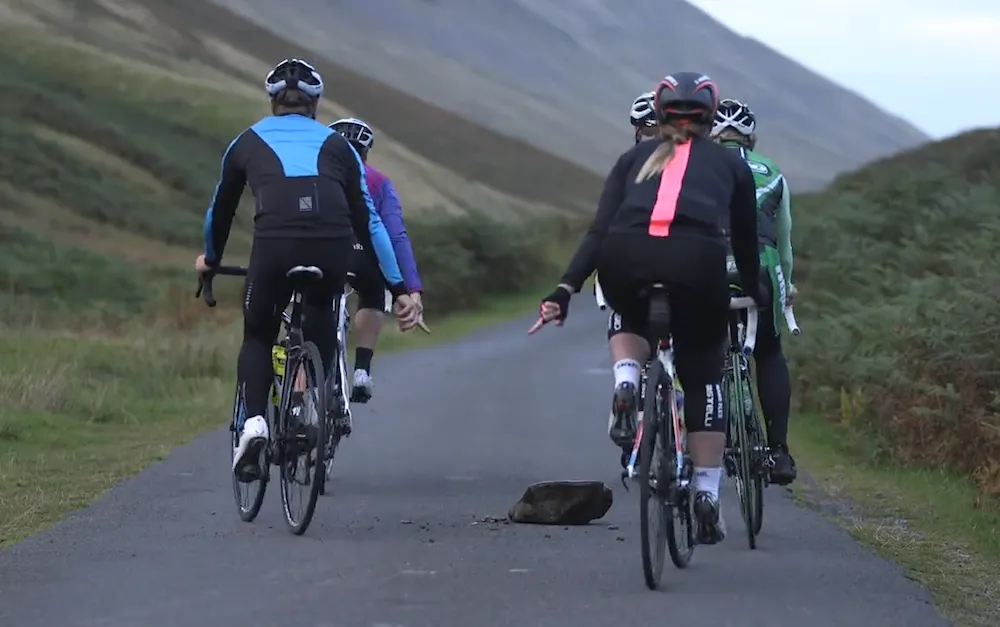
This signal is mostly for the safety and benefit of other cyclists that are following you. Its purpose is to alert them about any hazards or poor road conditions they should avoid, such as potholes, broken glass, rocks, gravel, slippery liquids, and more. Merely point in the direction of the problem as you pass it, and the other cyclists around you will know to pay attention to that area.
Frequently Asked Questions
Can You Ride a Bike on the Sidewalk in the State of Georgia?
No, riding a bike on the sidewalk is prohibited if you’re thirteen years or older. Unless you’ve gotten explicit permission to ride on the sidewalk, you should only move in the specified bicycle lanes or on the street. However, if you must use the sidewalk, then walk alongside your bike.
Can You Pass Vehicles on the Right?
Passing vehicles on the right is acceptable if you’re riding in a bicycle lane or street that’s wide enough for both cars and bikes, provided that you stay 1.5-2 feet away from the curb. Still, you should always take care and closely watch for other vehicles or cars turning or backing out of spots to avoid any unfortunate accidents.
Also, remember to stay off the left side of the road when cycling, because riding there is not only illegal but also very dangerous.
Conclusion
All in all, communicating with others while riding your bike is necessary to protect you from getting hurt or killed on the road. And bike hand signals were invented as a method to make road cyclists do just that. They’re capable of alerting any driver or cyclist near you to your direction and intentions by moving your left or right arm.
So, don’t forget to signal. And always obey traffic laws to a point to limit the risk to yourself and clear yourself from any blame in case of an accident. If you are involved in a cycling crash, a Georgia bicycle accident lawyer can help you understand your rights and pursue compensation.
Frequently Asked Questions
How does modified comparative negligence work in Georgia?
Under O.C.G.A. § 51-12-33, you can recover damages if you are less than 50% at fault; your recovery is reduced by your share of fault. At 50% or higher, you recover nothing. Insurance adjusters work to push your percentage above the bar.
Should I accept the insurance company’s first offer?
Almost never. First offers reliably underestimate medical-treatment trajectories, lost-income totals, and the value of pain and suffering. Settling before the full scope of injury is documented permanently waives those claims. According to the State Bar of Georgia, consulting an attorney before signing any release is the standard protective step.
How long do I have to file a personal-injury claim in Georgia?
Two years from the date of injury under O.C.G.A. § 9-3-33. For minors, the statute is tolled until they reach 18 — they then have until age 20 to file. Claims against governmental entities may carry shorter ante litem notice deadlines, sometimes as short as six months under O.C.G.A. § 36-33-5.
What damages can I recover?
Past and future medical expenses, lost income and future earning capacity, property damage, pain and suffering, mental anguish, and (in catastrophic or fatal cases) loss of enjoyment of life or wrongful-death damages. Georgia does not cap most economic or non-economic damages.